
Timken Navigates Profitability Pressure Despite Sales Growth Through Strategic Portfolio Shifts
Q2 2026 results show rising revenues driven by both volume and pricing but profitability impacted by significant impairment charges and cost pressures.
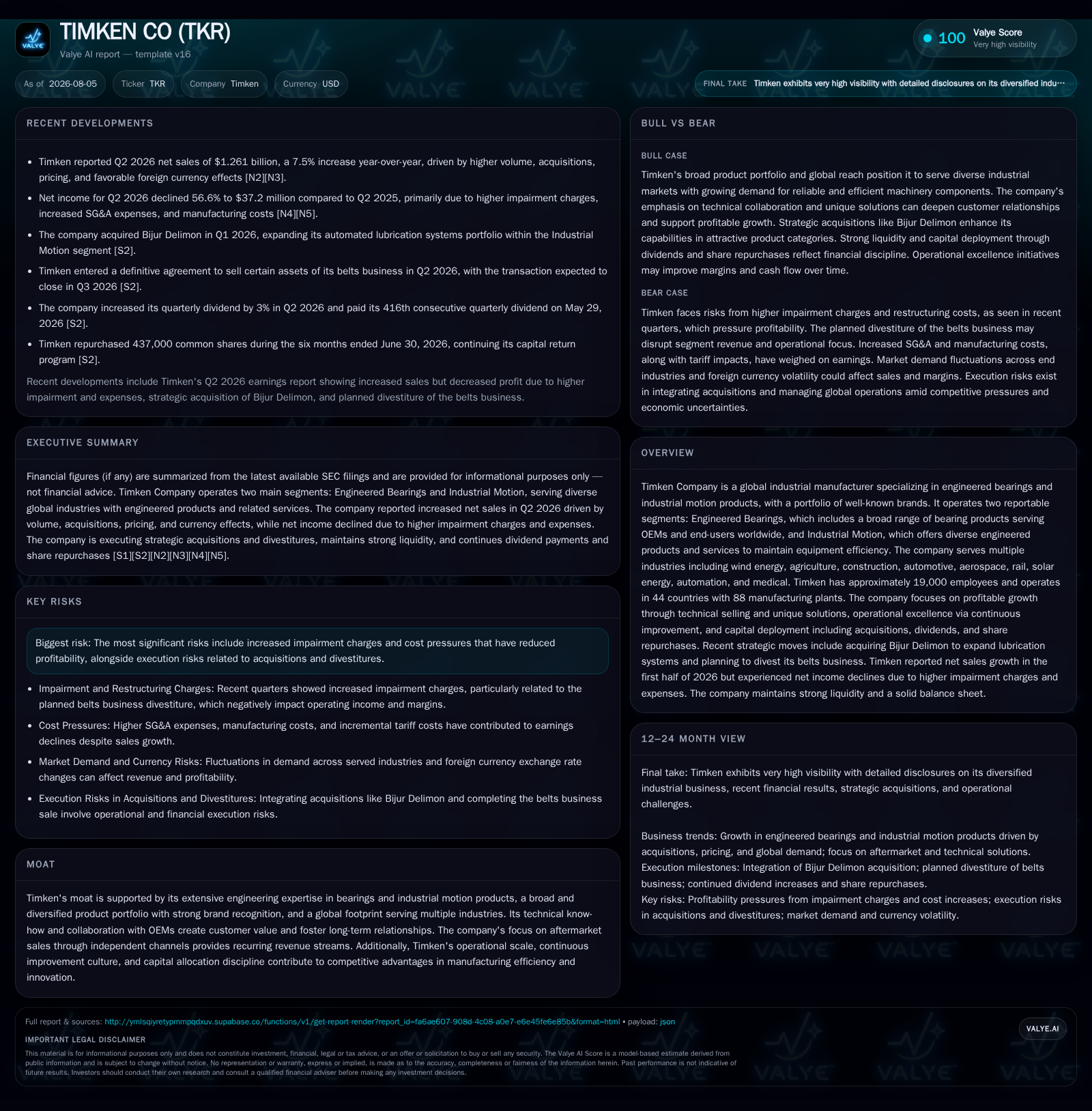
The Timken Company reported a 7.5% increase in net sales for Q2 2026 driven by volume growth across segments, favorable pricing, acquisitions, and foreign currency impacts. However, net income declined sharply due to $94 million in impairment and restructuring charges related to the belts business sale and closure. Engineered Bearings posted modest organic volume growth with improved adjusted EBITDA aided by price/mix benefits but offset by higher SG&A and manufacturing costs. The Industrial Motion segment expanded its footprint through the Bijur Delimon acquisition, with robust demand and positive adjusted EBITDA gains despite tariff headwinds. Timken remains focused on profitable growth via technical selling and aftermarket channel strength while pursuing operational excellence and optimized capital allocation. Leverage is well within covenant limits following refinancing actions, supporting disciplined capital deployment amid a challenging near-term margin environment.
Recent Operating Update: Q2 2026 Results Highlight Revenue Growth with Profitability Challenges
with the planned sale of the belts business and closure of its Springfield manufacturing plant [S8],[S20]. This non-cash charge notably weighed on profitability metrics during the quarter.
While operating income decreased due to these impairments alongside higher operating expenses and incremental tariffs (netted partially by favorable IEEPA tariff refunds), underlying operational performance showed resilience especially in segments benefitting from aftermarket demand cycles and differentiated engineered products [S11]. The Industrial Motion segment demonstrated robust revenue expansion above 7% organically (excluding acquisition and FX impacts) alongside a sizable EBITDA increase exceeding 40%, reflecting strong demand across diverse industrial markets like solar energy automation, marine, agriculture, packaging logistics, aerospace, and passenger rail applications [S22],[S26]. This breadth underpins Timken’s ability to mitigate end-market cyclicality via geographic dispersion (44 countries) and industry diversification (including wind energy, construction, agriculture) [S1]. Importantly, after-tax adjusted EPS rose to $1.83 on an adjusted basis versus $1.42 last year despite GAAP EPS suffering from restructuring impacts [S21].
Business Model: Engineered Bearings & Industrial Motion as Core Drivers
Timken’s business model centers on two complementary divisions: Engineered Bearings provides precision designed rolling element bearings—such as tapered roller bearings where Timken commands technological leadership—to OEMs worldwide in capital equipment sectors requiring high reliability and efficiency; Industrial Motion offers engineered products including automated lubrication systems, power transmission components like chains/belts/couplings, industrial drives/clutches/brakes along with precision linear motion products facilitating equipment uptime through maintenance services [S1],[S16]. These segments leverage a hybrid revenue mechanic combining new product OEM sales enhanced by collaborative technical selling with customers plus locked-in aftermarket parts replacement via independent channels that yield durable reoccurring revenue streams.
This dual focus grants Timken significant customer stickiness owing to switching costs linked to specialized engineering solutions built deep into machinery designs plus preferred supplier status via brand strength under trademarks like Timken®, Philadelphia Gear®, GGB®, Nadella®, Rollon®, Bijur Delimon®, among others [S1]. Aftermarket sales especially in the Industrial Motion division bolster margin stability against capital equipment cyclicality since maintenance requirements decay slower than initial machinery purchase timing. Technical expertise enables customization for demanding applications like wind turbines or rail axles where friction management advancements extend equipment lifespan—an increasingly important value driver given sustainability demands globally.
Industry Structure & Competitive Positioning
Timken competes in the global industrial components market alongside peers such as NSK Ltd., SKF Group, Rexnord, and RBC Bearings which similarly serve broad OEM base industries encompassing automotive assembly lines through aerospace propulsion systems. Competition is predicated not solely on price but engineering innovation depth, service responsiveness through aftermarket penetration levels, global manufacturing footprint scale (88 plants), product breadth spanning bearings to lubrication systems processing critical motion control challenges [S1],.
The company’s ongoing investments in R&D focusing on materials science—developing advanced alloys for bearing durability—and continuous improvement culture pursuing operational excellence underpin its moat against commoditized bearing suppliers or low-cost fragmented competitors in emerging markets.
Strategic acquisitions like Bijur Delimon extend capabilities in automated lubrication systems vital for predictive maintenance trends gaining traction among capital goods operators aiming for uptime maximization through sensor-integrated industrial motion controls [S5],[N8]. Conversely, divesting less strategic assets such as belts streamlines portfolio focus while capturing value via third-party transactions.
Growth Drivers
Several structural drivers shape Timken’s growth trajectory:
- Industrial automation adoption accelerating demand for precision motion products capable of synchronizing complex factory processes.
- Rapid infrastructure expansions globally driving capital equipment purchases in construction machinery needing durable engineered bearings.
- Renewable energy sector growth propelling specialized bearing needs for wind turbine reliability.
- Expansion of aftermarket services contributing predictable recurring revenues beyond initial OEM sales cycles.
- Emerging markets’ continued industrialization fostering broadened geographic reach for Timken’s offerings.
- Product technological innovations enhancing friction management reduce downtime costs improving customer economics.
- Customer preference for vendors offering integrated systems promoting cross-segment bundled sales opportunities.
These factors coincide with management’s emphasis on profitable growth leveraging sophisticated technical selling approaches targeting fragmented niches valuing service excellence plus reliability [S1],.
Risks and Watchpoints
Notable risks include:
- Cost inflation pressures from raw materials impacting gross margins—current filings indicate rising manufacturing costs offset some pricing gains despite tariff refund offsets from IEEPA litigation settlements that remain partially uncertain given ongoing legal developments around alternative tariffs [S7],[N2].
- Execution challenges integrating acquired businesses while extracting anticipated synergies without disrupting core operations.
- Exposure to geoeconomic disruptions affecting supply chains or restricting repatriation of overseas cash balances ($372 million held outside U.S.) potentially slowing investment agility [S4],[F1].
- Competitive pricing pressure amidst economic downturn scenarios compressing margins particularly if end-market volumes soften abruptly.
- Risks tied to impairments/divestitures as evidenced recently with belts business closure inducing a large one-time charge illustrating potential capital deployment tradeoffs.
- Dependence on key OEM customers requiring continuous innovation—failure risks losing design wins.
What to Watch Next
Investors and analysts should monitor:
- Completion timing of belts business divestiture expected in Q3 2026 clarifying operating outlook going forward [S5].
- Adjusted earnings trends excluding restructuring effects signaling margin recovery feasibility.
- Order backlog changes especially in sectors tied to infrastructure build-outs or renewable projects as early demand indicators.
- Integration progress of Bijur Delimon along with additional bolt-on acquisition announcements supporting component portfolio expansion.
- Tariff developments post Supreme Court ruling impacting cost pass-through ability.
- Free cash flow generation consistency supporting dividend sustainability amid capital expenditure guidance around ~3.3% of sales annually [S6],[S9],[F1].
Financial Profile Discussion
As of June 30, 2026, Timken held $399 million in cash and equivalents and total debt of approximately $2.08 billion, resulting in net debt of about $1.68 billion [S2]. The company’s net debt to adjusted EBITDA ratio stands near 2.0x based on trailing twelve months adjusted EBITDA of $857 million, reflecting prudent leverage management amid ongoing acquisition activity [S2]. Timken maintains access to $651 million in available credit facilities following recent refinancing of senior credit agreements extending maturities into the mid-2030s, providing covenant headroom with net leverage capacity up to approximately 3.75x EBITDA [S2].
In sum, while profitability faces short-term dilution primarily from restructuring costs linked to strategic portfolio pruning efforts evident this quarter, Timken’s operational discipline combined with its diversified technical products portfolio serving resilient industrial markets support a constructive medium-term earnings recovery path bolstered by steady free cash flow conversion.
Disclaimer: This is research-only, informational analysis and not investment advice. It may include AI-generated interpretation and general industry context. Always verify important details using primary sources.

Comments