
Seacoast Banking Expands Florida Footprint with VBI Acquisition Amid Strong Credit Quality and Capital Buffer
Q2 2026 results reflect robust credit discipline, active interest rate risk management, and integration costs from recent acquisitions.
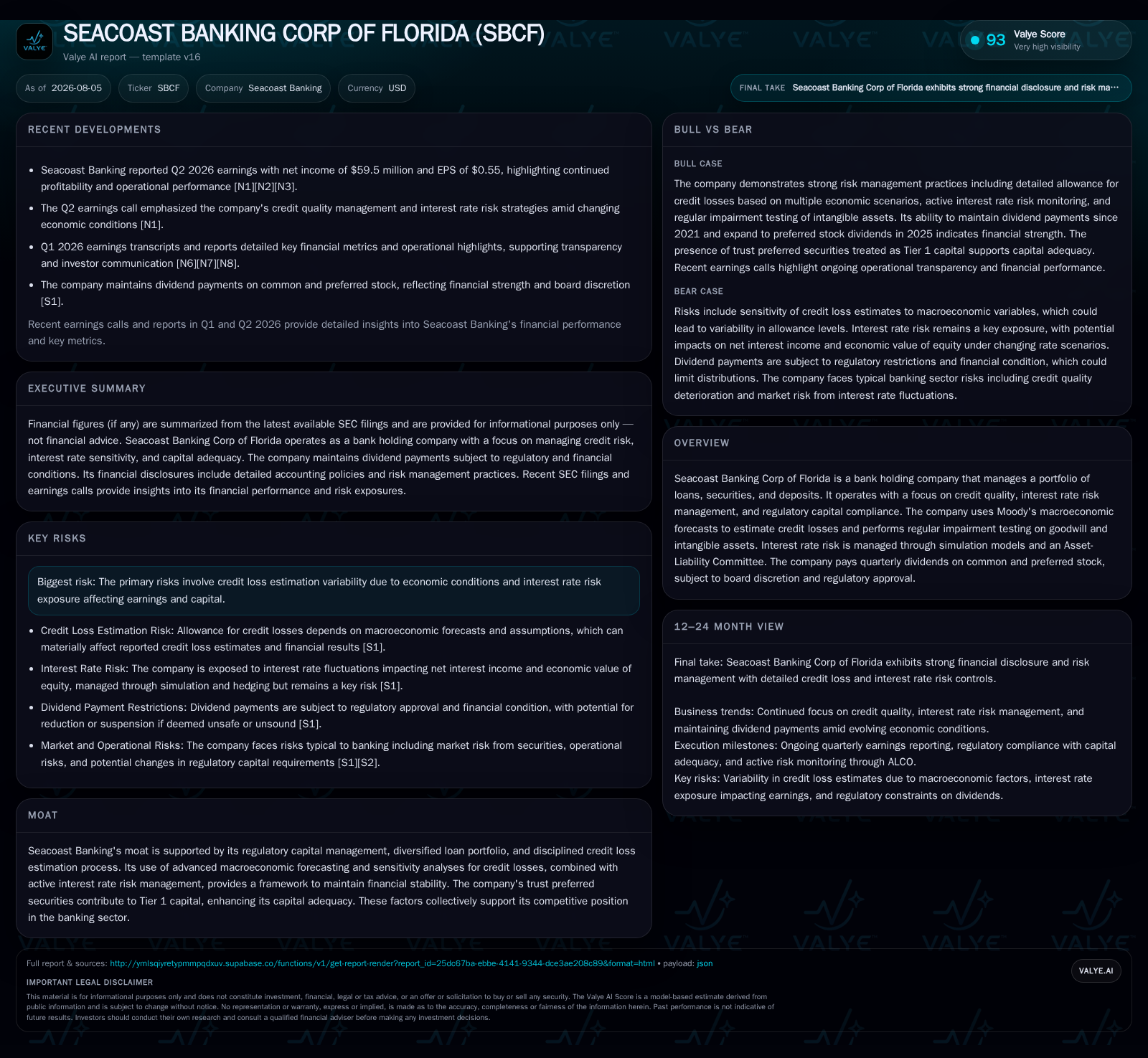
Seacoast Banking Corp of Florida reported Q2 2026 operating results emphasizing disciplined credit management and proactive asset-liability strategies amid a low interest-rate environment. The acquisition of Villages Bancorporation, Inc. (VBI) in late 2025 expanded branch network and loan portfolio while contributing to goodwill and intangible assets requiring impairment monitoring. Regulatory capital, including trust preferred securities, remains solid supporting dividend payments subject to board discretion. Key risks include economic variability affecting credit losses and interest rate dynamics impacting net interest margins. Upcoming milestones focus on VBI systems integration and monitoring provisioning trends to validate portfolio resilience.
Recent Operating Update
Seacoast Banking Corporation of Florida (SBCF) reported its Q2 2026 results signaling resilience in core banking operations despite macroeconomic uncertainties. The latest filing dated August 4, 2026, reveals the bank's ability to maintain stable credit quality through disciplined forecasting using Moody's macroeconomic inputs for expected credit losses [S2]. The company updated that it continues to perform impairment testing on goodwill and intangibles acquired notably through recent acquisitions such as Villages Bancorporation, Inc. (VBI) completed in October 2025. These acquisitions contributed $45.5 million in allowance for credit losses (ACL) including purchase credit deteriorated loans, reflecting careful recognition of credit risk at acquisition points [S1].
The acquisition added operational scale with nineteen new branches primarily across North Central Florida but also increased intangible asset balances demanding continued attention to potential impairment indicators during evolving market conditions. Integration activities are expected to conclude early Q3 2026, which will be a near-term milestone for assessing synergy realization and operating cost reductions [S21][S16]
Business Model Analysis
As a regional bank holding company headquartered in Florida, Seacoast operates primarily through its subsidiary Seacoast National Bank providing traditional banking services: commercial loans oriented towards business working capital and asset acquisition as well as consumer banking products encompassing installment loans and lines of credit [S1]. Revenue is predominantly generated via net interest income — the spread between interest earned on loans and securities versus deposit costs and wholesale borrowings — complemented by fee-based income from wealth management, mortgage services, and deposit service charges.
Loan underwriting focuses heavily on cash flow analyses for commercial clients while utilizing collateral support secondarily to mitigate risk exposure [S1][S6]. Consumer lending balances installment versus revolving lines of credit, some collateralized by residential property. Deposit liabilities form the foundation of funding, drawn largely from retail demand deposits, savings accounts, money market funds, and brokered certificates with a strategic emphasis on low-cost deposits that exhibit low beta even during rate cycles
The company's use of trust preferred securities treated as Tier 1 capital reflects an advanced approach to regulatory capital optimization enhancing tangible common equity — a key moat supporting dividend distributions without compromising regulatory thresholds [S1]. Noninterest expenses are managed closely though recently elevated by merger-related items; adjusted expense measures excluding integration costs provide more transparency into underlying operating efficiency trends [S1].
Industry Structure and Competitive Position
Operating within the regional banking sector serving local Florida markets, Seacoast competes broadly against other regional banks and community financial institutions while contending with alternative lenders including fintech platforms offering lending or deposit solutions. The competitive landscape necessitates attention to net interest margin trends relative to peers that often hinge on asset yield management amidst changing interest rates alongside managing non-performing asset ratios during economic fluctuations.
Seacoast’s strategy leverages its diversified loan portfolio reducing concentration risks complemented by active asset-liability management governed by its Asset-Liability Committee which models interest rate scenarios influencing deposit beta assumptions and funding cost outlooks [S1]. The balance sheet shows strong liquidity positioning with cash & equivalents totaling approximately $430 million at June 30, 2026, supporting operational flexibility and funding needs even during potential liquidity stress periods common in regional banking cycles [F1]. Its deposit base includes a sizable uninsured portion backed by loss protection via public deposit programs like the Florida Qualified Public Depository program improving stability compared to peers less embedded in such structures [S13].
Growth Drivers
Loan growth remains pivotal to SBCF’s revenue expansion with economic activity in Florida markets driving demand for commercial real estate financing, small business credit lines, and consumer borrowing [S16][S23]. The recent acquisitions (VBI in October 2025 adding new branch franchise value plus Heartland Bancshares earlier in July 2025) materially expanded the geographic footprint supporting both organic loan origination increases and cross-selling opportunities within new customer bases
The reinforced capital base augmented by trust preferred securities enhances capacity for further lending or investment without immediate dilution or restrictive capital actions. Fee income derived from wealth management and ancillary products is expected to contribute incremental revenue diversification helping buffer against pure interest margin compression.
Technology investments supporting online/mobile banking improve customer engagement efficiency thereby potentially lowering cost-to-serve ratios once acquisition integration phases complete fully — particularly relevant given the elevated noninterest expense due to merger-related charges recorded recently [S1]. Favorable macroeconomic projections underpin SEC-mandated forecasts used for provisioning allowing proactive credit risk management supporting sustained profitability.
Risks and Watchpoints
Key risks reside around projection uncertainty inherent in the company’s allowance for credit losses methodology tied tightly to Moody’s economic outlooks which may shift abruptly if localized or national downturns materialize affecting borrower repayment capacities especially within commercial real estate or consumer segments [S1]. Interest rate risk remains front-and-center given deposition cost sensitivities (deposit beta) can erode net interest margins if asset yields fail to adjust proportionally during tightening or easing cycles.
Acquisition-related goodwill and intangible assets invite impairment risk if combined operational synergies or growth fail to materialize at anticipated levels post-integration phase conclusion planned Q3 2026 [S11][S16]. Deposit composition shifts impacting wholesale versus retail funding costs could increase reliance on more expensive sources affecting earnings leverage.
Regulatory interventions could impact dividend policies since payments must align with supervisory rules designed to prevent unsafe or unsound practices; thus earnings volatility could constrain payout flexibility despite prior dividend continuity since mid-2021 across common and more recently issued convertible preferred shares starting Q4 2025 [S1]. Lastly cybersecurity threats represent ongoing operational risks common across regional banks relying increasingly on digital delivery channels.
What to Watch Next
Investors should monitor several milestones including completion of VBI systems conversion early Q3 2026 critical for realizing cost efficiencies and seamless customer experience enhancements. Metrics tied to loan growth rates segmented by commercial versus consumer sectors will indicate traction in targeted markets post-acquisition expansion.
Trends in provision for credit losses through subsequent quarters will serve as a barometer for durability of portfolio quality amid fluctuating economic conditions that challenge prior macroeconomic assumptions baked into allowances. Net interest margin developments will reveal success in navigating prevailing interest rate risks balanced against deposit betas indicating funding cost responsiveness.
Capital adequacy metrics incorporating trust preferred securities’ treatment remain crucial to gauge dividend sustainability alongside regulatory compliance adherence potentially influencing board decisions on future payouts or share repurchases. Lastly, underlying adjustments excluding merger charges will clarify management’s ability to control operational expense growth proceeding beyond integration noise.
Financial Profile Discussion
At quarter-end June 30, 2026, Seacoast held $429.9 million in cash and cash equivalents providing ample liquidity for ongoing operations and commitments [F1]. The company’s net debt position was negative approximately $355 million as of December 31, 2025, indicating a surplus of liquid assets over total borrowings and bolstering financial flexibility essential during volatile market phases [F1].
Noninterest expenses rose mainly due to acquisition-related integration costs but adjusted figures indicate controlled expense trends relative to revenue base sustaining efficiency ratios within peer regional bank bandings.
-- This analysis is intended solely as an informational piece without any investment advice or research views.
Disclaimer: This is research-only, informational analysis and not investment advice. It may include AI-generated interpretation and general industry context. Always verify important details using primary sources.

Comments