
Altria’s Q2 2026 Results Signal Continued Pressure on Combustible Tobacco with Smoke-Free Growth at Crossroads
Altria’s latest quarterly filing reveals sustained declines in cigarette volumes balanced against emerging smoke-free product initiatives amid regulatory and market challenges.
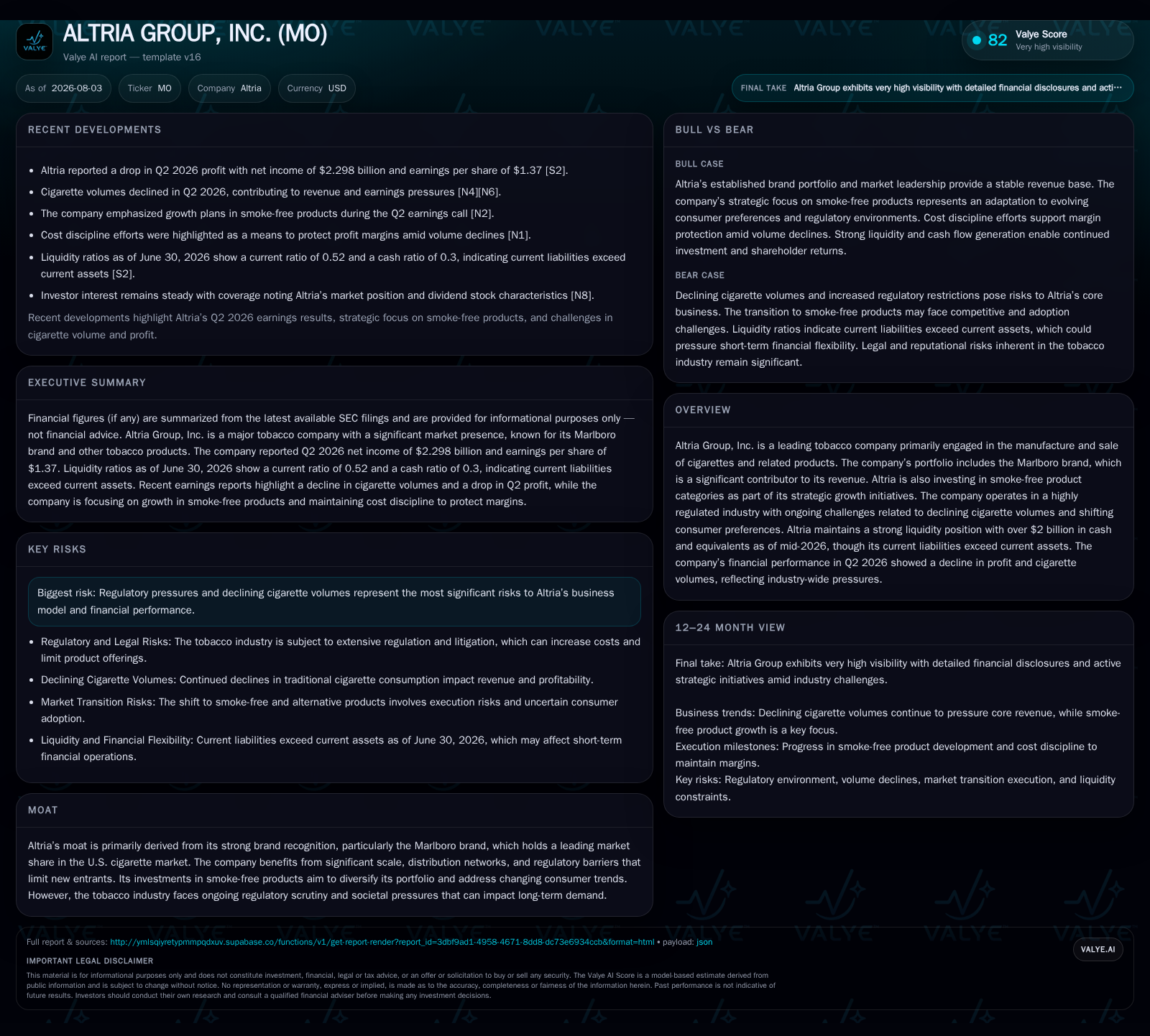
In Q2 2026, Altria Group, Inc. reported a notable decline in combustible cigarette shipment volumes, reflecting ongoing secular challenges within the tobacco industry. While traditional revenue streams face contraction, the company’s strategic push into smoke-free and reduced-risk products presents an important but still nascent avenue for diversification and future growth. Regulatory headwinds, particularly excise taxes, continue to pressure profit margins and volume trends. Altria’s strong brand equity, anchored by Marlboro, and broad distribution network remain key competitive advantages as it navigates these shifts. The company’s financial profile shows solid liquidity but carries considerable leverage, underscoring the importance of efficient capital allocation amid evolving market dynamics.
Quarterly Operational Shifts Reflect Accelerated Declines in Combustible Volume
Altria’s Q2 2026 filings disclose a clear continuation of volume declines in its core combustible tobacco segment, primarily cigarettes [S2]. Cigarette shipment volumes decreased notably during the second quarter compared to prior periods, further intensifying an already entrenched secular decline across the U.S. tobacco landscape driven by public health campaigns, price sensitivity due to excise taxes, and shifting consumer preferences toward smoke-free alternatives [N4]. This volume reduction exerts downward pressure on revenue stability given that combustible tobacco still dominates Altria’s sales. Moreover, this decline exacerbates operating leverage challenges as fixed manufacturing and distribution costs do not proportionally decrease with volume. Despite pricing actions to mitigate top-line erosion—manifested as higher average selling prices per unit—the volume contraction dominates the revenue impact in this quarter's performance [S2].[N4]
This dynamic matters because cigarette volumes historically form the backbone of Altria’s cash flow generation given their mass-market penetration through extensive wholesale and retail channels. A sustained drop erodes the base profitability even if pricing ameliorates some revenue loss. Confirmation that volume declines persist or accelerate in coming quarters would indicate deeper structural demand weakness; conversely, stabilization or improvement would signal potential market resiliency.
Dual Revenue Streams: Contrasting Dynamics Between Traditional Cigarettes and Smoke-Free Products
Altria is actively navigating this market transformation by increasingly emphasizing its smoke-free product portfolio alongside its combustible legacy business [S1],[N2]. The company is leveraging investments in reduced-risk products such as heated tobacco devices and nicotine pouch offerings aimed at capturing consumers migrating away from traditional cigarettes due to health concerns or social normalization trends. Although smoke-free product sales volumes showed incremental gains in Q2 2026—reflecting increased distribution reach and marketing efforts—these categories remain relatively modest contributors compared to core cigarettes at present [S2],[N2].
This dual-stream model highlights Altria's strategic challenge: successfully scaling smoke-free alternatives fast enough to offset combustible volume declines before those losses substantially weaken overall profitability. The contrasting performance between segments underscores the need for continued innovation pipeline development, consumer adoption acceleration, and expanded retail channel penetration for new products. Distribution breadth remains a critical lever here since product availability at convenience stores and tobacconists directly influences trial rates and repeat purchasing behavior.
The implication is that while reduced-risk offerings provide essential growth vectors signaling portfolio resilience, they have yet to achieve scale that could materially dampen financial pressures from legacy combustion product erosion. Close monitoring of sales trajectory in these categories will indicate how quickly Altria can pivot its revenue mix.
Regulatory Headwinds and Pricing Power: Navigating Excise Tax Pressure Amid Market Share Battles
Altria operates in a highly regulated environment where excise taxes constitute a significant cost component embedded into retail prices [S1]. Recent filings confirm that regulatory compliance costs remain elevated while excise tax hikes continue to challenge pricing strategies [S2]. In response, Altria has enacted price increases intended both to preserve gross margins amid rising costs and to partially offset volume contractions.
However, pricing power is constrained by consumer price sensitivity and illicit trade risks that cap how far prices can rise without accelerating defections to alternative nicotine sources or unregulated products. Despite these headwinds, Marlboro’s brand equity provides robust consumer loyalty support helping maintain market share relative to competitors who face similar tax-induced demand elasticity.
From a broader peer perspective, companies like Philip Morris International have pursued analogous tactics balancing tax absorption with price adjustments while shifting portfolios toward reduced-risk products as a hedge against regulation-driven volume declines. This interplay illustrates how regulatory frameworks directly sculpt pricing strategies and downstream revenue behaviors within the industry.
Competitive Landscape and Peer Benchmarking: Positioning Against Industry Giants and Emerging Alternatives
Within the tobacco sector, Altria stands among dominant U.S. manufacturers alongside peers such as Philip Morris International (PMI) globally recognized for strong brand portfolios including Marlboro equivalents.
Altria’s competitive moat is largely sustained by the Marlboro brand’s prominence and an expansive distribution network facilitating wide product availability across wholesale channels serving convenience retail outlets nationwide [S1]. These assets create barriers for new entrants given steep regulatory compliance hurdles compounded by litigation risks.
While direct market share percentages are not disclosed here, qualitative peer context suggests all major tobacco firms wrestle with similar transitions toward smoke-free categories though execution pace varies. PMI is often cited for more aggressive international diversification in reduced-risk technology areas whereas Altria balances domestic leadership with incremental innovation investments.
The ability to efficiently navigate regulatory scrutiny and public health pressures while preserving brand strength underpins competitive positioning in this capital-intensive sector marked by significant fixed costs related to manufacturing infrastructure and compliance frameworks.
Growth Engines Under Focus: Innovation Pipeline and Consumer Adoption of Reduced-Risk Products
Altria’s recent earnings commentary emphasizes a continuing commitment to developing smoke-free offerings reflecting both regulatory anticipation and changing consumer preferences favoring lower-risk nicotine delivery systems [N2],[S3].
This focus includes expanding heated tobacco device availability, nicotine pouch innovations, and potential next-gen products aligned with public health shaping factors. However, early-stage sales volumes indicate initial traction rather than widespread consumer acceptance at scale.
Risks pertinent here include execution uncertainties around product development timelines, regulatory approvals for modified risk claims which could enhance marketing effectiveness, as well as competition from digitally native vaping companies aggressively pursuing market share.
Growth drivers rely heavily on innovation efficacy measured via adoption KPIs such as trial conversion rates, repeat purchase frequency, retail outlet penetration metrics, and geographic expansion capability within the U.S. market. Positive momentum on these fronts would validate strategic repositioning success; delays or tepid uptake could extend transition pains.
Risks Anchored in Regulation, Litigation, and Consumer Behavior Changes
The company reiterates longstanding risks centered on tightening regulatory restrictions including advertising limitations, flavor bans impacting product appeal especially among younger consumers, excise tax escalations incentivizing illicit trade activity as well as exposures arising from litigation postures against tobacco manufacturers [S9]. These factors embed uncertainty around sustainable volume levels given societal pressures toward harm reduction or cessation support.
Legal proceedings continue to represent contingent liabilities influencing risk management priorities though no material changes were noted recently compared with prior disclosures. Evolving consumer attitudes manifest in gradual but persistent declines in combustible use exacerbated by demographic shifts further compounding demand deterioration risks.
Managing regulatory compliance cost inflation while fostering profitable innovation pathways remains critical operational levers mitigating downside scenarios tied to external policy developments or reputational challenges.
What Investors Should Watch: Upcoming Milestones, Volume Signals, and Strategic Execution Markers
Key near-term metrics include quarterly updates on cigarette shipment volumes serving as bellwethers for core franchise health alongside discrete tracking of smoke-free product sales growth reflecting adaptation success amid structural change [N3],[S2]. Monitoring average selling price progression relative to excise tax changes offers insight into pricing power sustainability.
Strategic execution angles encompass evidence from forthcoming launches or expanded retail collaborations in reduced-risk segments potentially amplifying consumer access footprint. Regulatory engagement outcomes concerning modified risk authorization petitions may meaningfully influence product positioning capabilities.
Investor attention should also focus on any updated guidance around capital allocation plans especially share repurchase pacing or dividend policy shifts indicative of confidence in financial flexibility under leverage constraints [N3]
Financial Profile Discussion: Liquidity Cushion and Debt Load Contextualize Strategic Flexibility
As of June 30, 2026, Altria held approximately $2.37 billion in cash and cash equivalents against current liabilities nearing $7.77 billion resulting in a current ratio of about 0.52 which signals tight short-term liquidity coverage though manageable given steady operating cash flows [F1]. Total debt stood near $25.9 billion at year-end 2025 with net debt after cash approximating $23.5 billion reflecting significant leverage common within tobacco companies where stable cash flows back capital-intensive operations including compliant manufacturing facilities.
This debt profile necessitates disciplined capital allocation balancing shareholder returns such as dividends—which have historically been resilient—with investment requirements for innovation plus legal defense contingencies documented previously [F1],[S9]. Strong brand cash flows provide underpinning but declining volumes spotlight refinancing risk considerations over longer horizons if structural erosion accelerates.
Financial markers like operating income margins trending with volume adjustments will be telling indicators confirming how effectively fixed cost absorption adapts amidst portfolio evolution.
This analysis synthesizes Altria Group's latest SEC filings alongside recent earnings commentary providing an informed lens on operational dynamics within a complex regulated industry facing long-term consumption shifts towards reduced-risk nicotine alternatives. It highlights critical interplay between legacy combustible declines offset partially by emerging smoke-free growth initiatives framed by regulatory cost pressures against a backdrop of strong brand equity leadership but substantial leverage obligations shaping strategic choices ahead.
Disclaimer: This report does not constitute investment advice or research views. It is prepared solely for informational purposes based on publicly available sources.
Disclaimer: This is research-only, informational analysis and not investment advice. It may include AI-generated interpretation and general industry context. Always verify important details using primary sources.

Comments