
Laureate Education Advances Market Position in Mexico and Peru While Managing Liquidity Constraints
Laureate Education’s Q2 2026 update highlights enrollment resilience and ongoing curriculum innovation amid a challenging private-pay higher education landscape.
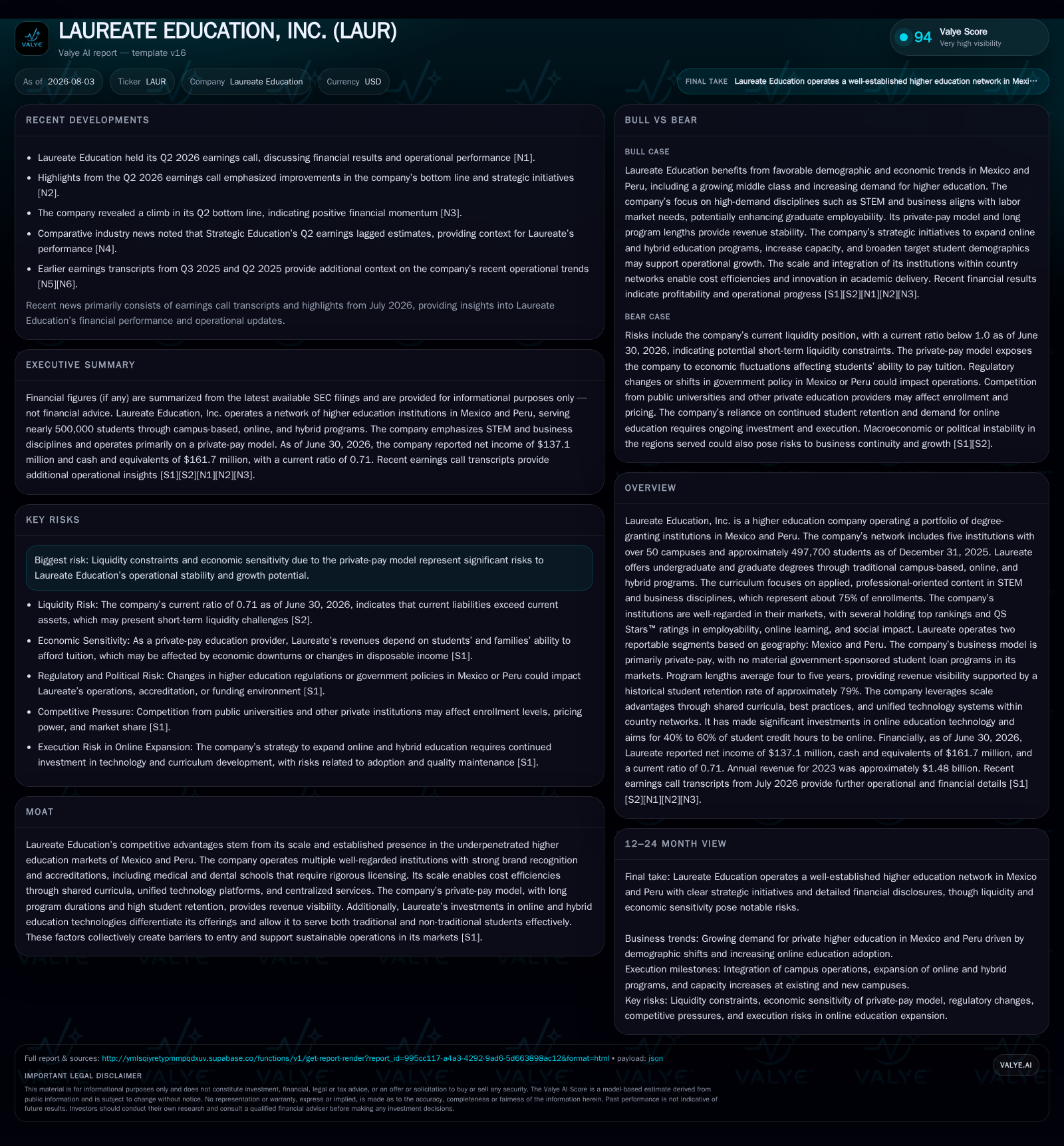
Laureate Education reported steady operational progress in its latest quarterly filing, maintaining nearly 500,000 students at its five institutions across Mexico and Peru. The company's focus on professional-oriented programs in STEM, business, and health disciplines remains central to sustaining demand within underpenetrated emerging markets characterized by limited public university capacity. Despite enrollment strength and investments in online and hybrid delivery methods enhancing reach, liquidity constraints tied to the private-pay tuition model persist as key risks. Laureate’s scale and accreditation credentials underpin competitive moat attributes, while tighter economic conditions in its core markets emphasize the importance of retention and adaptive pricing strategies.
Recent Operating Update: Q2 2026 Context
Laureate Education's Q2 2026 filing reaffirmed operational stability within its core Mexican and Peruvian university network, serving nearly 497,700 students across more than 50 campuses at five institutions [S2][S3][S1]. This enrollment base has been maintained through a blend of traditional campus-based programs supplemented by growing online and hybrid course offerings — investments that management credits with expanding accessibility for both traditional college-aged students (18–24) as well as working adults seeking flexible learning paths [S1]. The company emphasized that its curriculum focuses predominantly (approximately 75% of enrollments) on applied disciplines such as STEM fields, business administration, medicine, health sciences, engineering, and IT — areas aligned with robust employment prospects in their regional economies [S1].
Financially, Laureate holds approximately $161.7 million in cash & equivalents as of June 30, 2026, with current assets totaling $365 million versus current liabilities of $513 million, yielding a current ratio near 0.71 indicative of short-term liability coverage challenges [F1]. These fixed costs underscore the capital-intensive nature of physical campus operations alongside ongoing curriculum development and technology platform investments. The company maintains access to revolving credit facilities maturing in September 2028 which provide structural support against these liabilities.
Management cited ongoing macroeconomic challenges affecting its primarily private-pay tuition revenue base where no substantive government-sponsored student loan schemes exist locally [S1][N2][N3]. This model inherently stresses the company’s susceptibility to economic downturns that may impair students’ ability to pay or reduce new admissions volumes
Business Model Specifics: Tuition-Driven Private Higher Education in Emerging Markets
Laureate operates chiefly on a private-pay revenue paradigm derived from tuition fees charged to enrolled students domiciled principally in Mexico and Peru. Unlike many U.S.-based or developed-market peers that benefit from significant government loan or grant assistance programs underwriting student fees, Laureate's geographic markets lack such systemic financial aid infrastructure at scale. This compels the firm to rely more directly on sustained student willingness and ability to pay out-of-pocket or via limited third-party financing arrangements.
The company bundles education services around degree offerings tailored to professional workforce entry—primarily undergraduate four-year degree programs complemented by select graduate-level credentials—all delivered via multimodal channels: traditional on-campus classrooms complemented by online synchronous/asynchronous content and hybrid curriculum designs integrating both modalities for flexibility [S1]. Such diversification in delivery modes enhances market reach while mitigating campus physical capacity constraints.
A critical element of Laureate’s value proposition is its portfolio curation emphasizing disciplines quantitatively aligned with labor market demand – notably engineering disciplines supporting Mexico’s growing industrial base; medicine/dentistry reflecting regulated professions with licensing barriers; and business/IT skills requisite for emerging service sectors dominating urban economies. This focus supports competitive differentiation beyond price competition common among local private institutions.
The company leverages centralized curriculum design frameworks and technology platforms facilitating content standardization along with scalability benefits across its campuses—yielding operating cost efficiencies critical in a region where affordability limits pricing power [S1]. Moreover, strong institutional accreditations including QS Stars™ ratings underpin brand equity essential for student recruitment.
Industry Structure and Competitive Positioning
The Mexican higher education market features approximately 39% private sector share led by Laureate’s two nationally licensed institutions distributed over about 30 campuses nationwide—a large footprint enabling preferred network effects relative to smaller independents or niche specialty colleges [S1]. Similarly, Peru’s private universities constitute rising capacity that is increasingly sought due to insufficient public university resources; however, this segment represents a smaller share (~7%) indicating room for growth with attendant rising competition anticipated.
Peers in the Latin American private higher education space include university networks focused on professional disciplines (e.g., Adtalem Global Education) that similarly balance degree quality assurance integrated with vocational alignment; Grand Canyon Education-like players emphasize hybrid/online growth strategies attractive for margin expansion. But localized accreditation systems combined with distinct language/regulatory nuances constrain direct peer substitutability globally.
Laureate benefits structurally from:
- Extensive multi-campus scale allowing cost amortization across programs;
- Established accreditation status inducing trust among prospective students/employers;
- Proprietary technology investments facilitating differentiated blended learning;
- Networked branding effects boosting student enrollments amidst fragmented competitive sets.
Nonetheless, the market is evolving with increased competitive intensity spurred by growing middle-class demands attracting new entrants as well as public policy shifts potentially reshaping regulatory landscapes downstream.
Growth Drivers
Several long-term structural tailwinds underpin demand expansion:
- Rising middle-class populations expanding the addressable student demographic;
- Underfunded public universities creating persistent supply-demand imbalances;
- Increasing employer demand for credentialed graduates proficient in STEM/business domains driving perceived education ROI;
- Expansion of flexible online/hybrid delivery unlocking access for working adults previously excluded from higher ed pathways;
- Government reforms sometimes encouraging private sector participation enhancing market legitimacy;
- Technology-enabled efficiency gains potentially reducing average operating costs per enrolled student.
These factors collectively create a secular backdrop encouraging steady new admissions inflows alongside improved retention/graduation metrics crucial for revenue visibility given multi-year program durations.
Risks and Watchpoints
Primary risks revolve around economic sensitivity intrinsic to a private-pay tuition funding model without substantial government loan guarantees:
- Macroeconomic downturns may erode student affordability leading to lower admissions or higher delinquencies;
- Currency fluctuations impacting cross-border financial reporting or local cost structures;
- Regulatory changes affecting accreditation approvals or new program launches could slow innovation initiatives;
- Intensifying competition may compress pricing or decrease yield amid fragmenting market shares;
- Failure to sustain high retention/graduation rates could impair forward revenue streams given cohort-based billing models;
- High fixed-cost leases elevate operating leverage risk during enrollment softness periods;
- Political instability or policy unpredictability specific to Mexico/Peru markets could impact operational continuity.
Monitoring quarterly admissions trends, retention improvement initiatives' effectiveness, changes in program mix especially online/hybrid ratios, pricing strategies relative to competitive dynamics, plus evolving regulatory developments are all essential near-term focus areas.
What to Watch Next
Clarifying subsequent indicators will center on:
- Quarterly admissions figures dissected by country segment revealing directional momentum,
- Retention rate improvements evidencing enhanced student success efforts,
- Gradual shift towards hybrid/online enrollment ratios reflecting product mix transformation,
- Average tuition per student trends signaling pricing power amid inflationary pressures,
- Regulatory developments particularly relating to program expansions or accreditation renewals,
- Capital expenditure pacing toward selective campus expansions or technology platform enhancements,
- Earnings guidance updates incorporating macroeconomic assumptions impacting financial forecasts.
Industry peers like Strategic Education (STRA) provide useful barometers regarding shifts within comparable private education providers navigating similar market dynamics [N1].
Financial Profile Discussion
Laureate holds approximately $161.7 million in cash & equivalents as of June 30, 2026, with current assets totaling $365 million versus current liabilities of $513 million, yielding a current ratio near 0.71 indicative of short-term liquidity challenges requiring vigilant working capital management [F1]. Net debt was modestly negative at approximately -$6.9 million as of September 30, 2024, reflecting a net cash position relative to total debt of about $154.8 million at that date [F1]. Operating leases constitute substantial fixed commitments exceeding $387 million (present value) per prior disclosures underscoring capital-intensive infrastructure dependencies [S8][S9].
Free cash flow generation driven by tuition collections will be critical for sustaining growth initiatives alongside share repurchase programs authorized up to $180 million illustrating board confidence balanced with strategic capital allocation discipline [S6][S19]
Effective cash conversion hinges on robust enrollment maintenance combined with optimized collections managing allowance for doubtful accounts consistently given regional economic volatility exposures [S25]. Capital expenditures focus on capacity expansion aligned with tendered new programs while also investing in education technology platforms contributing incrementally to margin expansion potential over time.
This analysis synthesizes Laureate Education’s SEC filings through mid-2026 augmented by industry context around private higher education dynamics within emerging Latin American markets. It aims to provide rigorous operational insight without forward-looking investment research views.
Disclaimer: This is research-only, informational analysis and not investment advice. It may include AI-generated interpretation and general industry context. Always verify important details using primary sources.

Comments