
Myers Industries Boosts Profitability on Restructuring and Loan Agreement Amendment
Q2 2026 results reflect operational cost efficiencies and enhanced financial flexibility, underpinning Myers Industries’ strategic resilience amid market pressures.
Myers Industries’ second quarter 2026 performance demonstrates meaningful profitability improvement driven by accounting policy adjustments that reallocated costs between cost of sales and operating expenses. The company also secured a material amendment to its loan agreement that reinforces liquidity and debt management in a capital-intensive industrial manufacturing environment. Myers’ revenue streams remain anchored in its diversified industrial and material handling product segments with ongoing emphasis on distribution reach and aftermarket services. Key risks revolve around raw material cost volatility and capital structure, but recent operational changes and financial negotiations suggest improved readiness to sustain growth.
Specifically, cost of sales increased by $6.2 million due to reclassification of certain costs previously categorized under selling, general and administrative expenses (SG&A), which declined by $1.8 million accordingly. Additionally, freight-out expenses fell by $4.4 million within the quarter’s consolidated statement of operations [S2]. This reallocation suggests enhanced granularity in capturing direct product-related costs rather than reflecting transient operational shifts.
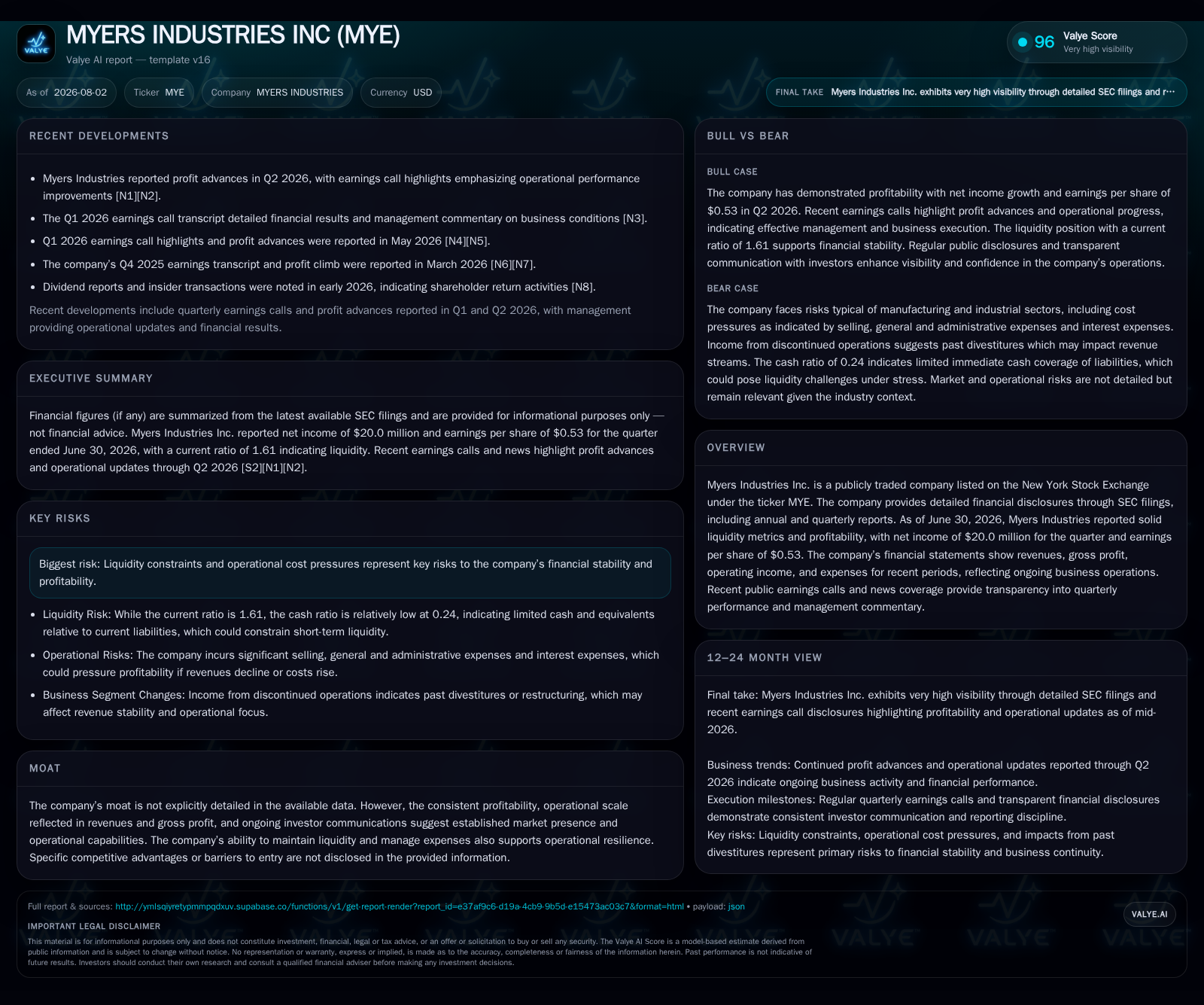
Economically, this adjustment refines the visibility into underlying cost structures—shifting some fixed or semi-variable operating expenses directly into cost of goods sold (COGS) offers a clearer picture of gross margin dynamics. This holds importance in an industrial manufacturing context where absorption of overhead through volume leverage is vital for sustainable margin improvement. Evidence from the concurrent earnings call underscores that while this policy change impacts line-item presentation materially, it aligns reported profitability more closely with cash flow realities observed in ongoing operations [N1]. Net income for Q2 reached $20.0 million with basic EPS at $0.53, signaling robust earnings generation despite macroeconomic headwinds typical for capital-intensive peers.
Driving Revenue: Industrial Products and Distribution Channel Dynamics
The company’s business model is anchored across two principal operating segments detailed in its most recent annual filing: Industrial components including tires and mats primarily serve manufacturing customers; Material Handling products cater to logistics and warehouse operations [S1]. These segments feed through an extensive distribution network combining direct sales efforts with third-party distributors. This multi-channel approach extends Myers’ reach to commercial and industrial clients requiring durable goods characterized by long replacement cycles supported by aftermarket services.
Aftermarket services constitute an important recurring revenue element stabilizing demand beyond new product sales—a critical buffer given cyclicality inherent in end markets served like automotive parts or warehousing equipment. Although Myers does not disclose exact segmental revenue splits publicly in this quarter’s filing, prior reports confirm material handling products form a substantial portion reflecting rising industrial automation needs. Product mix evolution within these segments influences gross margins significantly as specialized materials or innovative designs carry premium pricing possibilities relative to commodity-oriented offerings.
Cost Management Focus: Accounting Changes, SG&A, and Freight Insights
Cost discipline remains paramount as Myers pursues restructuring and facility consolidation strategies implemented over previous periods aimed at reducing fixed costs and improving operational footprint efficiency [S2]. The quarter’s adjusted SG&A reduction partly reflects these ongoing efforts alongside the accounting policy impact noted earlier.
Meanwhile freight-out expense reduction signals improvements in supply chain logistics or renegotiated contract terms with carriers—an area where peers such as Genuine Parts Company have historically sought savings via optimized distribution scheduling or vendor consolidation. Such freight cost variances strongly influence net margins given their variable nature tied closely to shipment volumes.
Key here is distinguishing recurring savings versus one-time benefits from accounting restatements or restructuring charges—a distinction not fully quantified yet but essential for evaluating sustainable operating leverage gains.
Industrial Market Pressures Shape Competitive Positioning Strategy
Operating within the broader industrial manufacturing ecosystem—comparable peers include Brady Corporation specializing in safety products or The Timken Company in power transmission goods—Myers competes on three main fronts: product quality differentiated by design/material composition; distribution network coverage enabling timely customer access; and aggressive cost management confronting input price volatility.
Capital intensity restricts rapid capacity expansion prompting focus on incremental efficiency improvements rather than volume-led growth spurts typical for less asset-heavy sectors. Pricing power faces pressure not only from raw material inflation but also customer bargaining leverage amid multiple supplier options common in commoditized components.
Growth Opportunities Hinged on Product Innovation and Supply Chain Optimization
Strategic growth levers identified during management discussions encompass enhanced product development aimed at automation-friendly materials or ergonomics suited for evolving warehouse functions [N1]. E-commerce expansion escalates demand for material handling aids capable of supporting faster fulfillment cycles driving aftermarket service uptake.
Improvements in inventory turnover via better supply chain synchronization could mitigate working capital strain prevalent in inventory-heavy industrial firms while boosting cash flow conversion ratios. Monitoring KPIs like order backlog progression or inventory turnover ratio post-policy adjustment will provide clarity on execution effectiveness going forward.
Risks Around Raw Material Costs, Capital Intensity, and Credit Profile
Consistent with sector norms outlined in the annual report risk factors section [S1], Myers remains exposed to raw material price volatility impacting COGS unpredictably alongside disruptions hampering timely fulfillment. Its high fixed-cost base coupled with ongoing capital expenditure demands creates sensitivity to demand cyclicality.
Credit risk management received notable attention following the July 28 loan agreement amendment which recalibrated terms among borrowers including foreign subsidiaries and lenders under JPMorgan Chase agenting [S3]. This provides both covenant relief flexibility essential under fluctuating earnings regimes as well as mitigates interest rate exposure via associated swap contracts covering $175 million notional principal currently carrying a modest unrealized loss of approximately $2.3 million [S2].
"Next Steps": Monitoring Loan Amendments and Quarterly Guidance Updates
The recent loan amendment reflects proactive balance sheet stewardship supporting strategic initiatives including facility consolidations or selective acquisitions without immediate liquidity constraints [S3]. Investors should monitor subsequent earnings disclosures for updated management guidance encompassing operating segment performance outlooks alongside any indications of backlog shifts—a forward demand proxy critical for capacity planning decisions.
Additionally evaluating subsequent quarters’ results will clarify whether Q2’s accounting policy-driven margin effects translate into sustainably improved EBITDA margins or represent transitory reclassifications.
Financial Profile Discussion: Liquidity Sturdiness Supports Strategic Flexibility
At June 30, 2026 Myers Industries reported cash & equivalents totaling approximately $47.6 million against total debt nearing $316 million resulting in net debt around $268 million [F1]. The current ratio stands at a comfortable 1.61 reflecting adequate short-term liquidity coverage relative to current liabilities near $195 million [F1].
The existence of interest rate swaps indexed to term loans aligns debt service obligations mitigating variability in interest expense amid prevailing rate volatility—a critical consideration given recent Federal Reserve tightening cycles impacting capital-intensive manufacturers broadly [S2]
This financial positioning affords Myers continued operational flexibility supporting transformation programs while navigating cyclical demand fluctuations characteristic of industrial manufacturing peers like Brady Corporation or Genuine Parts Company known for balancing robust distribution networks against cyclical aftermarket revenues.
This analysis synthesizes discrete quarterly reporting adjustments and recent debt covenants within Myers Industries’ broader operating context informed by industry dynamics typical of the industrial manufacturing sector specializing in durable goods for commercial end markets. It avoids speculative projections focusing instead on concrete recent filings corroborated by public earnings commentary aiming to guide domain-savvy stakeholders through near-term developments shaping the company’s operating profile.
Disclaimer: This is research-only, informational analysis and not investment advice. It may include AI-generated interpretation and general industry context. Always verify important details using primary sources.

Comments