
Bicycle Therapeutics Advances Clinical Pipeline and Maintains Strong Financial Position Amid Ongoing R&D Investment
Bicycle Therapeutics reports progress in key oncology clinical programs supported by its proprietary synthetic peptide platform, underpinned by a solid cash reserve enabling sustained R&D activities.
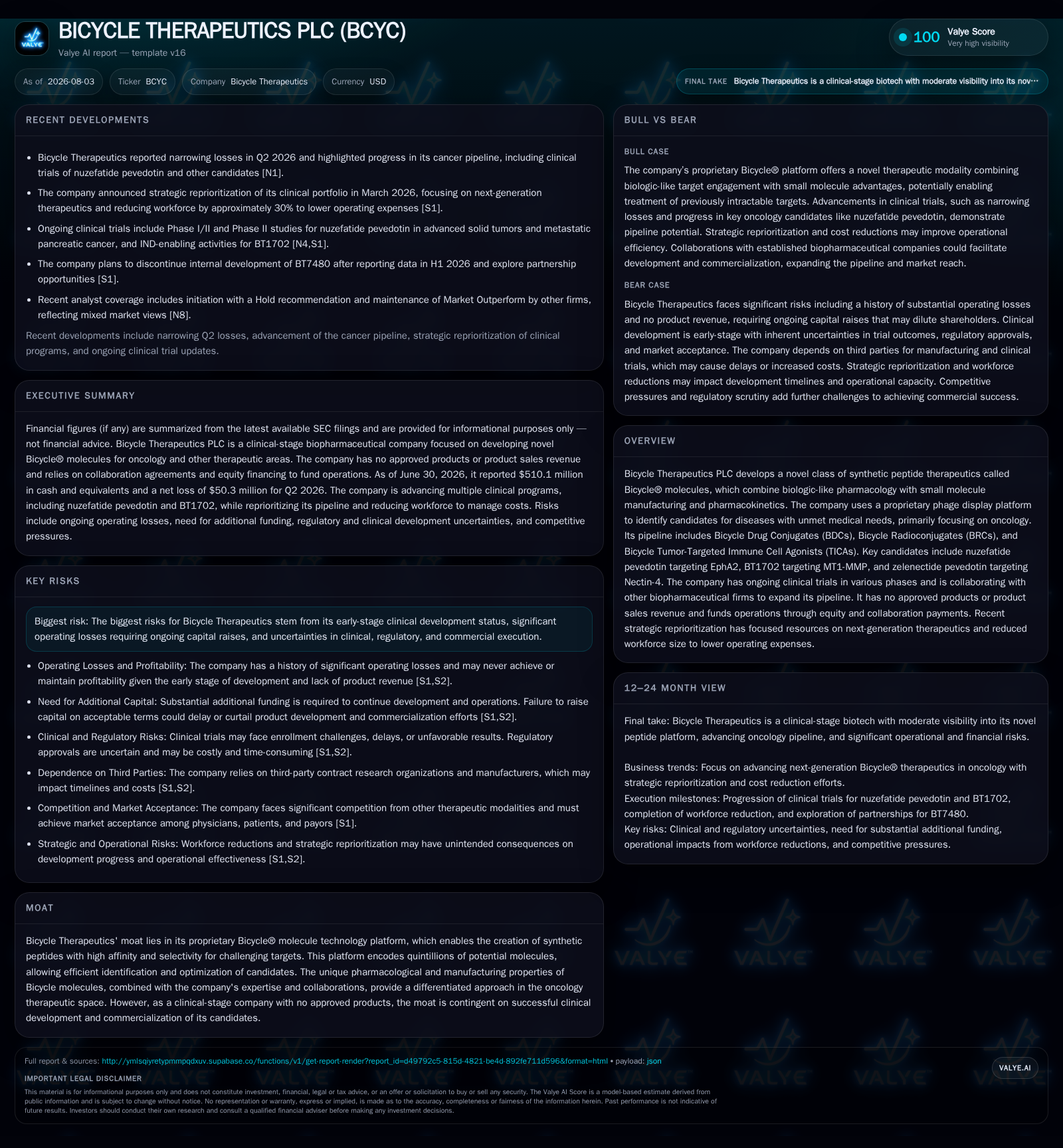
Bicycle Therapeutics PLC, a clinical-stage biotech developing synthetic peptide therapeutics for oncology, reported Q2 2026 operational updates highlighting advancement of lead candidates nuzefatide pevedotin and BT1702 in clinical trials. The company’s proprietary phage display technology supports a diversified pipeline including Bicycle Drug Conjugates, Radioconjugates, and Tumor-Targeted Immune Cell Agonists. Despite ongoing operating losses typical of early-stage biotech, Bicycle sustains a strong liquidity position with $510 million in cash as of June 2026, supporting continued development and strategic initiatives. Key risks include patient enrollment delays and regulatory challenges inherent to novel therapeutic modalities.
Recent Clinical Progress Anchored by Q2 2026 Filing
In its latest quarterly report filed July 30, 2026 [S2], Bicycle Therapeutics outlined meaningful progression of its lead oncology candidates. Nuzefatide pevedotin targeting EphA2 and BT1702 targeting MT1-MMP have entered or advanced through key clinical trial phases, marking tangible milestones that validate the company’s development strategy. These advances underpin near-term value inflection points fundamental to early-stage biotech valuation paradigms. Despite the complexities of enrolling patients in specific cancer subtypes, the company reports active recruitment efforts supporting timely data generation [S3]. This operational momentum is critical to sustaining investor confidence and collaboration-driven funding.
Proprietary Synthetic Peptide Platform Drives Targeted Therapeutic Innovation
Central to Bicycle Therapeutics’ differentiation is its proprietary phage display platform encoding vast libraries of synthetic peptides [S1]. This technology facilitates identification of molecules combining the high affinity and selectivity typical of biologics with the manufacturing efficiencies and pharmacokinetic benefits associated with small molecules. The resulting Bicycle Drug Conjugates (BDCs) chemically link these peptides to cytotoxic payloads to enable precise tumor targeting while aiming to minimize off-target effects.
Compared to larger antibody-drug conjugates, Bicycle’s smaller molecules potentially achieve improved tumor tissue penetration and faster systemic clearance, which may translate into enhanced safety profiles. The platform’s versatility extends beyond BDCs into innovative modalities such as Bicycle Radioconjugates (BRCs) and Tumor-Targeted Immune Cell Agonists (TICAs), broadening therapeutic mechanisms to address diverse unmet oncology needs. This technological foundation establishes a competitive moat by enabling modular candidate design alongside scalable synthetic manufacturing.
Competitive Landscape: Differentiation Versus Established Antibody-Drug Conjugate Firms
While firms like Seagen and ImmunoGen have commercialized antibody-drug conjugates leveraging monoclonal antibodies with proven efficacy, their larger molecular size imposes inherent limitations on tumor penetration and manufacturing complexity. Bicycle Therapeutics’ synthetic peptide approach strives to overcome these constraints by delivering targeted therapies with distinct pharmacokinetic profiles.
Similar to other emerging biotech platforms exemplified by companies such as Amgen and Moderna, Bicycle relies primarily on milestone-driven collaboration revenues rather than product sales at this stage. The company’s challenge lies in efficiently advancing candidates through clinical phases to demonstrate modality superiority relative to antibody-based platforms while maintaining capital discipline.
Growth Drivers: Pipeline Advancement, Collaborations, and Operational Efficiency
Key growth vectors include progression of lead candidates through pivotal trials with expected data readouts that may trigger milestone payments from partners [S2]. Patient enrollment rates remain a crucial operational KPI impacting timelines toward regulatory submissions. Further pipeline expansion through new partnerships or licensing could diversify indications addressed by the platform.
The company continues deliberate investment in R&D activities aimed at accelerating late preclinical studies and initiating additional Phase 1/2 trials across multiple programs [S2]. Previous workforce restructuring initiatives are expected to enhance operational efficiency by reducing annual expenses significantly without impairing scientific output.
Development Risks: Enrollment Challenges and Regulatory Scrutiny
Consistent with sector risk disclosures [S22], patient recruitment difficulties commonly encountered in rare oncology indications pose timing risks that could delay milestone achievement. Additionally, as synthetic peptides represent a novel therapeutic class subject to heightened regulatory examination, approval pathways may be prolonged or require supplementary data.
Potential adverse safety findings or lack of efficacy could result in program termination given limited precedent for this modality. Continued operating losses driven by intensive R&D necessitate prudent capital management; failure to secure future financing under favorable terms may force program scale-backs or rights relinquishment.
Financial Position Supports Sustained Development Despite Operating Losses
Bicycle Therapeutics reported cash and cash equivalents totaling approximately $510 million as of June 30, 2026 [F1], providing substantial liquidity uncommon among similarly staged biotechs. With current liabilities near $47.6 million [F1], the current ratio exceeds 12x, indicating strong short-term financial flexibility.
Operating losses remain significant—historical full-year operating loss was approximately $247 million in 2025 [F1]—reflecting heavy investment in clinical development without product revenue. Income is primarily derived from milestone payments under collaboration agreements rather than product sales [S1]. This capital base supports planned trial enrollments, pharmacology studies, manufacturing scale-up efforts, and intellectual property development well into late-stage evaluations without imminent refinancing pressure.
However, dilution risk persists if clinical progress slows or outcomes prove unfavorable, necessitating future equity raises common within the sector.
Conclusion
Bicycle Therapeutics is advancing a differentiated synthetic peptide platform with promising early clinical validation within targeted oncology therapeutics. Its diversified pipeline encompassing BDCs, BRCs, and TICAs addresses significant unmet medical needs while leveraging collaborations for non-dilutive funding aligned with industry norms for pre-commercial biotechs.
Financially fortified by over half a billion dollars in cash reserves and ongoing cost optimization measures initiated earlier in 2026 [S1][S3], the company is positioned to drive multiple mid-stage programs toward proof-of-concept milestones essential for demonstrating modality value.
While patient recruitment hurdles and regulatory uncertainties inherent to novel therapeutics warrant close monitoring, Bicycle’s technical platform offers competitive advantages over established antibody-drug conjugate approaches. Upcoming catalysts such as trial completions, milestone-triggered payments, regulatory filings, and partnership expansions will be pivotal in shaping its valuation trajectory within a competitive yet innovative biotech landscape.
This analysis reflects information available through July 30, 2026 from regulatory filings [S1][S2][S3], validated financial data [F1], industry context frameworks, and credible news sources without speculative forward-looking assumptions or proprietary insights. It aims to provide a rigorous internal assessment of Bicycle Therapeutics’ operational status within the biotechnology sector.
Disclaimer: This is research-only, informational analysis and not investment advice. It may include AI-generated interpretation and general industry context. Always verify important details using primary sources.

Comments