
Paramount Skydance’s Strategic Crossroads Following Warner Bros. Discovery Merger Headwinds
Q2 results reveal operational resilience at Paramount Skydance despite merger delays clouding strategic and financial outlook.
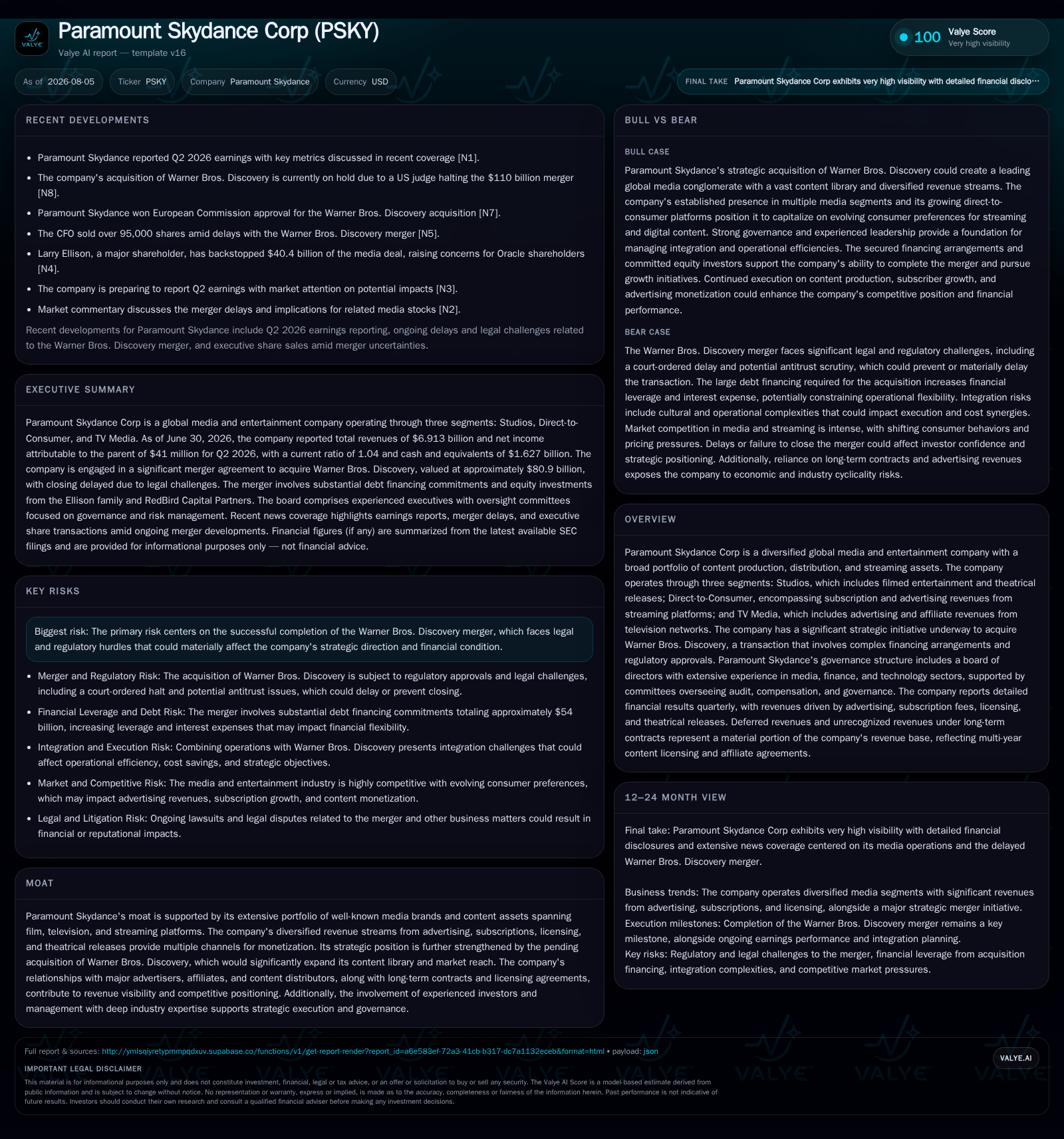
Paramount Skydance Corporation posted slightly improved revenues and operating income in Q2 2026, reflecting continued execution in its diversified media businesses. However, the stalled acquisition of Warner Bros. Discovery due to regulatory pushback remains a significant overhang, impacting investor sentiment and strategic clarity. The company's multifaceted revenue streams across studios, streaming, and TV media provide both growth opportunities and margin challenges amid shifting consumer behaviors and ad market volatility. Paramount Skydance’s balance sheet shows substantial leverage linked to acquisition financing, underscoring execution risks ahead.
Q2 Operating Results Highlight Resilience Amid Merger Uncertainty
Management's ability to maintain positive operating leverage amid this mounting expense base suggests operational control within a complex cost structure.
Multi-Channel Revenue Mix Drives Paramount Skydance’s Business Model Complexity
Paramount Skydance operates as an integrated media entity spanning three principal business segments: Studios (theatrical releases and licensing), Direct-to-Consumer (comprising subscription and advertising-based streaming services), and TV Media (advertising sales and affiliate fees) [S1]. This diversified revenue architecture offers resilience to shifts in consumer behavior—such as cord-cutting or changing ad spend—but complicates cost management given differing margin profiles across segments.
The Studios segment capitalizes on producing high-profile intellectual property with long-lived franchise value, which generates licensing agreements internationally. Such licensing expands the reach of proprietary content beyond theatrical windows into digital platforms and international territories, building long-term content library valuation.
The Direct-to-Consumer segment's subscription revenue model provides recurring cash flow yet demands continual subscriber acquisition and retention efforts (churn rate management). Average revenue per user (ARPU) is another critical KPI here but specifics remain undisclosed [S1][S2]. Streaming also leverages advertising inventory in hybrid models to diversify monetization.
TV Media relies heavily on advertising revenues tied to audience measurement accuracy and affiliate fees derived from cable/satellite distributors. This segment faces cyclicality linked to broader advertising market conditions.
Competitive Dynamics Shaped by Content Scale and Distribution Synergies
In a fiercely competitive media landscape marked by giant conglomerates like The Walt Disney Company—which combines strong studio production with direct streaming presence—and pure-play streamers such as Netflix focused exclusively on subscriber growth dynamics, Paramount Skydance's integrated approach offers both opportunity and challenge.
Paramount Skydance competes through its deepening content library fueled by organic production investments alongside license deals that bolster franchise longevity. Intellectual property rights management is central for creating sustainable monetization avenues across platforms.
Audience measurement sophistication impacts advertising revenue predictability; Paramount must continue enhancing data-driven ad targeting to maintain advertiser confidence amid shifting media consumption patterns.
Merger-Related Operational Risks Amplify Regulatory and Integration Challenges
A pivotal risk confronting Paramount Skydance is its stalled acquisition of Warner Bros. Discovery valued at approximately $110 billion [N9]. Despite securing European Commission approval [N8] along with clearances in South Korea and other jurisdictions [S18], a U.S. federal judge recently issued an injunction blocking the deal owing to antitrust concerns [N9]. Further legal opposition from several state attorneys general underscores substantial regulatory headwinds and prolongs uncertainty around this transformative merger [N10].
This blockage threatens not only the immediate capture of scale economies but also introduces integration execution risks as management distraction rises while employee attrition potential increases during such protracted negotiations [S5]. Operational synergies predicted from combining two expansive content libraries face delay or dilution if antitrust clearance is never achieved.
Streaming Subscriber Trends Versus Advertising Market Volatility: Implications for Margin Sustainability
The subscription base for streaming services represents a core growth driver for Paramount Skydance’s direct-to-consumer segment. While subscriber metrics remain undisclosed publicly [S3], industry trends indicate intensifying competition places upward pressure on customer acquisition costs and churn rates require meticulous management to sustain ARPU levels.
Concurrently, TV Media advertising revenues fluctuate with broader economic cycles; advertisers become cautious amid uncertain economic outlooks exacerbated by imperfect audience measurement tools impacting spend confidence. These dual forces create margin variability where gains in one segment may be offset by softness in another—demanding agile cost structures complemented by effective pricing strategies across platforms.
Growth Opportunities Stem from Content Expansion and Distribution Innovation but Face Execution Hurdles
Paramount Skydance aims to leverage robust content production pipelines supported by escalating investments in original film and television projects paired with selective acquisitions that amplify library breadth [S1][N2]. International market penetration remains an underexploited avenue especially via streaming platforms tailored for regional audiences employing localized content strategies.
Technological innovation in delivering premium video experiences—such as enhanced streaming quality or interactive features—could differentiate offerings versus competitors if successfully executed.
However, these growth avenues come with heightened cost inflation pressures especially around top creative talent compensation alongside amortization expense that temporarily depresses free cash flow margins until new content recoups investment through diverse distribution channels.
What Investors Should Monitor Next: Merger Milestones, Subscriber Metrics, Advertising Performance Updates
Key milestones pivot primarily on advancing regulatory clearances for the Warner Bros. Discovery merger including potential appeals or settlements resolving antitrust blockades [S3][N5]. Tracking quarterly updates on streaming subscriber additions or retention dynamics would clarify the underlying health of direct-to-consumer operations—a significant driver for valuation upside potential once scale effects materialize.
Additionally, monitoring advertising demand trends within TV Media alongside any innovations around ad-supported tiers could signal margin stabilization or volatility ahead given macroeconomic uncertainties impacting advertiser budgets.
Current assets of $11.0 billion slightly exceeded current liabilities of $10.6 billion, yielding a current ratio of approximately 1.04, indicating a tight but positive liquidity position consistent with ongoing acquisition-related funding commitments [F1]
The company expanded its revolving credit facility earlier in the year from $3.5 billion to $5 billion to support merger financing obligations, with borrowings under this facility around $1.8 billion at mid-year and interest rates exceeding 6% following rising benchmark rates [S9]
This analysis draws exclusively from SEC filings dated August 4, 2026 ([S2], [S3], [S1]) supplemented by corroborating recent news reports ([N8], [N9], etc.) and places Paramount Skydance within its broader media industry context without speculative forecasts or research views.
Disclaimer: This is research-only, informational analysis and not investment advice. It may include AI-generated interpretation and general industry context. Always verify important details using primary sources.

Comments