
AGM Group Holdings' Strategic Shifts Amid Market Pressures and Nasdaq Compliance Challenges
AGM Group Holdings navigates intensified competition in crypto mining hardware while expanding into AI infrastructure and fintech software markets.
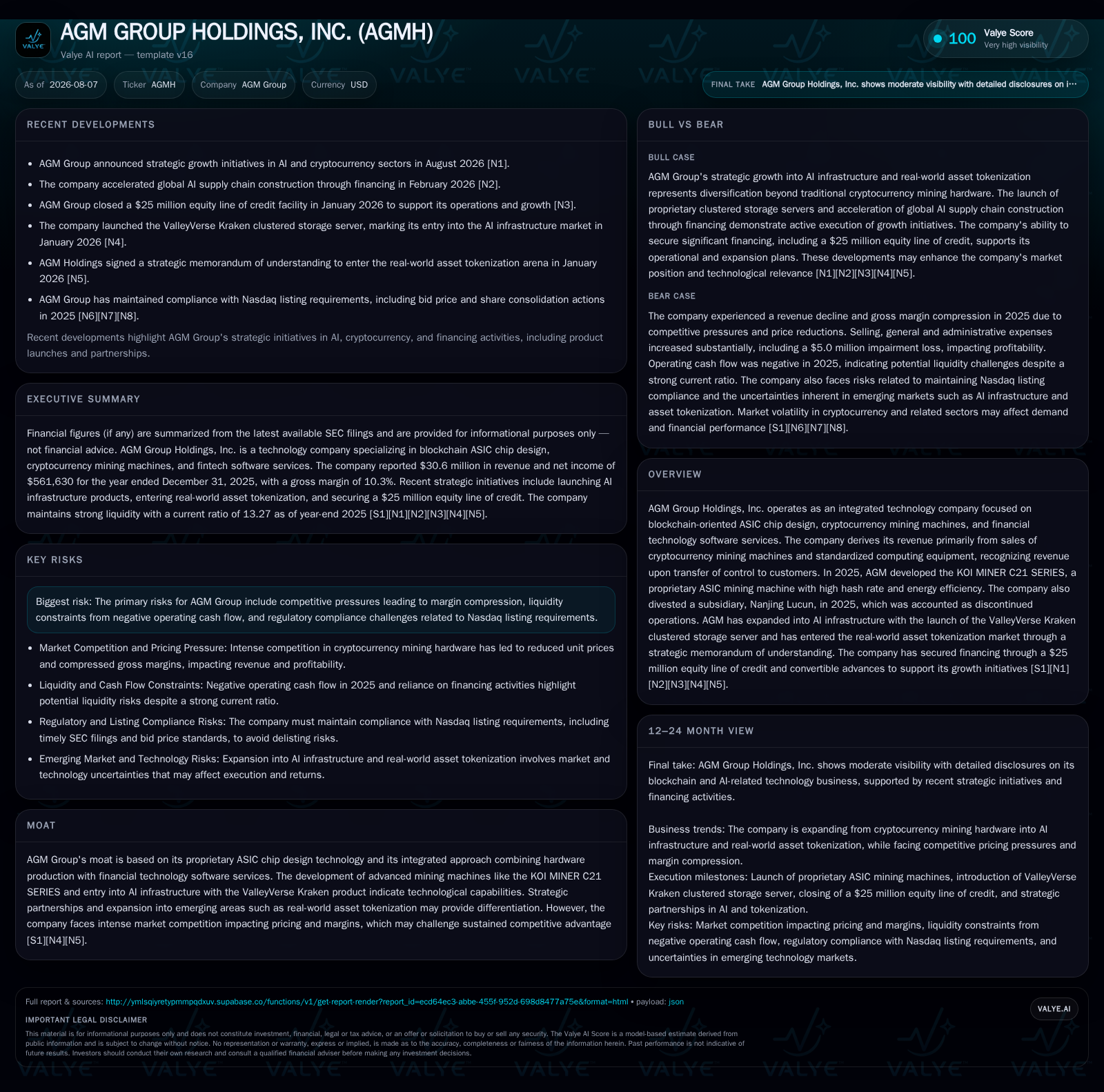
AGM Group Holdings, Inc. reported a slight revenue decline in 2025 driven by strategic price reductions to defend market share amid intense industry competition. The company continues its integrated business model combining proprietary ASIC mining hardware with fintech software, recently advancing AI-oriented clustered storage servers and entering real-world asset tokenization. Despite positive net income from continuing operations, the firm faces margin compression and liquidity considerations as it works to regain Nasdaq filing compliance. Its future growth depends on successful execution of product innovation and financial stabilization alongside managing regulatory requirements.
Recent Operating Update
AGM Group Holdings recently disclosed in its Form 6-K dated May 26, 2026, that it has not yet filed its Form 20-F for the fiscal year ended December 31, 2025, resulting in noncompliance with Nasdaq Listing Rule 5250(c)(1) [S2]. The company has submitted plans aiming to regain compliance or complete the filing ahead of November 11, 2026, thereby averting any immediate delisting threat. This regulatory pressure underscores the importance of timely financial reporting for maintaining investor trust and continuous access to capital markets.
Business Model Analysis
AGM Group operates through an integrated technology business model focused primarily on blockchain-oriented ASIC chip design and the production of cryptocurrency mining machines [S1]. Revenue recognition occurs upon delivery—consistent with industrial hardware sales dynamics—where customers (primarily cryptocurrency miners and blockchain operators) pay for specialized computing equipment optimized for hash rate efficiency and energy consumption metrics such as Joules per Terahash (J/TH)
Notably, AGM developed the KOI MINER C21 SERIES featuring a hash rate up to 285 TH/s and energy efficiency around 13.2 J/TH—a competitive threshold that signals significant R&D commitments aimed at mitigating rapid tech obsolescence common in ASIC manufacturing [S1]. This product integrates tightly engineered hardware traits essential for high-volume automated mining operations where even fractional improvements can materially affect customer ROI.
Beyond hardware, AGM complements its product portfolio with financial technology software services aligned with blockchain infrastructure applications. This dual focus is intended to create ecosystem synergies whereby hardware clients could potentially leverage AGM’s fintech platforms to enhance operational workflows or asset management related to cryptocurrency mining or tokenized assets.
In late 2025, AGM strategically divested subsidiaries (e.g., Nanjing Lucun) marking a conscious reshaping toward core activities centered on proprietary mining machines and fintech software development [S11]. This refinement aims to streamline operational complexity while possibly reallocating capital toward higher-margin product lines.
The company's recent expansion into AI infrastructure roles—highlighted by launching the ValleyVerse Kraken clustered storage server—exemplifies diversification efforts targeting adjacent high-growth sectors requiring dense computation and data storage capabilities [N1][S1]. Concurrently, securing a memorandum of understanding for real-world asset tokenization positions AGM at a nascent intersection between traditional finance and blockchain-enabled digital securities.
Industry Structure & Competitive Position
The cryptocurrency mining hardware sector remains defined by rapid innovation cycles in ASIC designs competing primarily on hash rate throughput per watt consumed alongside cost-effectiveness for large-scale miners. The midstream value chain occupant role places AGM among companies designing specialized chips and assembling mining rigs sold principally through transactional models rather than recurring revenue streams typical of SaaS platforms.
Peers such as Bitmain Technologies set aggressive benchmarks both in scale (multi-million unit production) and technology sophistication; similarly MicroBT competes heavily on price-performance ratios that pressure margins across smaller or less vertically integrated firms like AGM. While AGM's proprietary ASIC development capability provides differentiation potential, sustaining it requires substantial R&D intensity measured by expenditures relative to sales—an area where margin pressure from competitive pricing constrains available reinvestment capacity.
Growth Drivers
AGM’s growth initiatives pivot around technological innovation within ASIC designs aiming for incremental advances in hash rate and energy efficiency crucially quantified by J/TH metrics seen with KOI MINER C21 SERIES [S1]. Such advancements are fundamental since operational miners’ profitability depends heavily on electricity costs against hashing power delivered.
Strategic moves into AI infrastructure with scalable storage solutions like ValleyVerse Kraken signal attempts to leverage existing semiconductor design expertise into emerging verticals beyond cryptocurrency mining. This expansion may mitigate dependence on volatile crypto demand cycles through diversified product sets addressing broader datacenter needs.
Furthermore, participation in real-world asset tokenization taps into increasing institutional interest around digitizing physical assets via blockchain frameworks—a potentially transformative market with cross-sector fintech software deployment prospects [N1]. Successful navigation here could create recurring revenue streams complimentary to hardware sales.
Capital raised via a $25 million equity line (detailed outside this excerpt) supports ongoing R&D investments as well as necessary working capital deployments required by growth projects amid negative operating cash flows highlighted below.
Risks and Growth Constraints
A principal risk faced by AGM is continued margin compression exacerbated by aggressive competitor pricing tactics aiming at market share capture or retention [S7][S1]. Revenue fell despite higher unit volumes partly due to strategic unit price declines illustrating inherent tension between scale growth versus profitability sustainability.
Regulatory compliance forms another watchpoint; delayed SEC filings leading to Nasdaq noncompliance pressure signal governance weaknesses that could erode investor confidence or limit capital access if unresolved promptly [S2]. Meanwhile internal control deficiencies have been acknowledged relating to accounting oversight which heightens risks around financial reporting accuracy affecting public company status stability [S20].
Moreover, supply chain uncertainties globally impacting semiconductor foundries may disrupt component sourcing leading to elevated costs or production delays weakening competitiveness during technology turnover windows typical in ASIC cycles.
What To Watch Next
Key milestones include punctual completion and submission of overdue Form 20-F filings by November deadline avoiding trading sanctions on Nasdaq [S2], thus preserving public investor access pathways critical for financing operations.
Market reception and order flow trends associated with KOI MINER C21 SERIES releases will inform competitiveness trajectory along essential KPIs like hash rate adoption rates and average selling price realizations supporting margin analyses.
Progress in AI infrastructure commercialization including ValleyVerse Kraken deployments coupled with traction metrics related to fintech software uptake particularly within real-world asset tokenization partnerships will indicate success diversifying revenue bases from pure mining equipment sales.
Monitoring quarterly cash flow patterns alongside research & development expense ratios can reveal whether AGM can sustainably fund innovation without further weakening liquidity profiles or resorting excessively to dilutive equity raises or debt issuance.
Financial Profile Discussion
Managing these financial variables effectively will be imperative if AGM is to sustain concurrent R&D investment momentum alongside liquidity adequacy amid ongoing competitive stresses within ASIC-centric hardware manufacturing sectors documented among peer groups.
Disclaimer: This is research-only, informational analysis and not investment advice. It may include AI-generated interpretation and general industry context. Always verify important details using primary sources.

Comments