
John Marshall Bancorp Leverages Local Focus and Credit Discipline for Steady Growth
The regional bank's latest quarter underscores solid credit quality and measured balance sheet management amid a competitive Washington, D.C. metropolitan market.
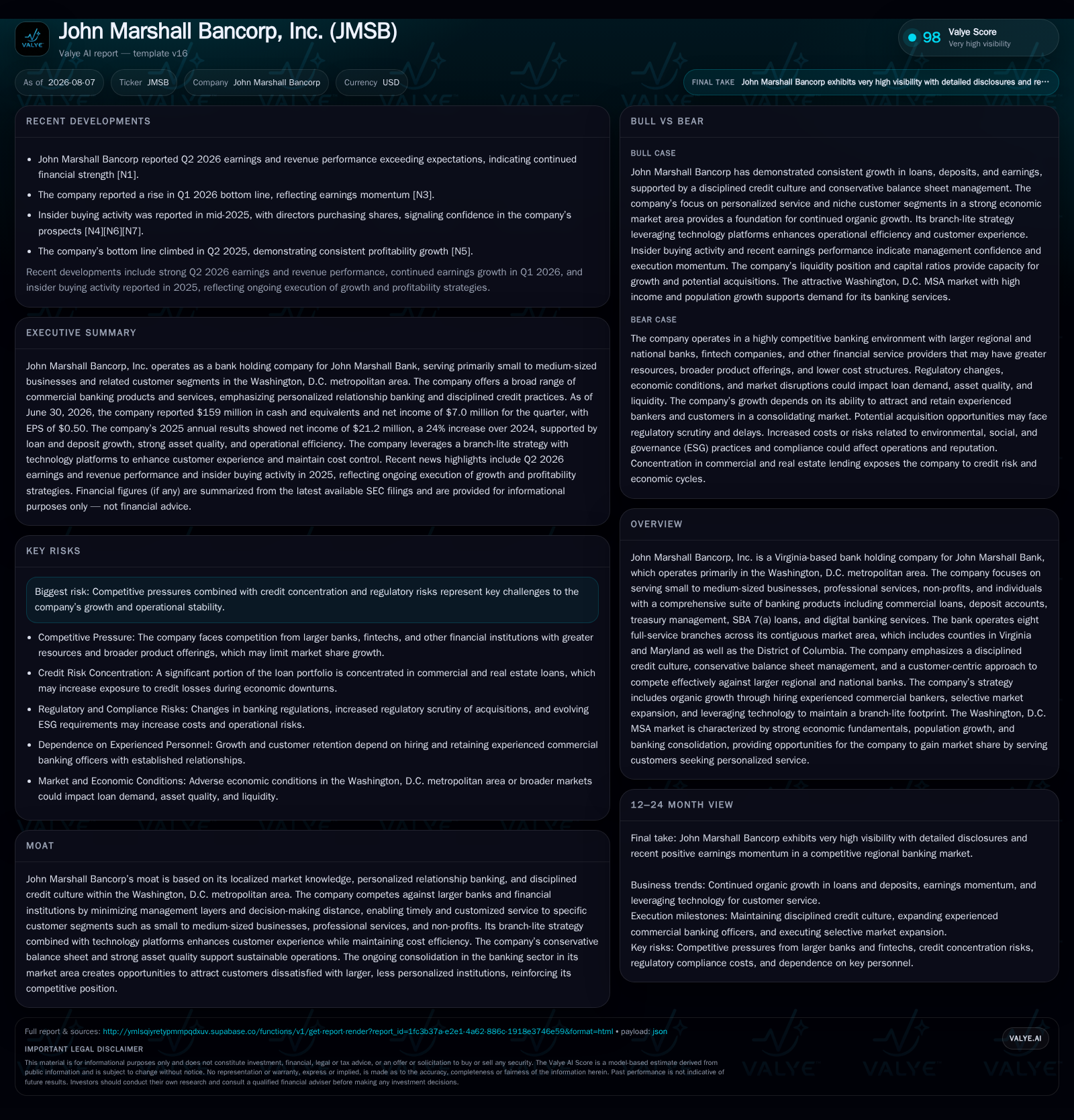
John Marshall Bancorp, Inc. (JMSB) reported a stable Q2 2026 with no material changes in risk factors and continued emphasis on its niche in small to medium-sized business banking within the Washington, D.C. metro area. The bank holds strong asset quality supported by disciplined credit culture and conservative balance sheet management alongside a modest branch footprint complemented by digital channels. Growth opportunities emerge from local economic resilience, SBA loan programs, and banking sector consolidation, though competitive pressure and credit concentration remain watch points. Financially, JMSB maintains robust liquidity with net cash position and prudent leverage, positioning it for sustainable expansion.
Recent Operating Update
John Marshall Bancorp’s latest quarterly filing for Q2 ended June 30, 2026 reveals steady operational execution without material changes to declared risk factors [S2]. The company confirmed the continuation of its share repurchase program through August 31, 2026 but reported no repurchases during the quarter. There were also no defaults or significant changes in director trading arrangements disclosed [S2]. This stability in governance and risk outlook follows an earnings beat announced earlier in July 2026 underscoring effective revenue delivery amid ongoing economic uncertainties [N1]. The firm’s participation at prominent banking conferences suggests active engagement with capital markets stakeholders [S3].
Business Model Analysis
As a Virginia-based bank holding company serving primarily the Washington, D.C. metropolitan statistical area (MSA), John Marshall Bancorp focuses on relationship-driven banking tailored to small- to medium-sized businesses (SMBs), professional practices, non-profit entities, and individuals [S1]. Its product suite includes commercial loans such as commercial real estate (CRE) financing, SBA 7(a) loans that benefit from government guarantees reducing lender risk exposure, treasury management solutions targeting cash flow optimization for business clients, as well as deposit accounts ranging from checking to certificates of deposit [S1]. The monetization model follows classic regional bank archetypes where net interest income derived from loan interest margins constitutes the core revenue driver while fee income from treasury services and deposit-related fees supplements profitability.
The bank maintains eight full-service branches strategically located within contiguous counties across Virginia and Maryland plus Washington D.C., balancing coverage with cost efficiency [S1]. Complementing this branch-lite physical presence is an investment in digital banking platforms that streamline routine transactions and customer access, limiting overhead while enhancing client stickiness.
Central to John Marshall’s offering is a disciplined credit culture that prioritizes conservative underwriting standards aligned with its focus on stable segments such as professional services and well-understood SMBs. This credit vigilance underpins asset quality metrics crucial for sustaining net interest margins amid varying interest rate cycles typical within regional banking [S1]. Its local market knowledge grants advantage over larger institutions by enabling faster decision-making through fewer management layers and more personalized service [S3].
Industry Structure and Competitive Position
Operating within the economically robust Washington D.C. MSA — characterized by high median household incomes ($123k projected median in 2025) and steady population growth (~2.8% projected through 2031) — JMSB benefits from a fundamentally attractive market environment that supports demand for commercial lending and deposit growth [S1]. However, the FDIC data as of mid-2025 shows a heavily concentrated deposit market where the top five banks control nearly 70% share, indicating intense competition against both large regional/national banks and community-based players.
JMSB's moat arises from its hyper-localized presence offering tailored customer interaction absent at bigger competitors burdened by bureaucratic delays or one-size-fits-all products. This advantage enables capture of SMBs and nonprofits desiring relationship access alongside technology-enhanced convenience. Compared with peers like South Plains Financial (SPFI), JMSB’s scale is smaller but its lean organizational model supports nimble responses to client needs or credit challenges.
The increasingly consolidated banking landscape presents opportunity as customers dissatisfied with impersonal service from large banks seek alternatives focused on responsiveness and trust. Yet risks remain given fintech entrants targeting payment processing or loan origination disintermediating smaller regional players lacking significant technology investments.
Growth Drivers
Local economic resilience across JMSB’s footprint drives steady loan demand growth supported by expanding commercial real estate activity linked to regional development trends. Particularly notable is the emphasis on growing SBA 7(a) loan originations which tend to carry lower credit loss provisions due to governmental backing while fulfilling capital needs of SMBs requiring affordable financing options [S1]. Complementing this are efforts to cross-sell treasury management services facilitating recurring fee income diversification.
Branch optimization combined with digital platform enhancements reflects strategic efforts to maintain operational efficiency as measured through key metrics like efficiency ratio without sacrificing customer outreach or convenience. Moreover, management’s targeted hiring of experienced commercial bankers aims at deepening penetration into niche verticals such as professional corporations or high-growth startups needing specialized lending solutions [S3].
Banking sector consolidation within the region could yield incremental market share gains for JMSB if it successfully attracts relationships fleeing larger institutions perceived as less attentive or slower in credit decisions.
Risks and Watchpoints
While JMSB adheres to a conservative credit stance supported by low non-performing loan ratios historically reported [S1], concentration risk remains salient given geographic focus on a single metro area alongside industry exposure notably around CRE lending which can be sensitive to economic cycles or regulatory shifts.
Competitive pressures not only stem from large-scale national and regional banks wielding broader product suites but also fintech companies offering alternate lending platforms or payment services that may erode traditional revenue streams over time. Additionally, deposit beta dynamics — the extent deposit pricing rises along with market interest rates — can pressure funding costs reducing net interest margin compression if managed inefficiently.
Regulatory compliance demands particular vigilance given stringent Federal Reserve oversight applicable to bank holding companies coupled with evolving cybersecurity threats posing operational risks in digital channels.
What to Watch Next
Upcoming milestones include monitoring JMSB’s quarterly net interest margin trends especially as interest rates fluctuate locally impacting both loan yields and deposit betas. Loan portfolio growth rates segmented by product type (commercial vs SBA loans) will indicate success in targeted expansion areas.
Efficiency ratio movement reflecting operating expense control relative to revenue also warrants scrutiny given branch network limitations balanced against digital channel investments.
Credit quality markers — including non-performing assets levels and provision for loan losses — serve as early signals of any stress emerging amidst competitive or macroeconomic headwinds.
Finally, capital adequacy metrics such as tier 1 capital ratio will reveal capacity for balance sheet expansion or buffer against unforeseen losses aligning with regulatory expectations.
Financial Profile Discussion
As of June 30, 2026, John Marshall Bancorp held approximately $159 million in cash and equivalents against total debt estimated at $81 million resulting in a net cash position roughly $78 million positive [F1]. This indicates prudent liquidity management providing ample runway for operational needs or opportunistic lending growth without immediate refinancing pressures.
Overall financial health appears solid with tangible book value preservation underpinning confidence among stakeholders looking for stability amid shifting regional banking dynamics.
Disclosure: This analysis is based solely on publicly available information including SEC filings dated up to August 7, 2026 ([S1], [S2], [S3], [F1]) and recent earnings commentary ([N1]). It does not constitute investment advice.
Disclaimer: This is research-only, informational analysis and not investment advice. It may include AI-generated interpretation and general industry context. Always verify important details using primary sources.

Comments