
Nathan's Famous Faces Inflationary Pressures Amid Merger Transition and Multi-Channel Growth
Higher commodity and labor costs challenge Nathan’s Famous as it balances pricing strategies and franchise expansion ahead of a pending acquisition.
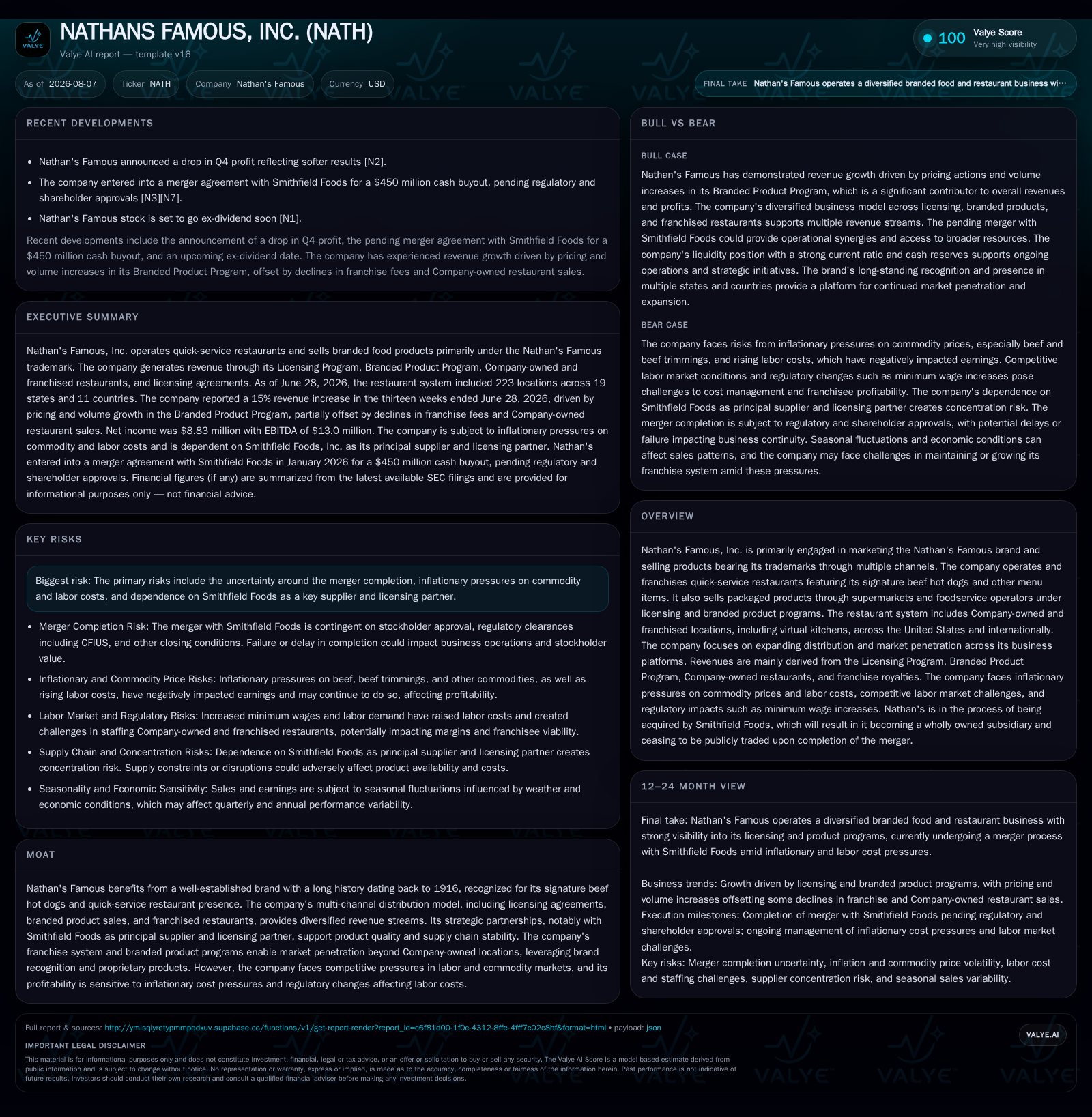
Nathan’s Famous reported inflationary impacts on earnings in its first quarter of fiscal 2027, primarily driven by rising beef prices and labor costs. The company offsets these pressures through selective price increases at company-operated restaurants and indexed contracts with branded product customers. Its multi-channel business model—including franchised quick-service restaurants, licensed branded products, and branded foodservice offerings—diversifies revenue but remains sensitive to commodity inflation and labor market dynamics. A merger agreement with key supplier Smithfield Foods adds strategic complexity, with the transaction expected to close in the latter half of 2026, imposing dividend restrictions and legal contingencies. Operating cash flow remains positive but modest, supporting the firm’s ongoing investments and debt service.
Recent Operating Update
Nathan's Famous, Inc. disclosed in its first quarter fiscal 2027 filing ending June 28, 2026 that inflationary challenges significantly compressed earnings, primarily through increased commodity costs and rising labor expenses. The cost of beef and beef trimmings—the core input for Nathan’s signature products—rose sharply by approximately 22% year-over-year in this quarter [S2]. This followed a trend from the prior fiscal year where hot dog costs were already elevated by around 19%. Labor cost pressure also intensified after New York State's minimum wage increase from $16.50 to $17.00 hourly as of January 1, 2026, combined with broader labor market tightness affecting franchisee operations [S27].
To mitigate margin erosion, the company strategically raised menu prices at its Company-owned restaurants while entering into sales agreements within its Branded Product Program that tie prices directly to beef cost indices. This indexed pricing approach facilitates partial cost pass-through to customers in retail and foodservice channels, though timing lags and competitive considerations temper full cost recovery [S2], [S19]. Despite these efforts, Nathan’s reported a gross profit decline as total cost of sales rose about 24% driven heavily by commodity inflation [S28].
The system-wide restaurant footprint remained stable with 223 locations operating at June 28 compared to 225 one year prior. Four new franchise locations opened offset by two closures reflect relatively flat unit count dynamics in a competitive quick-service restaurant (QSR) environment [S21], [S28]. Notably, the company favors franchising over expanding Company-owned units beyond their existing four stores (including one seasonal), per their strategic emphasis on leveraging franchisees for growth while minimizing capital expenditures [S21].
Business Model Details
Nathan's Famous operates a diversified revenue model encompassing Company-operated quick-service restaurants serving its iconic beef hot dogs and related menu items, royalties from franchised locations under both traditional restaurant models and Branded Menu Programs, as well as licensing fees from packaged products distributed through supermarkets, grocery outlets, club stores, and foodservice operators [S1], [S21]. This multi-channel approach provides revenue diversification but depends heavily on external partners’ operational success and consumer acceptance across channels.
The Licensing Program focuses on consumer packaged goods bearing the Nathan's Famous brand—including packaged hot dogs and frozen crinkle-cut French fries—sold via retail grocery channels under licensing agreements administered chiefly through a partnership with Smithfield Foods [S1]. The Branded Product Program enables selling proprietary bulk products directly to foodservice operators under limited trademark use licenses outside traditional franchising relationships. Both programs benefit from Nathan’s century-plus brand heritage but are vulnerable to commodity price swings common in meat processing supply chains.
Franchise royalties represent a recurring income stream tied to system-wide sales performance across domestically dispersed units (19 U.S. states) plus international presence (11 countries), providing geodiverse exposure but requiring legal enforcement of franchise standards internationally [S21]. The blend of revenue from licensing fees, branded product sales volume increases (noted 8% hot dog volume growth recently), franchise royalties, and Company-owned restaurant sales underpins Nathan’s topline [S28].
Industry Structure and Competitive Position
As a QSR player rooted in iconic beef hot dogs originating from Coney Island since 1916, Nathan's Famous competes within a highly saturated fast-food market characterized by intense competition on menu innovation, pricing flexibility, brand loyalty campaigns, delivery/digital order adoption, and labor cost management. While peers such as McDonald's or Shake Shack have broader geographical footprints or operational scale advantages, Nathan’s niche brand recognition coupled with multi-channel distribution creates defensible moat features.
The partnership with Smithfield Foods as principal supplier also doubles as a licensing linchpin underpinning branded product quality consistency—an important differentiation amid commodity volatility [S1], [S7]. However, this dual dependence simultaneously introduces risks around concentration, negotiating leverage asymmetry with Smithfield, and regulatory scrutiny given the pending merger respecting this relationship [S7]. The planned acquisition is expected to convert Nathan's into a wholly owned subsidiary of Smithfield upon closing projected for H2 FY2026; this will remove Nathan’s status as a public entity and may alter strategic directions or integration challenges [S7], [N1].
Growth Drivers
Key mechanisms driving growth include expanding distribution points across all business segments: increasing penetration of licensed branded products in retail foodservice chains; enhancing franchise network density primarily through franchising rather than capital-intensive company-operated units; advancing Branded Menu Programs granting foodservice operators broader access to proprietary menus beyond packaged products; and leveraging virtual kitchens as low-capital avenues for urban market reach expansions [S21]. Moreover, digital ordering platforms can enhance average check sizes and customer frequency if successfully adopted.
Menu innovation remains essential for maintaining relevance amid changing consumer preferences toward health-conscious options or convenience trends—though Nathan's current focus appears centered on core brand strengths rather than broad menu diversification [S1]. Pricing strategy adjustments controlling inflation impacts are critical near-term levers given commodity price volatility impacting margins directly.
Risks and Watchpoints
Crucial risks include continued inflationary pressures that may outpace pricing power or contract indexing effectiveness—particularly if competitive dynamics limit customer tolerance for price hikes or if supply chain disruptions elevate raw material costs unpredictably [S2], [S27], [S29]. Labor cost escalations due to minimum wage law changes coupled with union contract obligations or potential “joint employer” regulatory classifications introduce downside margin risk while complicating staffing stability.
Dependence on Smithfield Foods is a double-edged sword: while providing stable supply chain integration and co-branding advantages, it exposes Nathan’s to supplier-concentration risk reflected also in licensing revenues materially linked to Smithfield agreements—a significant factor heightened further by the ongoing merger process requiring regulatory clearances including Committee on Foreign Investment in the United States (CFIUS) oversight among other conditions [S7],[S16].
Franchisee performance variability presents operational risk given differential local execution capabilities affecting brand perception in diverse markets. Also at issue is potential erosion of the Coney Island flagship's draw as tourism patterns fluctuate economically or seasonally affecting brand cachet.
What to Watch Next
Investors and analysts should monitor completion progress of the merger agreement anticipated late in calendar year 2026 as regulatory approvals may face delays or additional conditions impacting strategic plans [S7]. Subsequent quarterly filings will clarify whether integration synergies materialize timely or if merger-related expenses escalate further.
Tracking same-store sales performance across franchised units provides insight into underlying demand strength amid macroeconomic inflationary headwinds. Observation of branded product volume growth trends including grocery channel expansion signals success in non-restaurant distribution penetration.
Price elasticity monitoring is critical given past partial pass-through successes but inherent risks with consumer pushback against repeated menu price elevations.
Operational KPIs like labor cost ratio improvements driven by optimized scheduling or productivity enhancements could signal margin resilience despite regulatory wage increases.
Lastly, any updates on purchase commitments for hot dogs or inventory management adjustments could foreshadow supply chain hedging effectiveness against raw material price volatility going forward [S20], [S24].
Financial Profile Discussion
As of June 28, 2026, Nathan's maintained $24.7 million in cash equivalents against total debt approximating $47.8 million per their Credit Agreement term loan facility used notably for refinancing prior notes earlier this year [F1], [S2]. The company’s current assets totaled approximately $58.8 million versus current liabilities near $24.0 million, implying a current ratio of about 2.45, which indicates a solid short-term liquidity position [F1].
Operating cash flow was positive though modest at $949 thousand for the recent quarter driven mainly by net income adjusted for non-cash items like depreciation ($239k) offsetting working capital outflows totaling $8.4 million attributable largely to increases in receivables due to higher branded product sales volumes [S2], [S18].
This financial positioning affords sufficient capital resource flexibility to fund ongoing operations including mandatory debt repayments computed at $600k quarterly alongside interest obligations approximating $1.8 million annually at current rate levels while navigating integration investment needs stemming from the pending transaction context.
This analysis synthesizes publicly filed data from Nathan’s Famous’ recent SEC disclosures without offering investment advice or research views regarding securities transactions.
Disclaimer: This is research-only, informational analysis and not investment advice. It may include AI-generated interpretation and general industry context. Always verify important details using primary sources.

Comments