
DraftKings’ Q2 2026 Struggles Highlight Marketing Costs and Regulatory Challenges in Scaling Online Sports Betting
DraftKings reported a Q2 revenue shortfall and ongoing operating losses despite growth in sportsbook handle, reflecting intense unit economics pressures and regulatory hurdles.
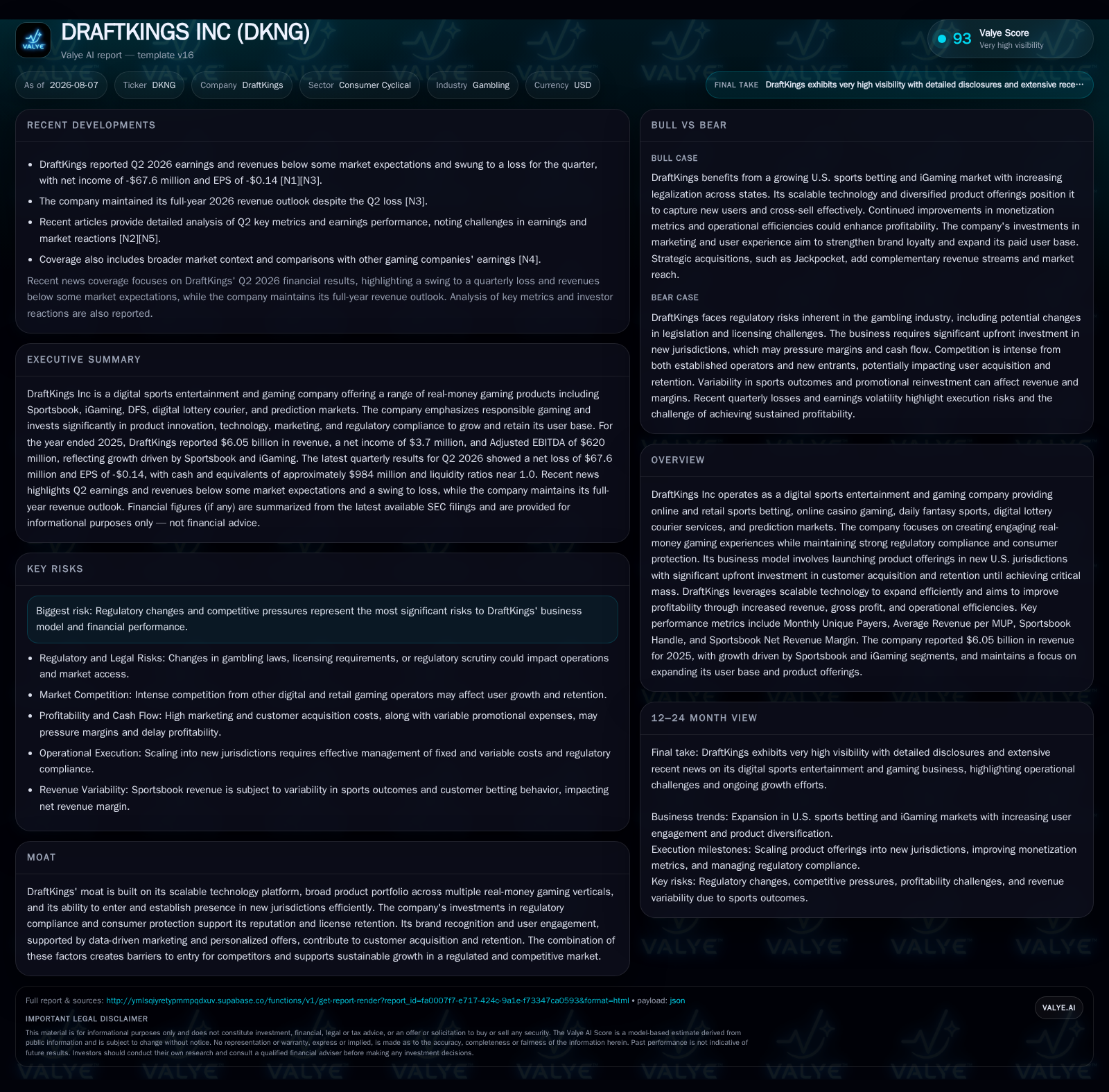
In its latest quarterly filing for Q2 2026, DraftKings disclosed revenue and earnings that missed estimates amid continued heavy investments in customer acquisition and expansion into new U.S. jurisdictions [S2][S18]. The company’s scalable technology platform supports rapid market entry, but high marketing expenses and regulatory compliance demand constrain near-term profitability [S1]. DraftKings' diversified product portfolio spanning sports betting, daily fantasy sports, iGaming, and prediction markets aims to cross-sell users and improve monetization metrics like Monthly Unique Payers (MUP) and Average Revenue per User (ARPU), yet risks from legal disputes and changing regulations remain acute [S1][S6]. Financially, as of mid-2026, DraftKings held nearly $1 billion in cash against about $1.86 billion in debt, indicating manageable liquidity but net leverage challenges [F1]. The company’s pursuit of scale economies and jurisdictional licensing is critical to improving contribution profit profiles.
Recent Operating Update: Q2 2026 Financials
DraftKings' Q2 2026 results revealed revenue below market expectations alongside ongoing operating losses as the company continues aggressive marketing spend to fuel growth across U.S. jurisdictions [S2][S18][N2]. The heavy upfront investment reflects the business model’s reliance on capturing a meaningful user base before achieving favorable unit economics. Despite these headwinds, sports wagering volume (handle) has grown as market penetration deepens.
The underlying technology platform’s scalability allows DraftKings to deploy sportsbook, iGaming, Daily Fantasy Sports (DFS), digital lottery courier services, and prediction markets efficiently across multiple states without proportionate fixed cost increases. This capability underpins management’s confidence in eventual margin expansion once critical mass is reached in new jurisdictions [S1][N3]. However, high Customer Acquisition Cost (CAC) driven by intense competition strains near-term contribution profits. Investor reaction included increased scrutiny of CAC relative to MUP gains — a vital metric for reimbursement of upfront marketing investments by recurring user revenue
Business Model: Multi-Product Digital Sportsbook Ecosystem
DraftKings operates as a digital gambling platform offering real-money betting products directly to consumers via mobile apps and web portals. Its revenue model primarily earns net revenue after payouts from sports wagers (Sportsbook), casino-style games (iGaming), fantasy sports contests (DFS), digital lottery ticket services, and prediction market contracts [S1]. Key monetization drivers include total betting volume ('Sportsbook Handle'), win/hold rate dynamics that determine gross gaming revenue (GGR), conversion rates from registered to paying users ('Monthly Unique Payers'), user monetization intensity ('Average Revenue per User'), and net revenue margin post-payouts.
The offering relies on active user acquisition through sizable marketing incentives such as personalized promotions and deposit matches while emphasizing cross-selling across product verticals to improve stickiness. Marketing spend thus functions as both a top-line growth driver and an operating leverage lever — though it initially pressures margins. Customer relationships generated by acquisition campaigns are booked as finite-lived intangible assets amortized over their economic life post-acquisition [S1]
The scalable technology infrastructure supports rapid statewide product launches with controlled incremental cost expansion at the fixed cost base level. Yet variable marketing expenses fluctuate based on promotional cadence and competitive dynamics in the newly regulated states where licensing agreements impose additional compliance costs.
Industry Structure & Competitive Positioning
DraftKings competes in the fragmented U.S. digital sports betting and online gambling market characterized by jurisdictional licensing complexity. Peers include FanDuel (a major DFS/sportsbetting operator), BetMGM with broader casino offerings, Caesars Entertainment blending retail/digital operations, Penn National Gaming combining offline venues with digital sportsbook assets, and Flutter Entertainment operating globally diversified platforms.
The company's moat stems from its broad multi-product suite combined with data-driven personalized marketing that promotes cross-product engagement enhancing lifetime value per customer. Regulatory compliance capabilities ensure licensing maintenance essential for continued operation across different states. This positioning creates barriers to entry compared to smaller or less diversified operators.
However, competition remains fierce leading to elevated CAC levels exacerbated by aggressive spending on brand awareness via partnerships with professional sports leagues and media entities to capture the "skin-in-the-game" demographic segment of sports fans who have wagered money actively.
DraftKings faces dependence on third-party ecosystem elements such as Apple App Store/Google Play store distribution channels that can impose advertising or app usage restrictions affecting user acquisition funnels [S1].
Growth Drivers
Key growth vectors encompass:
- Expansion into new U.S. states following evolving legalization frameworks enabling jurisdictional licensing launches enabling fresh customer pools.
- Rising consumer adoption of online sports wagering replacing traditional retail-based betting increasing addressable market size.
- Cross-selling synergies driving higher average spend per user through bundling DFS with Sportsbook/iGaming offerings improving ARPU metrics.
- Continuous deployment of product innovations supported by scalable technology platform enhancing engagement frequency thereby boosting retention.
- Leveraging data analytics for targeted promotions enhancing user lifetime value while optimizing CAC efficiency.
- Partnerships with sports leagues elevating brand recognition stimulating organic inbound traffic.
Recent reports indicate increasing annualized consumer volume on DraftKings' Predictions segment evidencing traction outside core sportsbook products suggesting diversification benefits [S12]
Risks & Watchpoints
Among the most material risks are:
- Regulatory uncertainty including possible revocations or suspensions affecting existing licenses or constraining new market entries.
- Intensifying competition elevating CAC beyond sustainable levels until economies of scale accrue creating margin pressure.
- Litigation exposures involving allegations around misleading promotions targeting vulnerable players that could result in costly settlements or operational constraints.
- Platform dependencies including potential adverse changes from app stores or payment gateway providers hampering distribution or monetization channels.
- Hold rate volatility inherent in wagering outcomes causing quarter-to-quarter unpredictability impacting net revenue margins.
- Technology disruptions or cybersecurity breaches could impair user experience risking reputational damage impacting retention rates.
- Macro-economic impacts reducing discretionary spending directly affect betting volumes putting topline growth at risk.
- Market saturation in mature jurisdictions limiting incremental growth requiring heavier promotion investments to maintain share.
Monitoring lawsuits’ progression related to "risk-free" promotion claims is particularly crucial given ongoing multi-state class actions alleging unfair trade practices by DraftKings VIP programs targeting vulnerable customers.
What To Watch Next
Investors should focus on quarterly updates for:
- Trends in Monthly Unique Payers (MUP) growth versus CAC levels indicating progress toward replicable positive unit economics.
- Changes in Average Revenue per User signaling success in cross-product monetization strategies.
- Sportsbook Handle volumes indicating underlying customer engagement trajectory aligned with seasonal sporting calendar effects.
- Net Revenue Margin fluctuations as a proxy for hold rate stability alongside payout management effectiveness.
- Marketing expense ratios relative to revenue assessing efficiency improvements or sustained investment needs.
- Expansion announcements into newly legalized states evidencing pipeline health supporting longer-term growth narratives.
- Updates on ongoing litigation outcomes impacting financial liabilities or promotional strategies adjusting risk profiles.
- Regulatory developments possibly altering permissible offer structures or compliance burdens shaping operating cost forecasts.
Regular tracking of these operational KPIs will clarify whether DraftKings can balance growth acceleration with margin improvement toward eventual sustainable profitability [S2][N3]
Financial Profile Discussion
As of June 30, 2026, DraftKings held approximately $984 million in cash equivalents alongside $1.86 billion of total debt resulting in net debt near $874 million; its current ratio stood just north of parity at about 1.02 indicating adequacy of working capital coverage over short-term liabilities [F1]. While liquidity appears sufficient for immediate requirements including marketing initiatives and regulatory compliance spend, net leverage remains elevated reflecting industry-standard capital structure given growth-stage status and previous convertible notes issuance maturing in 2028 [S4][F1].
Operating income has remained negative though narrowed losses reflect scaling contributions; maintaining disciplined capital allocation towards efficient customer acquisition will be vital to reduce cash burn going forward [F1][N4]. Continued improvements in gross profit coupled with moderation or optimization of variable marketing expenditures can enhance EBITDA margins over subsequent quarters helping mitigate refinancing risks related to outstanding credit facilities or convertible notes obligations documented through early 2028 maturities [F1][S11].
Overall DraftKings balances strong cash flow generation potential inherent in recurring revenue models against significant upfront costs required for geographic expansion under strict regulatory regimes. Monitoring leverage ratios alongside contribution margin improvement serves as a practical financial health barometer during this scaling phase.
Disclaimer: This is research-only, informational analysis and not investment advice. It may include AI-generated interpretation and general industry context. Always verify important details using primary sources.

Comments