
Crexendo Advances UCaaS Footprint Through Proprietary Licensing and Strategic Acquisition
Crexendo’s latest quarterly results and acquisition highlight its growth in cloud telecommunications leveraging concurrent session licensing and expanding enterprise reach.
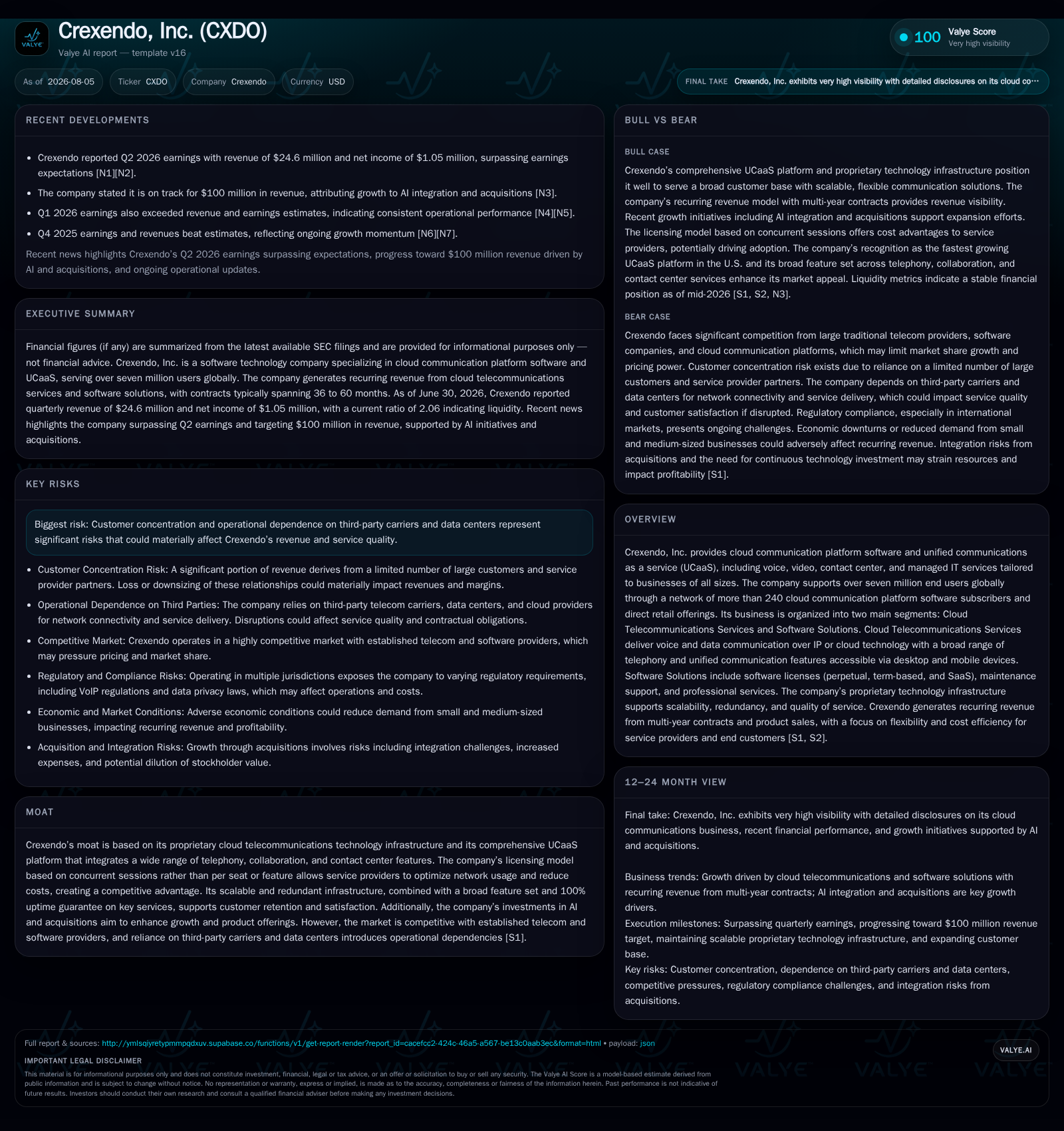
Crexendo reported solid Q2 2026 performance showcasing growth in its cloud telecommunications services supported by a unique concurrent session licensing model that enhances cost efficiency for service providers. The company's proprietary multi-tenant UCaaS platform supports over seven million global users, delivering voice, video, and contact center solutions. A $35 million acquisition completed in early 2026 broadens its product suite and customer base but also raises integration challenges. Operational reliance on third-party carriers and data centers as well as customer concentration remain notable risks. Financially, Crexendo maintains a healthy current ratio above 2.0 and low debt, providing flexibility to support expansion initiatives.
Recent Operating Update
Crexendo’s Q2 2026 filing [S2], supplemented by an August 4 event filing [S3], details ongoing momentum in its cloud telecommunications services underpinned by its proprietary unified communications as a service (UCaaS) platform. The company reported stable Annualized Exit Monthly Recurring Subscriptions (AERR), which it cites as a leading indicator of expected subscription revenue growth. This metric reflects the health of recurring billing streams crucial to the SaaS-driven business model here [S1], [S13].
On March 1, 2026, Crexendo completed the acquisition of Estech Systems for $35 million [S15]. Estech specializes in cloud-based and on-premises phone system solutions that complement Crexendo’s existing UCaaS offering. Financing this primarily with cash reserves signals strong internal liquidity but also introduces integration complexity that could strain management resources in the near term.
Business Model Analysis
Crexendo combines two key segments: Cloud Telecommunications Services and Software Solutions. The former transmits voice/data over IP or cloud infrastructure via a multi-tenant architecture supporting voice, video, contact center capabilities, and managed IT services. Unlike many peers who price licenses per seat or feature, Crexendo licenses concurrent sessions—meaning customers pay based on simultaneous active connections rather than total user counts. This licensing model allows service providers to oversubscribe their networks efficiently, reducing per-user costs as scale increases. It also provides flexibility across variable usage patterns typical of enterprise clients with multi-location or hybrid workforces [S1], [S13].
Recurring revenues stem from long-term contracts typically spanning three to five years with monthly billing cycles, supplemented by equipment sales/leases (Device as a Service) and professional services such as consulting or implementation support. The Software Solutions segment includes software licenses sold perpetually or via subscription (SaaS), maintenance contracts offering ongoing updates/support, and professional services sold standalone or bundled [S1]. This diversified revenue mix enhances overall resilience but requires balancing development investment against margin pressures.
Platform reliability underpins customer retention; Crexendo guarantees network uptime backed by its scalable, redundant infrastructure—a critical competitive differentiator given the mission-critical nature of communication tools for businesses [S1]. By integrating multiple communication modalities within one platform—voice calls, video conferencing, CCaaS features—Crexendo aims to capture higher wallet share compared to single-function vendors.
Industry Structure and Competitive Position
The cloud communications and UCaaS market is characterized by rapid adoption driven by digital transformation trends but remains intensely competitive. Large players like RingCentral, 8x8, Vonage, Zoom Video Communications, Twilio, and Cisco provide extensive capabilities backed by significant marketing budgets and broad ecosystem presence.
Crexendo operates primarily through a blend of direct retail offerings and over 240 cloud communication platform software subscribers globally servicing more than seven million end users [S1]. Its niche lies in serving SMBs to mid-market with flexible concurrent session licensing which helps lower upfront seat-based costs common among competitors.
However, challenges remain penetrating large enterprise accounts due to longer sales cycles and complex requirements for multi-site servicing including international deployments that expose technical and regulatory hurdles [S21]. Its smaller scale relative to major incumbents limits brand recognition but allows nimble adaptation through acquisitions.
Growth Drivers
Several structural factors underpin Crexendo’s growth thesis:
- Enterprises continue shifting from legacy telephony to IP/cloud communications seeking integrated platforms combining telephony with collaboration and contact center functionalities.
- Rise of remote/hybrid work expands demand for multi-device accessibility ensuring seamless connectivity despite geographic dispersion.
- Bundling managed IT services alongside UCaaS offerings aids differentiation while adding revenue streams with higher gross margins.
- Investments in AI-powered automation may streamline customer workflows improving product stickiness.
- Multi-year subscription contracts lengthen visibility into recurring revenues.
- Geographic expansion into underserved markets both domestically and selected international English-speaking regions provides further upside potential [S1], [N1].
The Estech acquisition further diversifies the product portfolio attracting customers needing hybrid cloud/on-premise solutions—an essential capability especially in regulated sectors reluctant to fully migrate off-premises technology [S15].
Risks and Constraints
Risks inherent in Crexendo’s business relate mostly to operational dependencies and market pressures:
- Significant reliance on third-party carriers for VoIP transport exposes Crexendo to cost fluctuations or service disruptions outside its control [S11]. Increases in carrier fees due to regulatory tariff changes or vendor pricing strategies could compress margins.
- Use of external data centers similarly creates potential availability risk requiring continuous investment in network redundancy.
- Customer concentration risk calls for diversification since loss of large contracts can materially impact quarterly results particularly in an environment where enterprise sales cycles slow down [S21].
- Regulatory environments governing telecommunications vary widely; compliance burdens are intensifying especially around privacy/security laws potentially raising operating costs or limiting geographic expansion efforts [S4], [S11], [S28].
- Integration risk following acquisitions including cultural alignment challenges may delay realization of anticipated synergies impacting near-term profitability.
- Competition causes pricing pressure which may limit ability to pass through cost increases inherent in fixed multi-year contract pricing structures.
- Technology obsolescence risk requires consistent innovation investment which tightens R&D budgets amid margin management efforts.
What to Watch Next
Key indicators to monitor include:
- Quarterly trends in Annualized Exit Monthly Recurring Subscriptions (AERR) as forward signals for recurring revenue trajectory [S1], [S14].
- Customer churn rates reflecting satisfaction with platform reliability and feature relevance.
- Pace of integration progress related to Estech acquisition reflected in sales cross-selling opportunities or cost rationalization.[N1]
- Capital expenditure levels oriented toward maintaining infrastructure scalability aligned with projected growth demands.
- Changes in average revenue per user (ARPU) signaling premium upsell success or discounting pressures.
- Updates on any regulatory inquiries or litigation outcomes relevant to historical operations or emerging risk scenarios.
- Macro impacts including enterprise IT spending shifts tracked against industry-wide pressures noted across peers.
Financial Profile Discussion
As of June 30, 2026, Crexendo holds current assets at approximately $34.8 million against current liabilities near $16.9 million yielding a current ratio around 2.06 which signals solid short-term liquidity suitable for operational flexibility amid growth investments [F1]. Minimal debt outstanding (~$79k) reported historically reflects conservative leverage usage supporting acquisition funding primarily via cash reserves rather than debt raising [F1].
Maintaining free cash flow generation is critical given ongoing capital expenditures necessary for network enhancement supporting SLA commitments crucial for customer retention amidst a competitive environment. The company’s ability to manage growth expenses while integrating acquisitions will be determinant factors influencing margin expansion going forward.
Disclaimer: This is research-only, informational analysis and not investment advice. It may include AI-generated interpretation and general industry context. Always verify important details using primary sources.

Comments