
ePlus Inc Builds Resilience with Diversified IT Solutions Mix and Strategic Vendor Partnerships
ePlus’s latest quarterly report reveals a strategic shift favoring recurring managed services and highlights its technical moats amid competitive IT services landscape.
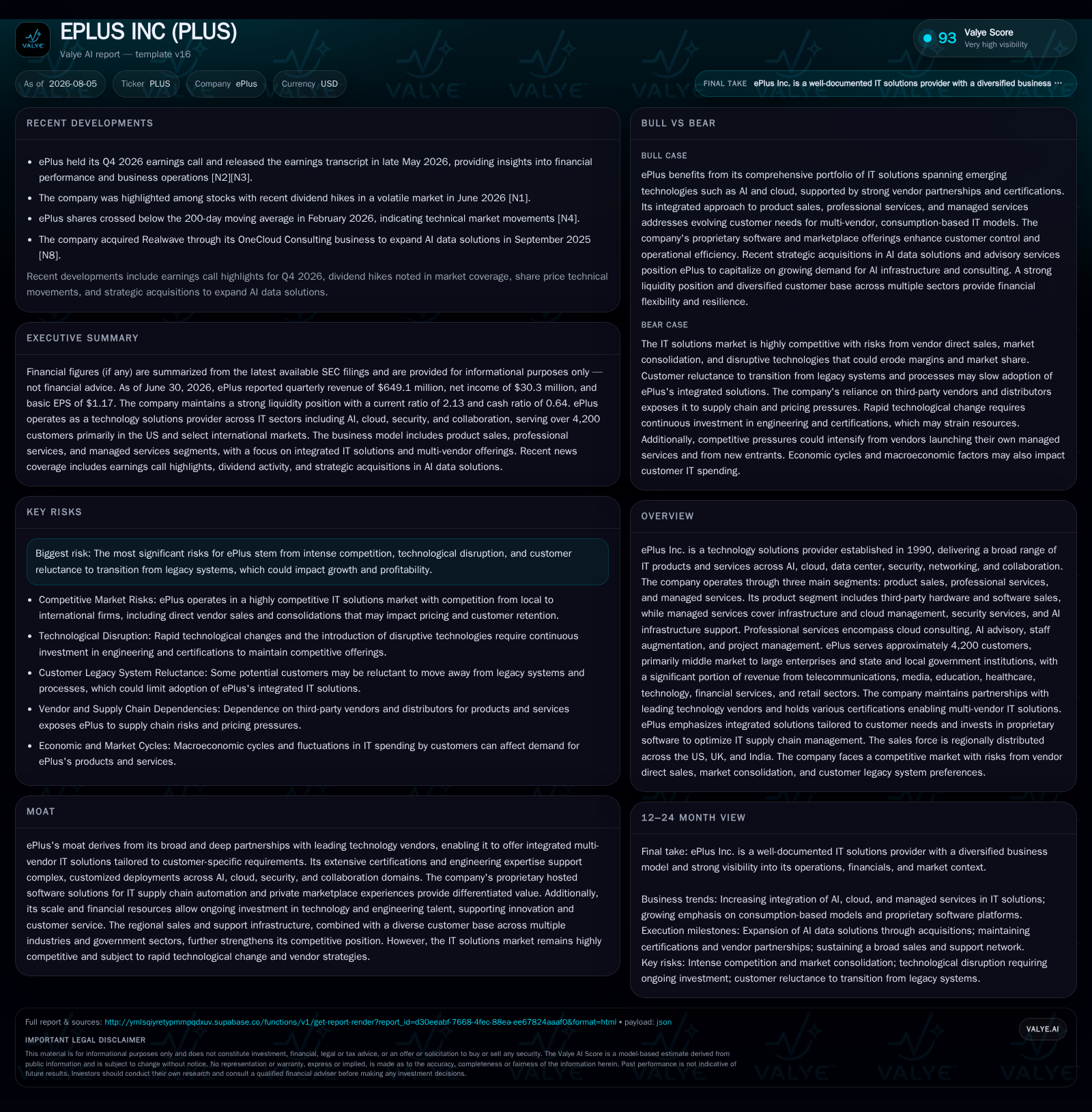
In its August 4, 2026 10-Q filing, ePlus Inc detailed operational dynamics reflecting a gradual pivot from product sales toward higher-margin and more stable managed services revenue streams. The company’s integrated business model unites third-party IT product distribution with professional consulting and managed service delivery across AI, cloud, security, and networking domains, supporting a diverse customer base across multiple sectors including telecommunications and government. ePlus’s competitive moat centers on multi-vendor engineering expertise and proprietary SaaS-enabled marketplaces that entrench client relationships despite intensifying vendor direct sales pressures. The ongoing expansion of cloud computing and AI infrastructure services underpin growth prospects while legacy system migration hesitancy, channel margin compression, and talent retention remain key risks.
Q1 FY27 Operating Trends Signal Incremental Shift Toward Recurring Revenue
ePlus Inc’s latest quarterly filing dated August 4, 2026, highlights evolving revenue dynamics with an incremental increase in the contribution from its managed services segment relative to product sales. While the absolute numbers are not granularly broken down in the public disclosures for this quarter,[S2] the narrative alongside the declared dividend of $0.27 per share payable in mid-September signals management’s growing confidence in stable cash flows backed by recurring contracted revenues.[S3] This shift aligns with broader industry trends where transactional hardware/software sales face margin pressure due to commoditization and direct vendor competition.
Managed services—offering encompassing infrastructure monitoring, cloud management (including Azure), security operations centers (SOC), network firewall management, endpoint protection, plus specialized AI infrastructure support—drive higher recurring revenue percentages that can buffer against quarter-to-quarter volatility endemic in product sales.[S1],[S21]
Decoding the Business Model: Integrated Multi-Segment IT Solutions Anchored by Vendor Partnerships
ePlus operates through three primary segments: product sales of third-party hardware/software encompassing perpetual licenses and subscriptions; professional services delivering cloud consulting, AI advisory workshops, staff augmentation including virtual CIO/CISO roles; and managed services providing outsourced monitoring and operational control across diverse enterprise IT environments.[S1],[S21]
Serving about 4,200 customers primarily in North America—with selected international exposure in the UK/EU/India—the client base spans telecommunications/media (30%), state and local government including education (13%), healthcare (13%), technology (12%), financial services (10%), retail (6%), highlighting sector diversification that imparts some risk dispersion [S5]
Vendor partnerships underpin solution depth with strategic alliances across AWS, Cisco Systems, Microsoft, Palo Alto Networks among others enabling ePlus to offer optimized multi-vendor solutions leveraging top-tier engineering certifications.[S1],[S25] The 705-strong regional sales force spans US, UK, India enhancing localized client engagement across multiple lines of business including IT departments and financial units for integrated solution adoption.[S25]
Competitive Moat Built on Engineering Expertise and Proprietary SaaS-enabled Marketplaces
ePlus distinguishes itself through robust technical capabilities supported by extensive partner certifications allowing complex deployments spanning cloud orchestration/automation through zero-trust architecture design.[S1] This engineering expertise addresses a critical barrier to entry amid fierce reseller market competition.
The company also leverages proprietary hosted software platforms facilitating IT supply chain automation which streamlines procurement and lifecycle management of assets—owned, leased or consumption-based [S1]. Expansion into private marketplace experiences such as AWS Marketplace further embeds customers into ePlus’s ecosystem creating stickiness beyond typical reseller transactions.
However, pressures emerge from vendor direct-selling strategies eroding product sales margins—a challenge mitigated partially by proprietary software differentiation combined with increasingly service-heavy offerings.
Industry Positioning Amidst Intensifying Competition and Technology Evolution
ePlus navigates a highly fragmented yet competitive landscape where large-scale resellers like CDW Corporation focus heavily on hardware/software distribution while consultancies such as Accenture/Deloitte emphasize professional advisory work. Managed service providers like Rackspace specialize more narrowly on cloud operations. ePlus straddles these areas with an integrated model providing both transactional products plus expanding recurring managed/cloud/security services elevating overall gross margin profile relative to pure resellers.
Commodity pricing pressures challenge product segment profitability while growth in high-value arenas such as AI infrastructure support—bolstered by ePlus’s unique NVIDIA DGX SuperPOD credentials—and cybersecurity offerings reflect evolving customer spending priorities against rising cyber threats [S1]
Growth Drivers: Cloud Adoption, AI Infrastructure Demand, Managed Services Expansion
ePlus benefits from secular tailwinds including accelerating adoption of cloud computing platforms paired with increasing complexity pushing enterprises toward expert consultancy-led modernization projects involving application migration and consumption licensing models.[S1]
AI advisory initiatives progressing clients through maturity stages along with specialized AI infrastructure managed services represent emerging vectors where few peers possess similar scale or certification depth.[S21]
Additionally, government sector modernization efforts particularly in SLED institutional IT upgrades contribute significantly to near- to mid-term pipeline robustness given regulatory spending patterns.[S5]
The gradual shift from capital expenditure-driven purchases toward ongoing recurring consumption further favors the managed services model enhancing revenue visibility.
Risks Spotlight: Legacy System Hesitancy, Vendor Channel Margins Compression, Talent Retention Challenges
Key risk areas include entrenched customer reluctance to abandon legacy technology stacks slowing new solution uptake.[S14],[S20] Furthermore, direct vendor competition directly threatens reseller margins particularly on transactional hardware/software business lines potentially constricting future growth if unmanaged.[S5]
Cybersecurity risks impose operational hazards both internally within delivery frameworks and externally among customer environments necessitating continuous vigilance.[S14]
Complex integration projects intrinsic to multi-vendor system deployments carry execution risks that can delay recognition of professional/managed service revenues impacting cash flow timing.
Finally, maintaining a pipeline of skilled engineers amid intense industry-wide talent shortages is crucial for sustaining technical moats and service quality reliability.[S14],[S20]
Near-Term Milestones: Upcoming Earnings Guidance, Contract Renewals, Customer Penetration Metrics
Investor focus should monitor Q2 FY27 guidance updates for confirmation of recurring revenue growth trends flagged this quarter along with sizable contract renewals or expansions especially among top telecom or government clients which could materially influence revenue trajectory.[S2],[S3]
Tracking client retention rates within managed services as well as average contract size evolution will serve as tangible indicators reflecting success in upselling integrated offerings over spot product sales.
Assessment of backlog development alongside new deal signings will further illuminate execution momentum relative to competitive pressures.
Financial Profile Discussion: Balance Sheet Strength Supports Strategic Investments
Current assets stood at roughly $1.5 billion against current liabilities near $704 million delivering a current ratio above 2.1 suggestive of solid short-term financial health capable of absorbing cyclical working capital shifts associated with inventory-intensive product sales alongside more stable service contract receivables [F1]
This balance sheet strength facilitates ongoing commitments to engineering talent acquisition/certification programs as well as proprietary platform development critical to sustaining competitive differentiation amid evolving market demands.
This analysis relies solely on material filed in SEC reports through August 4th, 2026 supplemented by recognized industry context; it does not constitute investment advice or research views.
Disclaimer: This is research-only, informational analysis and not investment advice. It may include AI-generated interpretation and general industry context. Always verify important details using primary sources.

Comments