
Ascent Industries Advances Specialty Chemicals Platform with Chemicals-as-a-Service Model
Ascent Industries reports organic growth and acquisition synergies in Q2 2026 amid raw material and macroeconomic challenges.
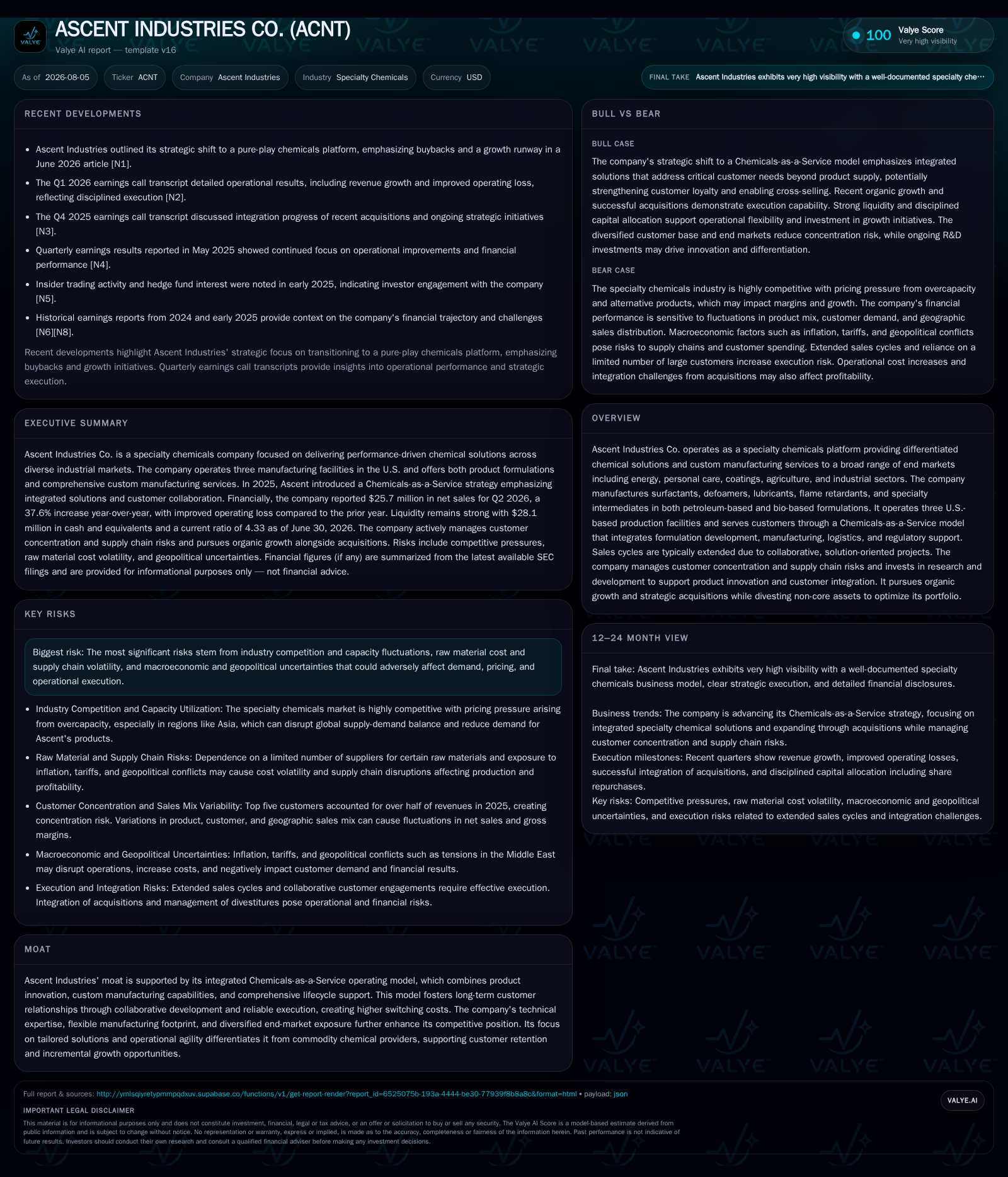
Ascent Industries Co. demonstrated operational resilience in its specialty chemicals segment during Q2 2026, achieving organic sales growth above market peers and successfully integrating a recent acquisition. The company’s Chemicals-as-a-Service (CaaS) model, emphasizing formulation development, custom manufacturing, and lifecycle support, underpins its competitive moat by enabling strong customer retention and collaboration. Key industry headwinds include raw material cost volatility, extended sales cycles, and customer concentration risk. Ascent manages liquidity conservatively with a strong current ratio and no debt outstanding as of mid-2026. Longer-term growth depends on innovation, capacity utilization, and navigating geopolitical trade dynamics.
Recent Operating Update
In its Q2 2026 earnings report filed August 4, Ascent Industries Co. highlighted a pivotal quarter realizing organic growth in its legacy specialty chemicals business that outpaced broader market trends despite persistent macroeconomic headwinds such as raw material inflation and geopolitical trade uncertainties [S2]. This performance reflects disciplined commercial execution and operational rigor in navigating an environment characterized by supply chain volatility and shifting tariff landscapes following the February 2026 Supreme Court ruling on tariffs under IEEPA [S2], [S23]. Additionally, the integration of the recently acquired Midwest Graphic Sales accelerated faster than anticipated, contributing positively to earnings from day one—a testament to Ascent’s operational agility amid consolidation efforts within the sector [S2].
Business Model
Ascent Industries operates as a specialty chemicals platform focused on delivering differentiated chemical formulations combined with extensive value-added services under a Chemicals-as-a-Service (CaaS) model introduced in 2025 [S1]. Rather than competing solely on product sales or commodity pricing, this approach bundles formulation development, custom manufacturing—including reaction chemistry and blending—logistics management, and regulatory support into an integrated offering that deepens customer collaboration at critical lifecycle touchpoints where performance reliability drives switching costs
This business model targets a broad set of end markets such as energy (including oil & gas production chemicals), personal care products, coatings systems, agriculture (agrochemical formulations), water treatment solutions, automotive applications, textile processing aids, pulp and paper industries, industrial cleaning formulations, adhesives/sealants/elastomers (CASE), construction materials, and metalworking fluids [S1]. The company's product portfolio includes surfactants, defoamers, lubricating agents, flame retardants, and specialty intermediates manufactured in both petroleum-based and bio-based variants—addressing evolving sustainability demands while maintaining technical performance standards
Revenue generation derives from selling these specialized chemical ingredients often under long-term collaborative projects characterized by extended sales cycles spanning months or quarters due to necessary lab qualifications and scale-up activities. Customers typically are formulators or industrial manufacturers requiring performance-tailored inputs; thus revenue varies on volume shipped but also heavily depends on successful project development milestones impacting pricing power and contribution margins. Additionally, service fees under contract manufacturing arrangements augment revenue beyond pure product sales.
The company’s three strategically located U.S. production facilities—Cleveland (TN), Fountain Inn (SC), and Danville (VA)—combine customer-dedicated assets with flexible multi-purpose lines capable of multi-step chemical reactions enabling rapid customization. Such flexibility supports cross-application synergies within commercial accounts while optimizing asset utilization rates crucial to margin stability given cyclical capacity risks pervasive in specialty chemical production [S1], [S10].
Industry Structure & Competitive Position
Ascent sits midstream in the chemical value chain between raw material suppliers (petrochemical or bio-based feedstock producers) and downstream industrial/end-user formulators across diversified sectors. The specialty chemicals space is typified by high technical barriers to entry due to formulation complexity, extensive regulatory compliance demands, capital intensity for flexible plant operations, and significant R&D investments needed to stay ahead of rapid technological change.
Peers such as Albemarle Corporation, Huntsman Corporation, and Ashland Global Holdings represent large-scale counterparts in specialty chemicals emphasizing broad product portfolios combined with innovation pipelines. While these peers may have greater scale or geographic breadth including international footprints that can provide some hedging against regional cyclicality or supply disruptions, Ascent competes effectively through its nimble CaaS strategy offering deeper customer integration which creates higher switching costs than commodity commodity-driven players or pure toll manufacturers lacking such services.
However, the company faces typical industry risks including market capacity fluctuations where excess production can depress prices; raw material cost volatility driven by feedstock inflation or supply constraints; competition from both incumbent specialty providers who invest aggressively in new chemistries plus emerging lower-cost producers especially from Asia exerting pricing pressures; customer concentration—with top five customers accounting for ~51% revenue in 2025—which limits revenue predictability; long sales cycle risks accentuated by solution-oriented projects requiring sustained technical collaboration; plus evolving regulatory landscapes pushing green/sustainable product transitions which entail ongoing R&D commitment [S1], [S10].
Growth Drivers
Key drivers for Ascent’s growth encompass structural demand trends toward higher-performance chemical solutions tailored to nuanced application needs across core end markets like personal care (cleaners/toiletries), coatings (industrial/consumer paints), agriculture (efficacy enhancers in crop treatments), energy (oilfield chemical optimization), water treatment technologies addressing stricter standards, automotive component accessories requiring advanced surfactants/lubricants among others.
Equally important is adoption momentum behind the Chemicals-as-a-Service platform itself: customers increasingly favor comprehensive partnerships integrating formulation development through manufacture/delivery enabled by regulatory expertise that minimize their upfront capital footprint yet accelerate time-to-market—this service bundling contributes not only revenue visibility but recurring touchpoints strengthening loyalty given the embedded nature of custom chemistries within client products [S1]
Innovation via steady R&D investments that prioritize biobased alternatives responds directly to consumer preferences for sustainability without compromising functional attributes—an imperative given tightening environmental regulations globally.
Additionally, Ascent’s ability to expand custom manufacturing offerings coupled with potential bolt-on acquisitions enhances scale economies while diversifying product mix away from more commoditized lines improving contribution margins.
Risks & Watchpoints
While execution appears solid recently, several watchpoints warrant attention:
- Raw material input costs remain vulnerable given heightened global inflationary pressures and recent shifts in U.S. trade/tariff policy introducing unpredictability in pricing even with largely domestic sourcing (~95% raw materials from U.S.)[S1], [S23]. Supply chain disruptions linked to geopolitical tensions such as Middle East conflicts could further exacerbate operational continuity risks.
- Industry cyclicality driven by capacity overbuilds especially abroad may pressure pricing steadily if demand softens in critical markets like oil & gas or agriculture.
- Customer concentration risk continues as the top five customers contributed roughly half of revenue last year; any contract renegotiation or loss could materially impact topline stability.
- Long sales cycles inherent to customized solution-oriented projects elevate execution risk—delays or qualification failures with key accounts could defer revenue recognition.
- Technological shifts or emergence of alternative chemistries by competitors that better meet evolving environmental profiles might erode Ascent’s competitive positioning unless R&D pipeline keeps pace.
Furthermore, technical milestones such as new product introductions approved by clients or expansion into adjacent end markets would validate the strategic roadmap's effectiveness accelerating transition toward a higher-value specialty chemical service platform.
Financial Profile Discussion
As of June 30, 2026, Ascent Industries held $28.1 million in cash and equivalents with no outstanding debt reported since at least end-2024, evidencing a conservative financial structure conducive to weathering industry cyclicality without leverage strain [F1]. The current ratio was approximately 4.33x, reflecting solid short-term asset coverage over liabilities inclusive of payables accrued typically from suppliers or lease obligations associated with plant operations [F1].
Operating cash flow usage eased marginally compared to prior periods despite continuing net losses mostly attributable to elevated SG&A expenses linked to strategic investments in personnel expansion alongside technology enhancements supporting CaaS rollouts [S2]. EBITDA showed quarter-to-quarter volatility influenced by amortization increases following acquisitions but generally improves alongside profitability gains noted earlier fiscal-year-to-date results suggesting operating leverage benefits accruing from higher incremental revenues per fixed cost increments
This financial posture affords flexibility for opportunistic M&A activity while supporting near-term organic initiatives without pressure on credit lines or equity dilution.
This analysis is based solely on publicly available information including SEC filings as cited. It does not constitute investment advice but aims to provide an informed view of Ascent Industries Co.'s business dynamics within the context of the specialty chemicals sector.
Disclaimer: This is research-only, informational analysis and not investment advice. It may include AI-generated interpretation and general industry context. Always verify important details using primary sources.

Comments