
Callaway Golf Refocuses on Core Golf Products Amid Supply Chain and Currency Challenges
Callaway’s latest quarterly report highlights operational discipline following divestitures, supply chain vulnerabilities, and currency headwinds impacting margins.
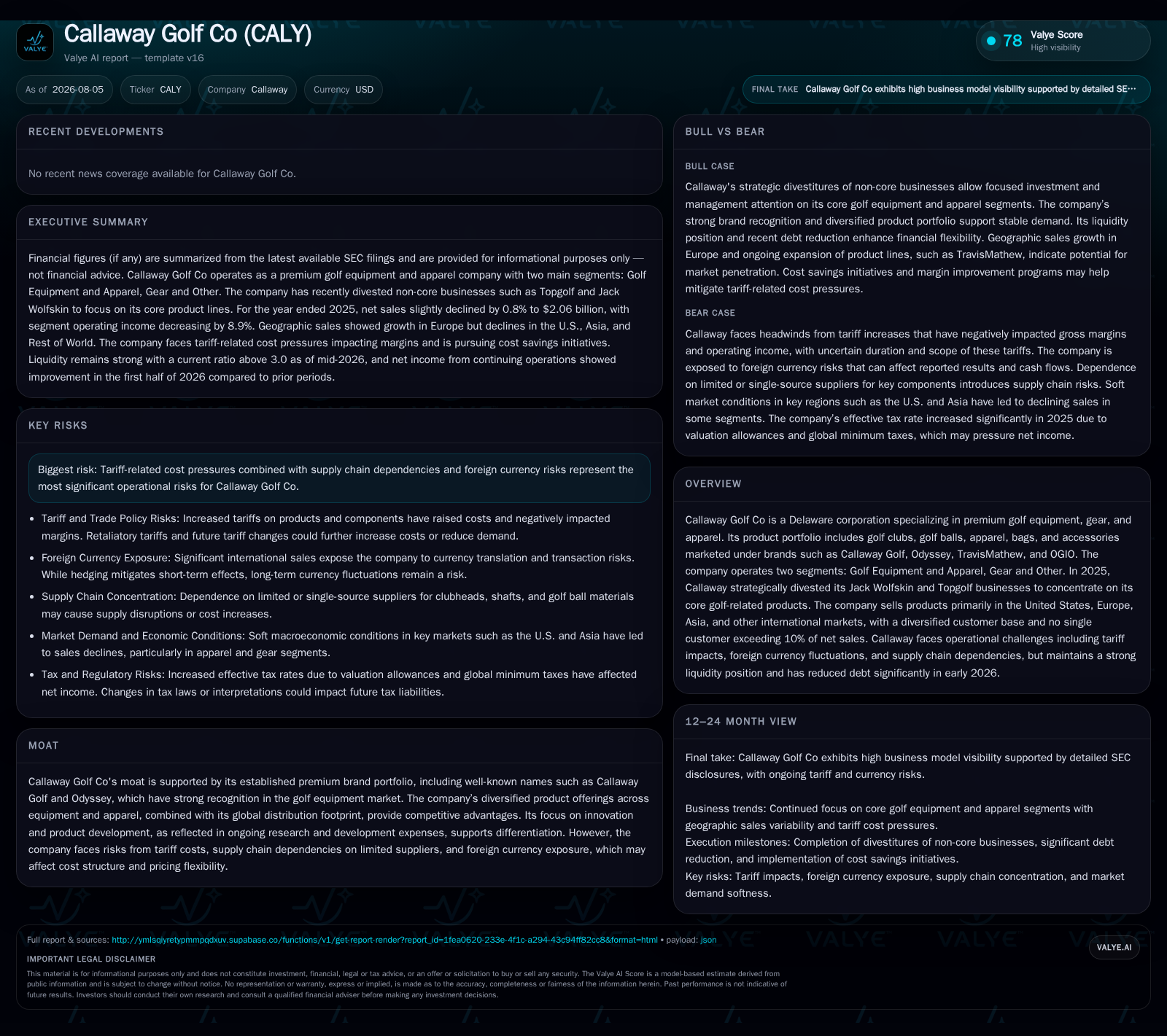
In Q2 2026, Callaway Golf continued its strategic transition by sharpening focus on golf equipment and apparel after divesting non-core assets such as Topgolf and Jack Wolfskin. Despite facing tariff impacts, supply chain constraints, and foreign currency headwinds, the company maintains a strong liquidity position with net cash on hand and low debt. Its diversified brand portfolio, including Callaway Golf, Odyssey, and TravisMathew, supports resilience amid soft market conditions. Key growth drivers include product innovation cycles and expanding direct-to-consumer channels, while risks center on supplier dependencies and geopolitical trade policies.
Recent Operating Update
Callaway Golf Company's second quarter ended June 30, 2026, represents a continuation of its strategic focus on premium golf-related products following significant divestitures of non-core businesses such as Topgolf (January 1, 2026) and Jack Wolfskin (May 31, 2025) [S1][S2]. These moves reflect management's deliberate pivot away from ancillary entertainment segments toward strengthening the company's core competencies in golf equipment and apparel. The Q2 2026 report notably accommodates recently issued FASB standards (ASU 2024-03) for expense disaggregation that may impact future reporting transparency [S2].
Under this refocused structure, Callaway reported incremental deferrals and recognitions within its short-term deferred revenue balance that align with typical seasonal sales dynamics common in golf products [S2]. While headline net sales data for Q2 are not fully disclosed in the filings provided here, segment-level commentary indicates ongoing challenges from tariff impacts and foreign exchange fluctuations that weigh on gross margin rates [S1][S2]. The company’s manufacturing processes remain sensitive to input cost inflation linked to global trade tensions.
Business Model Details
Callaway generates revenue primarily through the design, manufacturing, marketing, and sale of golf clubs, golf balls, apparel, bags, shoes, and related accessories under established brands such as Callaway Golf, Odyssey (putters), TravisMathew (lifestyle apparel), and OGIO (bags/accessories) [S1]. The business segments include Golf Equipment as well as Apparel, Gear & Other. Revenue streams derive from wholesale distribution to specialty sporting goods retailers globally—covering the U.S., Europe, and Asia—and increasingly from direct-to-consumer channels including proprietary retail stores (especially TravisMathew locations) and e-commerce platforms [S1].
Pricing mechanisms leverage Callaway’s strong brand equity to command premium pricing points with a focus on innovation cycles driven by R&D investments translating into new club materials or ball technologies that often define each product generation [S1][S25]. This product innovation cadence influences inventory turnover rates—a key KPI—whereby fast adoption of new models mitigates obsolescence risks.
Margins are shaped materially by tariff costs imposed on imported components or finished goods alongside foreign currency exchange rates given roughly one-third of net sales occur outside the U.S. [S10]. Effective price realization depends on balancing competitive pricing pressures against these input cost fluctuations while preserving premium positioning.
Industry Structure and Competitive Position
The golf equipment industry includes peers such as Titleist (Acushnet Holdings), TaylorMade Golf, FootJoy (apparel/footwear), plus historically Nike Golf before its exit from equipment. Callaway occupies a differentiated position through its diversified brand portfolio catering both to traditional golfers focused on performance clubs/balls (Callaway Golf & Odyssey) and lifestyle consumers pursuing fashion-forward apparel (TravisMathew).
Competition is intense along technological innovation lines—advances in materials science or clubhead aerodynamics can shift market share quickly. Furthermore, consumer discretionary spending cycles influence volumes due to the sport's leisure orientation.
Distribution channels typically comprise wholesale accounts plus growing direct sales formats [S1]. Callaway’s comparatively robust direct-to-consumer footprint via owned retail stores (63 TravisMathew stores in the U.S., plus additional Callaway-branded retail points internationally) enhances customer engagement and margin capture versus pure wholesale reliance
Growth Drivers
Key drivers include sustained global participation gains in golf supported by demographic tailwinds such as aging populations with disposable income coupled with modest growth among younger players intrigued by modernized brand offerings. Callaway's investment in product development is pivotal; continued R&D funding facilitates differentiation through cutting-edge club technology or advanced ball composition enhancing performance metrics valued by golfers.
The expanded focus on direct-to-consumer initiatives—e-commerce platforms coupled with branded retail locations—offers higher margin sales opportunities while allowing for richer customer data capture aiding targeted marketing campaigns.
Geographically diversified revenues help mitigate localized market softness; Asia represents a notable growth vector despite challenges from macroeconomic softness reported in Q2 apparel sales primarily driven by weaker demand in Asia-Pacific markets [S1]. Meanwhile seasonal demand patterns keep inventory turnover a priority metric especially ahead of peak golfing periods.
Risks and Constraints
Supply chain fragility poses one of Callaway's most significant operational risks due largely to reliance on single or limited suppliers for specialized components such as clubheads or customized materials for balls. Any disruption there could delay product launches or increase costs unpredictably [S10]. Tariffs remain an ongoing concern affecting raw material inputs or finished product imports across major markets.
Foreign currency volatility affects reported results due to a substantial portion of international sales; adverse movements can erode gross margins especially where local pricing lacks full pass-through flexibility.
Macroeconomic conditions affecting discretionary spending can depress demand for higher-priced equipment or luxury apparel lines. Seasonality exacerbates this risk given concentrated sales windows aligned with golfing seasons.
Competitive intensity requires continuous innovation investment; failure to keep pace could erode brand relevance over time. Additionally, inventory management is critical to avoid build-up risking markdowns or obsolescence amidst rapid product iterations.
What to Watch Next
Investors should monitor subsequent quarterly disclosures for updates on:
- Segment revenue trends by category (clubs vs apparel) especially recovery signals post macro softness.
- Gross margin stabilization reflecting tariff mitigation efforts or supply chain improvements.
- Same-store sales performance at retail locations coupled with expansion or contraction plans for proprietary stores.
- R&D expense trajectories signaling innovation pipeline strength.
- Changes in distribution channel mix emphasizing lift from direct-to-consumer channels versus wholesale partners.
- Foreign currency translation impacts amid evolving global economic conditions.
- Capital allocation updates particularly regarding share repurchases under the new authorization program announced early 2026 [S11]
Financial Profile Discussion
As of June 30, 2026, Callaway maintained $278 million in cash and cash equivalents against nominal debt approximating $7.7 million resulting in a net cash position exceeding $270 million—a marked improvement facilitated by proceeds from prior divestitures including the partial sale of Topgolf operations completed January 2026 [F1][S5][S15]. The current ratio stands strong at approximately 3.04 times reflecting solid near-term liquidity buffers relative to current liabilities [F1].
Long-term leverage risk has been reduced substantially since years prior when debt levels were elevated due to acquisition financing burdens. Interest expenses have moderated accordingly supporting improved bottom-line flexibility [S6][S13]. Capital expenditures reflect ongoing investment in manufacturing capabilities aligned with core golf products rather than non-core diversification.
Overall financial resilience positions Callaway well to weather intermittent disruptions while pursuing strategic growth initiatives targeting profitable market share expansion within its premium golf equipment niche.
This analysis is based solely on publicly available filings as of August 2026 without predictive statements or investment research views. It contextualizes Callaway Golf Company's positioning within broader industry dynamics emphasizing operational factors influencing performance under current economic conditions.
Disclaimer: This is research-only, informational analysis and not investment advice. It may include AI-generated interpretation and general industry context. Always verify important details using primary sources.

Comments