
IDACORP’s Earnings Stability Hinges on Regulatory Outcomes and Capital Spending Plans
IDACORP’s Q2 2026 update underscores regulatory-driven revenue mechanics and strategic asset management in its regulated utility operations.
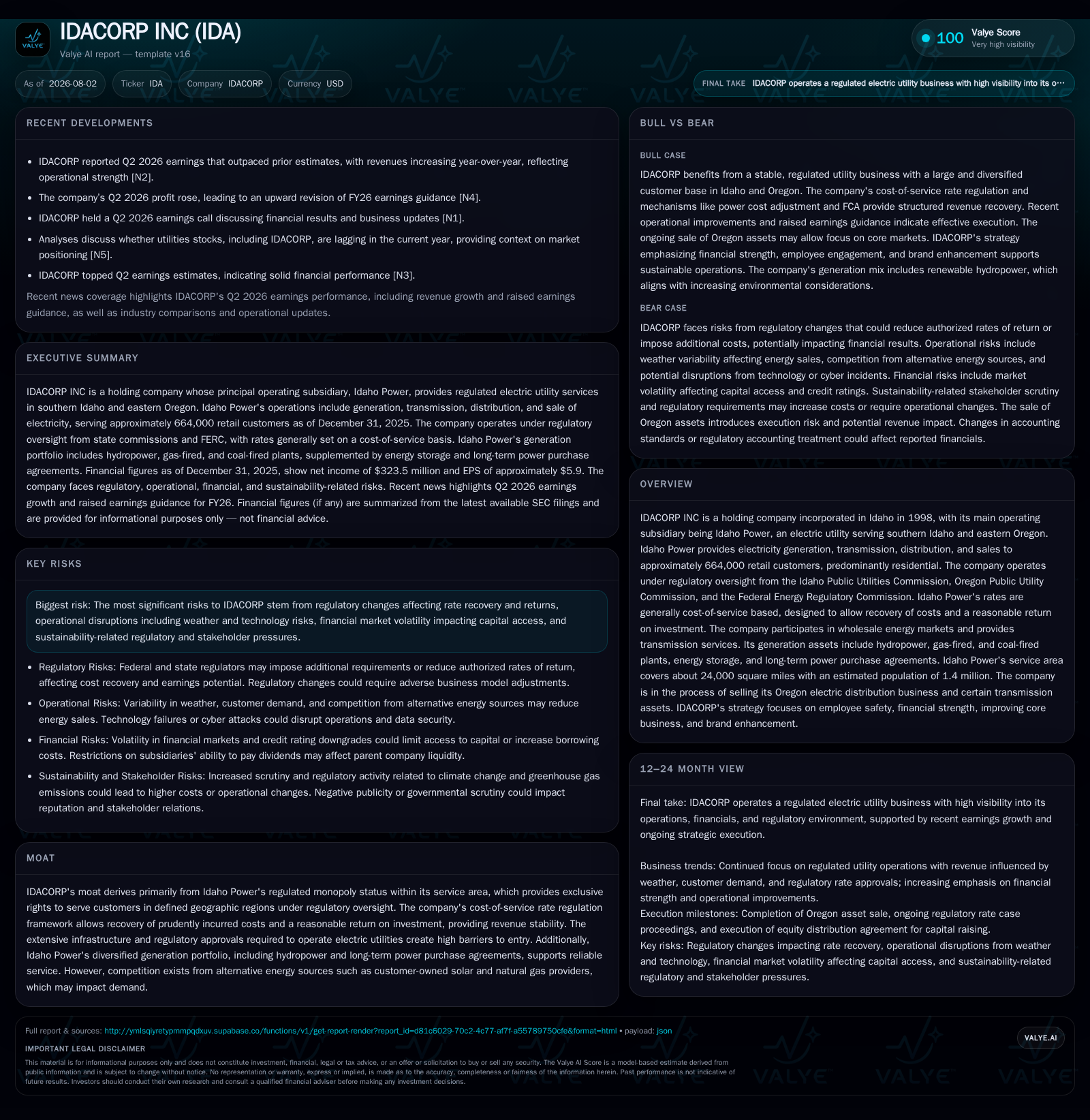
IDACORP, through its principal subsidiary Idaho Power, reported strong Q2 2026 earnings exceeding estimates, driven by cost-of-service regulated rates and managed operational performance. The company operates a vertically integrated electric utility serving over 660,000 customers with a diversified generation portfolio dominated by hydropower. Ongoing regulatory lag and recent rate cases highlight revenue timing risks but also opportunities for rate base growth. The announced sale of Oregon assets is a notable strategic move affecting future operational focus. Key challenges remain regulatory approvals, capital market conditions, and evolving energy demand patterns in the region.
Recent Operating Update
IDACORP's Q2 2026 filings confirm second-quarter earnings surpassed analyst expectations. This outperformance was driven by higher retail electricity sales within its regulated service territory and stable transmission service revenues governed under FERC tariffs [S2][S3][N2][N3]. Serving roughly 664,000 retail customers as of end-2025—mostly residential—Idaho Power benefits from steady underlying demand fundamentals anchored in its monopoly franchise areas across southern Idaho and eastern Oregon [S1][S26].
The company operates under a multi-jurisdictional regulatory framework involving the Idaho Public Utilities Commission (IPUC), the Oregon Public Utility Commission (OPUC), and the Federal Energy Regulatory Commission (FERC). These bodies approve rates designed to allow recovery of prudently incurred costs plus a reasonable return on invested capital (ROE). However, "regulatory lag"—the delay between expense incurrence and cost recovery through rates—introduces timing volatility that influences earnings and cash flow dynamics [S1][S18][S24]. Recent rate cases filed between 2023-2025 in both Idaho and Oregon seek to address rising infrastructure investment needs and compliance-related expenses.
Business Model Overview
IDACORP functions primarily as a holding company with Idaho Power as its core operating subsidiary. Idaho Power is a vertically integrated regulated electric utility managing generation assets—including predominantly hydroelectric facilities supplemented by coal-fired and natural gas plants—alongside transmission networks, distribution systems, and retail sales operations within its defined service territory [S1][S26]
Revenue generation largely depends on cost-of-service regulation whereby rates are established to cover operating expenses including depreciation while providing an authorized ROE on capital deployed in the rate base [S1][S24]. Wholesale energy sales contribute supplementary income but remain secondary to retail operations. The company utilizes tariff riders and power cost adjustment mechanisms to reconcile actual fuel costs against those embedded in base rates, moderating exposure to commodity price fluctuations but adding complexity to quarterly financial results
Industry Structure and Competitive Position
Idaho Power holds exclusive franchise rights within its service area granted through certificates of public convenience from regulators covering approximately 25 counties in Idaho and three in Oregon across about 24,000 square miles [S26][S28]. This natural monopoly status underpins high entry barriers protecting revenue stability.
The generation portfolio’s hydropower dominance provides low-cost baseload capacity that enhances reliability while fossil fuel plants address peak demands or intermittency [S1]. Long-term power purchase agreements further diversify supply sources mitigating fuel price volatility risks
Distributed energy resources such as customer-owned solar pose emerging challenges by potentially reducing net retail consumption. Regulatory frameworks currently mitigate revenue erosion through fixed charges or alternative tariff structures designed to preserve essential fixed-cost recovery.
Comparable peers include Duke Energy and Pacific Gas & Electric, which face analogous challenges like infrastructure modernization demands, shifting load profiles, regulatory scrutiny over allowed returns, and renewable integration.
Growth Drivers
Growth prospects are linked to population expansion and economic development within the service territory driving increased electricity load demand. Residential consumption correlates with demographic trends while commercial/industrial growth stems from sectors like food processing, manufacturing, healthcare, and government services prevalent locally [S1].
Electrification trends—including electric vehicle adoption and heating electrification—offer long-term upside for kilowatt-hour sales despite countervailing energy efficiency initiatives.
Ongoing capital investments targeting grid modernization—such as smart grid deployment—improve operational efficiency while facilitating integration of renewables mandated by environmental policy objectives.
Regulatory approvals enabling additions to the rate base through new infrastructure projects or system upgrades are critical growth enablers reflected in future authorized rates.
Risks and Watchpoints
The foremost risk lies in the regulatory environment. Rate case outcomes directly influence allowed ROEs—a pivotal determinant of shareholder returns—and delays inherent in regulatory lag affect cash flow timing.
Disallowance of costs deemed imprudent or unfavorable ratemaking methodologies could materially impact profitability. Additionally, increasing environmental compliance demands may elevate operating expenses.
Operational risks include weather-induced disruptions affecting hydroelectric output or transmission reliability leading to outages requiring costly remediation or penalties if performance standards are breached [S20].
Capital markets conditions affect Idaho Power’s ability to finance large projects within existing credit covenants that enforce leverage limits designed to maintain credit quality.
Competitive pressures from distributed resources persist as a structural challenge despite current regulatory measures preserving revenue integrity for utilities like Idaho Power.
What to Watch Next
Key upcoming events include resolution of pending rate cases in Idaho and Oregon anticipated throughout 2026 which will clarify allowed returns on infrastructure investments impacting future earnings.
Progress on the planned sale of Oregon electric distribution assets finalized earlier this year will reshape IDACORP’s geographic footprint potentially simplifying cross-state regulatory complexity [S28]
Monitoring seasonal load demand patterns versus historical trends will provide insights into regional economic health.
Operational metrics such as transmission system availability or outage frequency remain important indicators of infrastructure resilience amid Pacific Northwest weather volatility.
Financial Profile Discussion
Revolving credit facilities totaling $500 million ($100 million at IDACORP level; $400 million at Idaho Power) provide liquidity buffers subject to financial covenants limiting leverage ratios critical for maintaining credit ratings required for capital access [S12][S27]. Regulatory approval processes constrain rapid capital raising capabilities making prudent liquidity management essential.
Dividend distributions depend heavily on Idaho Power generating sufficient distributable cash flow constrained by regulatory timing of cost recoveries [S9]
Interest expense sensitivity linked to floating-rate borrowings introduces earnings variability risk amid fluctuating interest rate environments impacting overall financial costs.
This analysis synthesizes IDACORP's latest public filings alongside sector fundamentals without providing investment advice.
Disclaimer: This is research-only, informational analysis and not investment advice. It may include AI-generated interpretation and general industry context. Always verify important details using primary sources.

Comments