
CCC Solves Insurance Workflow Complexity with Scale and AI Integration
CCC’s latest quarter showcases its growing insurance technology platform leveraging network effects and AI-driven automation to enhance operational efficiency.
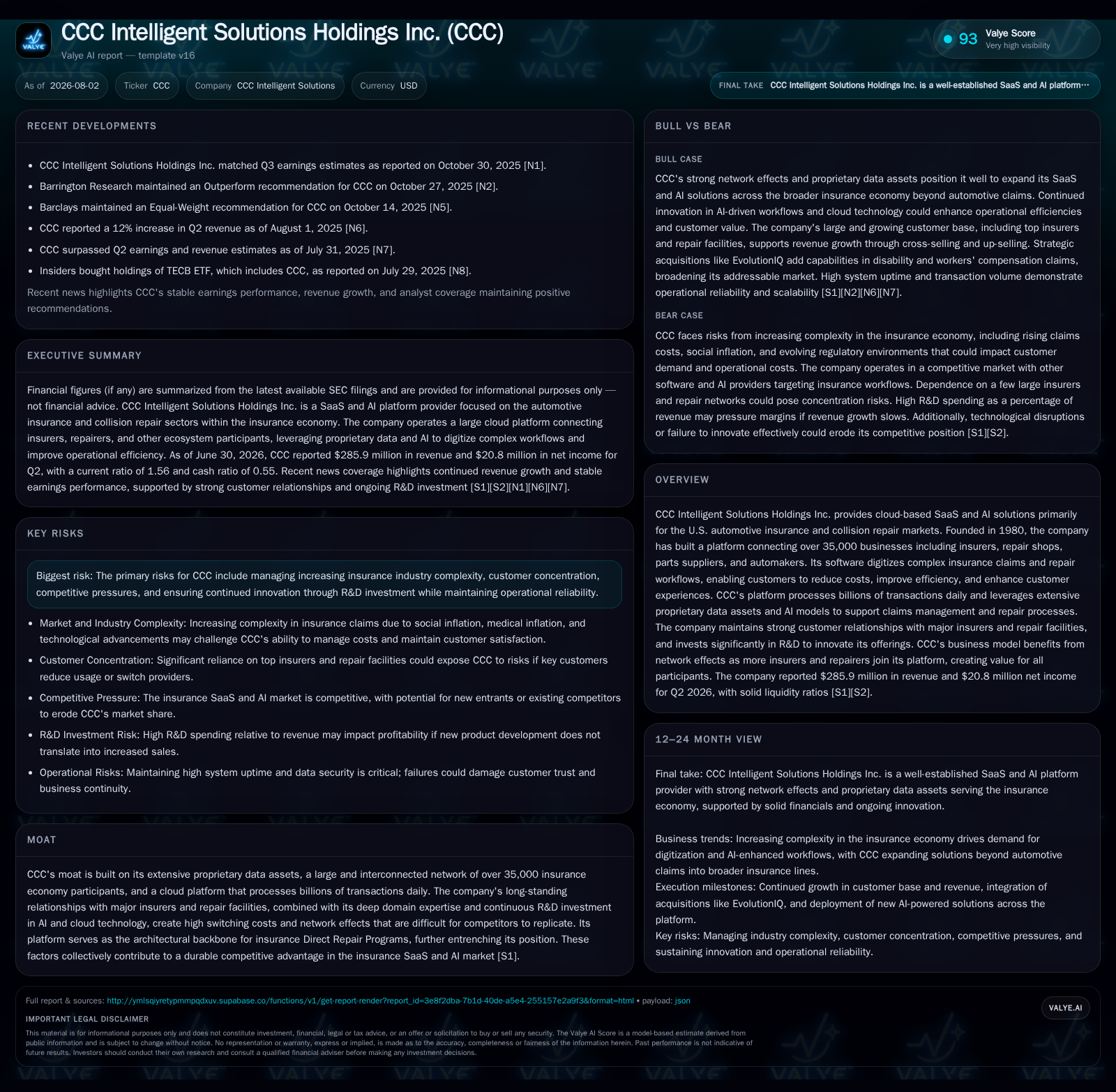
In its Q2 2026 filings, CCC Intelligent Solutions Holdings Inc. reinforced its position as a central SaaS and AI platform provider in the automotive insurance and collision repair ecosystem, connecting over 300 insurers and more than 30,500 repair facilities [S2][F1]. The company’s scale enables strong network effects integral to its Direct Repair Program (DRP) backbone, driving recurring subscription revenue and customer retention [S1]. CCC continues to invest significantly in AI-powered workflow automation and R&D expansion, supporting operational efficiencies and enhanced claims management [S1]. However, risks remain around customer concentration, pricing pressures from major insurers, and technology integration complexity [S1][S2]. The upcoming quarters will be critical to monitor contract renewals and further ecosystem growth amid these dynamics.
Quarterly Operating Update Highlights Platform Scale and Innovation Trajectory
CCC's Q2 2026 filings reveal sustained growth in its insurance technology cloud platform ecosystem. As of June 30, CCC connected over 300 insurance carriers alongside roughly 30,500 collision repair facilities — a testament to the expanding scale vital for network effects in its multi-sided architecture [S2][S1]. These participants transact billions annually through CCC's cloud infrastructure that digitizes complex claims processing and vehicle repair workflows. Significantly, subscription renewal rates remain robust, supporting recurring revenue streams fundamentally tied to user volume across insurers and repair shops. This expansion reflects growing industry adoption of automated SaaS solutions amidst increasing pressure for operational efficiency across the U.S. automotive insurance sector [F1][S2].
Simultaneously, CCC continues prioritizing research and development; investments target enhancements in AI capabilities—such as predictive analytics for fraud detection—and platform scalability improvements aligned with evolving regulatory compliance demands. This consistent R&D expenditure underpins CCC’s strategy to broaden product breadth while maintaining reliability and security within a highly mission-critical environment where downtime or errors can have outsized cost impacts on customers [S1][S2]. The sustained scaling of both connected users and transaction volume concretely signals strengthening network effects that are key to CCC's durable competitive positioning.
Strategic Value in Connecting Insurers and Repairers Through DRPs
A cornerstone of CCC's platform dominance lies in its pioneering role in Direct Repair Programs (DRPs), which it began developing in the early 1990s. DRPs facilitate insurer-to-repairer connectivity enabling coordinated workflow management that yields cost efficiencies and quality improvements on both sides of claims adjudication [S1]. This "many-to-many" connection framework creates significant switching barriers for customers—insurers rely on CCC’s data-driven orchestration to administer these programs effectively while repair shops depend on seamless platform interactions to secure steady business flow.
The network effect induced by DRPs feeds into recurring software license adoption because insurers prefer the largest connected networks where maximized shop participation enhances program value. Conversely, collision shops benefit disproportionately when multiple insurers use the same system as it consolidates operational complexities. Hence, CCC's control of this architectural backbone reinforces lock-in dynamics that stabilize revenue visibility across its clientele base even as individual contract durations average three to five years within this ecosystem [S1]
AI-Powered Automation Drives Operational Efficiency Across the Insurance Ecosystem
CCC leverages proprietary artificial intelligence models integrated into its SaaS suite to streamline claims settlement cycles while mitigating leakage risk through automated fraud detection algorithms. With upwards of 400 developed AI models deployed at scale across more than 125 insurer clients and 15,000 collision repair shops, CCC harnesses vast historical data exceeding $2 trillion worth of processed transactions to deliver precise analytics informing decision-making processes [S1].
This intelligent automation reduces manual intervention needs thereby lowering operational costs for insurers while improving throughput quality at repair facilities. It also enhances customer experience by accelerating claims closure times—a critical KPI given how protracted claims can erode insurer satisfaction metrics. While exact transactional performance gains remain proprietary, CCC's continued emphasis on expanding AI integration indicates material progress towards deeper workflow digitization that aligns with broader industry digitization trends.
Competitive Set Dynamics: CCC's Network Moat Compared to Industry Peers
Within the insurance technology software space, CCC stands apart from peers such as Guidewire Software or Mitchell International largely by virtue of its network-centric approach emphasizing many-to-many DRP connections versus single-customer-focused core system implementations typical among some legacy providers. While competitors offer strong claims lifecycle management tools or repair estimating modules individually, CCC distinguishes itself through an encompassing ecosystem that engages insurers, repairers, parts suppliers, and automakers simultaneously on a shared cloud platform orchestrating collaboration at scale.
Moreover, unlike peers who may rely more heavily on integrating with legacy infrastructure or operate narrower product suites, CCC invests aggressively in advanced AI capabilities embedded natively within its multi-tenant architecture—creating an ongoing innovation moat custom tailored to the distinct operational friction points facing auto insurance claimants today. This layered differentiation consolidates CCC's position as an indispensable vendor within complex U.S. automotive insurance networks rather than merely another software supplier targeting isolated functions.
Key Growth Catalysts: Digital Transformation, AI Adoption, and Platform Expansion
Several structural drivers undergird potential growth avenues for CCC beyond current footprint consolidation. Increasing regulatory mandates compelling digital recordkeeping amplify demand for modernized claims platforms capable of complex reporting requirements. Simultaneously, widespread adoption of Direct Repair Programs grows as insurers seek scalable partnership frameworks facilitating cost containment amid rising vehicle complexity.
Furthermore, accelerating uptake of AI-powered applications across fraud detection and automated damage appraisals expands wallet share opportunities by cross-selling new modules atop the foundational SaaS licenses already prevalent among long-tenured clients [S1]. The ongoing transition in the industry from traditional on-premise systems towards cloud-native platforms also plays to CCC’s strengths given its mature multi-tenant deployment strategy designed for agile feature rollout with minimal disruption.
Network effects reinforce platform value proposition: each additional insurer or shop joining not only increases participant count but enriches overall data pooling enabling tighter algorithmic insights enhancing efficiency benefits for all users involved—demonstrating virtuous cycles that widen competitive lead over newer market entrants offering narrower or less integrated solutions.
Risks Focused on Customer Concentration, Pricing Pressures, and Technology Evolution
Despite robust positioning, significant risks remain explicitly noted in recent filings regarding dependence on a concentrated set of large insurers responsible for meaningful portions of revenue [S1][S2]
This dynamic exacerbates margin compression potential particularly given elevated R&D spend levels required to keep pace technologically in a rapidly evolving sector reliant on continual innovation cycles in AI model refinement and cloud infrastructure upgrades. Moreover integration challenges inherent in accommodating legacy insurer IT environments while simultaneously rolling out sophisticated new workflows introduce execution complexities that could impact customer satisfaction or delay time-to-market for enhanced features.
Customer contracts typically run three to five years but may be cancellable post-term relatively quickly indicating renewal cycles represent critical milestones where business retention risk manifests directly tied to competitive intensity among insurtech vendors attempting footprint expansion within incumbent relationships.
Upcoming Milestones: Renewal Trends, Network Expansion Metrics, and R&D Outcomes
Looking ahead into forthcoming quarters as part of normal SEC reporting cadence will be key indicators validating whether GCC sustains momentum across core ecosystem KPIs: renewal rates among large insurer contracts; addition pace of connected repair facilities; transaction volume growth trajectories; plus tangible deployments stemming from ongoing R&D initiatives notably relating to new AI-driven modules targeting operational bottlenecks or regulatory reporting enhancements.
Updates surrounding successful integration wins particularly with evolving losses adjusters’ workflows or novel digital commerce partnerships embedded inside DRPs will further substantiate platform stickiness beyond existing contractual terms thereby signaling quality growth consistency.[S2][S3]
Financial Profile Discussion
As of June 30, 2026, CCC reported cash & equivalents totaling $115.9 million against total current assets near $330.6 million versus current liabilities approximating $212.2 million—yielding a stable current ratio around 1.56 indicative of prudent short-term liquidity management supportive of ongoing operations including sizeable R&D outlays [F1][S2]. Net debt stood at approximately $1.175 billion (total debt $1.29 billion less cash), reflecting leverage levels that require careful capital allocation decisions balancing innovation investments with financial discipline [F1].
This financial structure underscores a reliance on steady operating cash flows generated from subscription renewals coupled with usage-based fees tied closely to escalating transaction volumes processed daily through the platform—factors pivotal in funding continuous technological advancement needed to uphold market leadership.
Disclaimer: This analysis is based solely on publicly available SEC filings dated through July 2026 and company facts data points as cited; it does not constitute investment advice or an endorsement of any securities.
Disclaimer: This is research-only, informational analysis and not investment advice. It may include AI-generated interpretation and general industry context. Always verify important details using primary sources.

Comments