
Franklin Resources’ Record AUM and Digital Push Boost Q3 Trajectory
Franklin Resources posted record assets under management and advanced its digital asset management initiative in Q3 2026, strengthening its recurring revenue base amid market volatility.
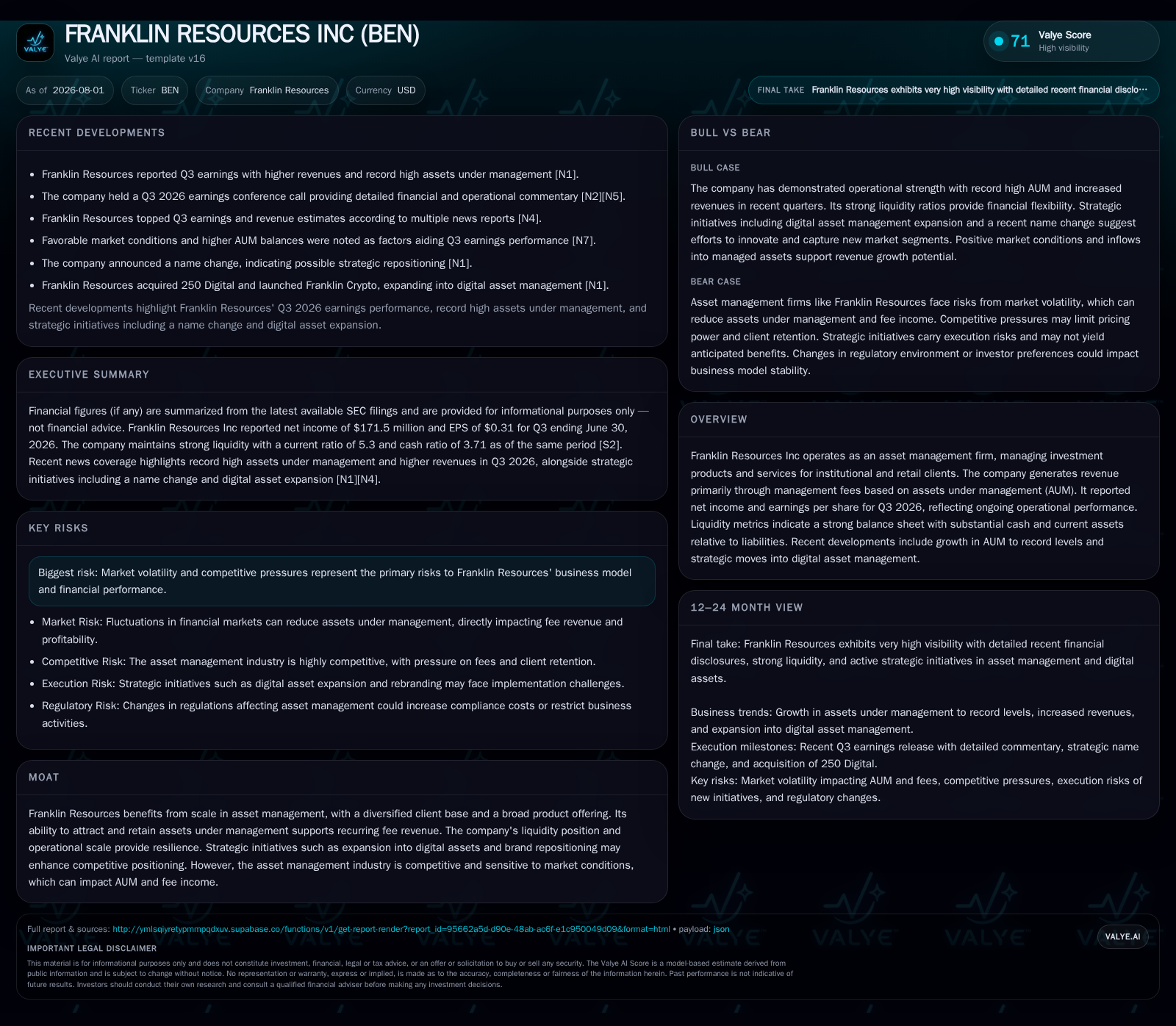
In its Q3 2026 filing, Franklin Resources reported a new record high in assets under management (AUM), supported by favorable market conditions and net inflows that have driven management fee growth and earnings beats. The company continues to leverage its diversified client base across institutional and retail segments, while advancing digital asset management capabilities as a strategic growth lever. Despite persistent industry-wide fee compression and market sensitivity, Franklin's strong liquidity and low net debt position provide operational flexibility to sustain investments. Key upcoming milestones include monitoring net flow trends and the impact of new product rollouts on margin expansion.
Q3 Surges: Record Assets Under Management Propel Revenue Gains
Franklin Resources' Q3 2026 operating results demonstrate meaningful momentum with assets under management (AUM) reaching unprecedented levels. This growth was driven by market appreciation combined with positive net inflows, directly lifting management fee revenue. Fee income for the quarter exceeded analyst consensus due to this elevated AUM base, illustrating how scale accentuates top-line stability in asset management businesses dependent on fee percentages applied to managed assets. Despite recent bouts of volatility in global markets during the quarter, Franklin's diverse product lineup has enabled it to sustain inflows from both institutional and retail segments [S2][N1][N4]. This resilience underscores the elasticity of recurring fees amid market gyrations and reflects successful client retention strategies.
Building Recurring Fee Base: Customer Segments, Fund Performance, and Retention
The company’s revenue model largely hinges on recurring management fees that are linked proportionally to AUM size. Franklin segments its clientele into institutional investors—such as pension funds, endowments, and insurers—and retail investors through mutual funds and retirement platforms. Institutionally focused mandates tend to offer steadier fee income with longer contract durations but occasionally at slightly lower fee yields due to competitive bidding pressures. On the other hand, the retail channel offers scale benefits but with increased sensitivity to fund performance cycles influencing inflows or redemptions.
Fund performance relative to benchmark indices remains a pivotal determinant of both net flows and client retention rates [S1][S2]. Franklin has emphasized investment performance as a core retention tool to mitigate outflows stemming from fee compression or shifting customer preferences. Its ability to maintain competitive fund returns enhances stickiness in assets under management—helping shield fees from abrupt declines even when market valuations fluctuate broadly. This dynamic is central for the operating leverage embedded in fixed-cost structures typical of asset managers
Industry Dynamics: Fee Pressure, Competitive Scale, and Product Diversification
Franklin operates within an intensely competitive marketplace typified by large diversified asset managers such as BlackRock and Vanguard who command vast scale advantages. Alongside these giants are numerous boutique firms agile in specialized or alternative strategies. Across this landscape, secular headwinds include persistent fee compression driven by passive investing trends, regulatory scrutiny on pricing transparency, and clients’ heightened cost-consciousness.
Scale is weaponized not just for cost efficiencies but also for negotiation leverage over distribution channels and technology investments. Franklin’s broad product suite spanning equities, fixed income, alternatives, and increasingly thematic or ESG vehicles offers differentiated appeal but is not immune to pricing pressures across categories.
By extending into alternative investments and maintaining competitive expense ratios relative to peers, Franklin aims to preserve operating margins despite lower average fee yields industry-wide. Managing expense discipline while investing in innovation constitutes an ongoing balancing act essential for sustaining profitability thresholds in this environment [S1].
Digital Asset Management: Emerging Growth Vector within Franklin’s Portfolio
A notable strategic pivot highlighted in recent disclosures is Franklin’s accelerated push into digital asset management—covering cryptocurrency exposure alongside fintech-enabled investment platforms. This initiative seeks to capture next-generation investor demand trends tied to digitization of financial services.
Digital asset offerings can command distinct fee structures potentially higher than traditional mutual funds given their novelty and operational complexity. They also attract younger demographics often underserved by legacy products. However, their contribution toward total AUM remains nascent relative to core lines but displays clear upside if adoption accelerates.
Monitoring client uptake metrics for these digital initiatives will be crucial for validating their materiality as a diversified revenue stream complementing conventional portfolio management services [S2]. Success here would deepen Franklin’s value proposition by blending heritage expertise with fintech agility—a necessary evolution given broad fintech disruption sweeping the asset management sector worldwide
Risks That Could Impede Growth: Market Volatility, Fee Compression, and Regulation
Despite positive near-term trends, inherent risks persist that are emblematic of the wider industry challenges facing asset managers like Franklin Resources.
Foremost among these is market volatility which directly impacts AUM valuations and consequently fee revenues—introducing earnings uncertainty especially where performance fees form a material component. Moreover, cyclical economic downturns can trigger net outflows as clients seek liquidity or rebalance away from active strategies.
Fee pressure driven by competition from passive products or discount brokers can compress margins further if not offset by scale or innovation-led pricing power enhancements. Finally, evolving regulatory landscapes impose compliance costs plus frequent disclosure updates that may alter product viability or customer attractiveness.
Collectively these factors dictate close attention to quarterly flow data alongside regulatory policy developments as leading indicators for sustained financial health amid this challenging operating backdrop [S2][S4].
Key Milestones Ahead: Net Flow Trends, Product Launches, and Margin Targets
Looking forward into upcoming fiscal periods several operational markers will help clarify whether Franklin’s current trajectory reflects durable growth or temporary cycles.
First is sustaining positive net inflows particularly onto newer digital platforms or alternative product lines which would attest both commercial execution effectiveness and expanding addressable market reach.
Second are margin metrics capturing both expense control outcomes amidst fee compression pressures plus incremental profitability gains springing from higher-margin offerings.
Finally forthcoming product launches or enhancements aimed at bolstering fund performance benchmarks will be pivotal retention levers influencing organic AUM growth patterns [S3][N2]. Public commentary plus earnings call disclosures in subsequent quarters will provide transparency against these progression vectors thus serving as useful barometers for evolving business momentum
Financial Position Discussion: Liquidity Strength Supports Strategic Flexibility
From a financial vantage point Franklin Resources benefits from robust liquidity providing significant maneuverability around operational needs and strategic deployments.
Moreover net debt stands negative due primarily to abundant cash reserves overshadowing total debt near $2.4 billion also consistent with manageable leverage levels reflecting conservative capital structure policies.
This healthy balance sheet foundation empowers continued investments into digital innovation while sustaining shareholder distributions without compromising flexibility during periods of market turmoil or tactical repositioning necessities.
This analysis is based solely on publicly available information from SEC filings and verified news sources; no proprietary company forecasts have been used. The discussion aims purely at understanding business dynamics without offering investment research views.
Disclaimer: This is research-only, informational analysis and not investment advice. It may include AI-generated interpretation and general industry context. Always verify important details using primary sources.

Comments