
Rithm Property Trust’s Short-Term Residential Loans Drive Strategic CRE Focus Amid Financing Challenges
Recent quarterly disclosures highlight Rithm Property Trust’s operational emphasis on Residential Transition Loans and capital structure dynamics within a shifting credit environment.
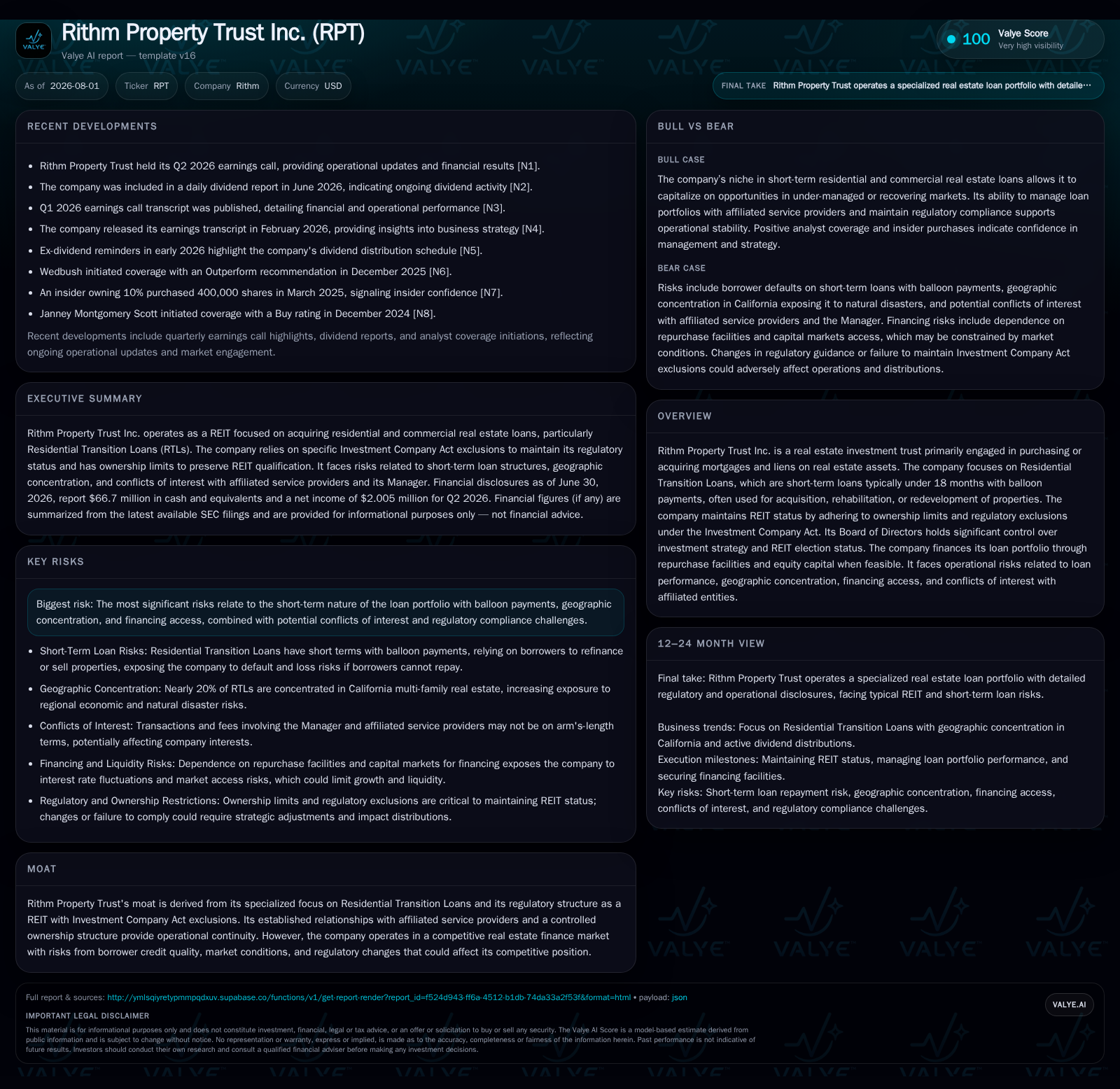
Rithm Property Trust Inc. operates as a real estate finance REIT specializing in short-term Residential Transition Loans (RTLs) predominantly under 18 months with balloon payments, targeting acquisition, renovation, and redevelopment finance. Its latest quarterly filings emphasize the risks inherent to these short-duration loans amid uncertain refinancing markets and the critical role of repurchase financing agreements and secured bonds payable in its capital structure. While the company leverages regulatory exclusions under the Investment Company Act for operational flexibility, challenges remain around loan performance risk, geographic concentration, and capital access. Management's recent decision to forego equity raises signals ongoing cautiousness about market conditions, underscoring the importance of maintaining liquidity and balancing debt maturities. Going forward, monitoring the company’s ability to finance future advances on construction loans and refinance maturing facilities will be key to assessing portfolio stability and distribution sustainability.
Recent Operating Update
Rithm Property Trust Inc.’s second quarter 2026 filing highlights ongoing operational focus on Residential Transition Loans (RTLs), which constitute short-term mortgage instruments with balloon payments usually maturing within eighteen months [S2]. This loan type is central to their business model but carries significant refinancing risk because repayment depends heavily on borrowers securing permanent financing or selling collateral properties within that timeframe. The June 2026 quarter emphasized this risk during tightening credit markets where rising interest rates challenge borrower refinancing options [S2]. Additionally, construction and renovation loans augment portfolio complexity; cost overruns or delays can increase the probability of non-payment or collateral shortfalls [S2].
The company's cash position at quarter-end was approximately $66.7 million against total debt near $119 million (net leverage approx. $52.5 million), signaling moderate leverage that management must manage prudently given recent credit market volatility [F1][S9][S10]. Crucially, management chose not to proceed with planned equity raises during early and mid-2026 citing unfavorable issuance pricing—a cautionary signal regarding capital markets for externally managed REITs focusing on real estate finance [S10].
Business Model
Rithm operates as an externally managed REIT specializing in acquiring and managing portfolios of residential mortgage loans primarily structured as short-duration RTLs aimed at property transition periods such as acquisitions requiring rapid rehab or redevelopment before resale or refinancing [S1]. Revenue derives predominantly from interest income on these mortgage loans and associated fees including servicing income through affiliated servicers under dedicated contracts modeled for operational continuity since June 2024 [S1]. The REIT maintains compliance with Investment Company Act exclusions—mainly Section 3(c)(5)(C)—which mandate specific asset composition thresholds of qualifying real estate assets or liens to avoid investment company registration that would impose restrictive constraints on capital structure and transactions [S1].
Financing occurs mostly via repurchase agreements whereby Rithm sells pools of mortgage loans to counterparties concurrently agreeing to repurchase them later at a higher price (reflecting interest expense). This allows short-term borrowings using loan pools as collateral typically advancing between 75%–90% of loan acquisition price. Secured bonds payable emerge from securitizing whole loan portfolios into rated notes issued by special purpose trusts guaranteeing repayment primarily through mortgage cash flows rather than recourse to corporate assets [S4][S6][S8][S11]
The company must distribute at least 90% of taxable income annually to maintain REIT status, thereby limiting retained earnings for reinvestment but enabling tax efficiency for investors [S18]. Dividend policies consider earnings stability alongside needs for working capital and strategic reinvestment opportunity assessment by the Board of Directors
Industry Structure and Competitive Position
Rithm occupies a niche between traditional mortgage REITs largely focused on agency residential MBS (e.g., Annaly Capital Management) and diversified commercial real estate lenders like Starwood Property Trust that hold broad portfolios including mezzanine debt and preferred equity positions. Rithm's specialization in short-term Residential Transition Loans differentiates it through exposure to fix-and-flip financing and construction-related lending—a segment sensitive to local real estate market cycles but capable of generating higher yields than stabilized long-duration mortgage assets.
However, this focus introduces distinct credit risk profiles due to higher likelihoods of borrower default, timing uncertainty regarding property sales or refinancing events leading to balloon payment maturities, and operational complexity from construction project management risk exposure [S2]. Moreover, maintaining compliance with regulatory limits on asset composition restricts opportunistic shifts away from qualifying assets necessary under the Investment Company Act exemptions—a key structural constraint not faced uniformly across peer groups.
Operationally, Rithm outsources loan servicing predominantly to affiliates under set agreements established post-strategic repositioning in mid-2024—balancing cost control versus potential conflicts arising when affiliates interact with borrowers about refinancing options that may impact prepayment speeds or yield realizations [S1][S27]
Growth Drivers
Key growth opportunities hinge on elevated demand for short-term transition financing fueled by increased residential redevelopment activity amid constrained conventional lending channels. Current commercial real estate dislocations create pockets where Rithm can acquire or originate CRE-related loans at attractive risk-adjusted yields with downside protection features embedded in collateral liens [S1][S22]. Favorable interest rate environments relative to cost of funds also support sustaining net interest margins.
Regulatory structures preserving REIT status favor distributions attractive to income-oriented investors while allowing external management relationships supporting operational flexibility and specialized underwriting capabilities
Increased fix-and-flip activity within targeted geographies may allow expansion of high-yielding residential transition portfolios complemented by select commercial loan acquisitions aligned with the CRE concentration strategy adopted since mid-2024 strategic transaction completion [S1][N1]. Monitoring borrower creditworthiness trends alongside macroeconomic indicators influencing refinancing access will inform deployment cadence.
Risks and Watchpoints
The prominently featured risks revolve around the nature of RTLs: reliance on borrowers’ successful refinancing or property sales within short time horizons creates liquidity bottlenecks potentially exacerbated by rising interest rates or tighter credit conditions resulting in increased default probability or delayed repayments affecting cash flows [S2]. Construction project loans compound timing and budgetary uncertainties whose overruns can diminish collateral values below outstanding principal balances leading directly to losses.
Refinancing risks extend beyond borrower level into broader capital market accessibility—repurchase facilities maturing require renewals often subject to lender repricing or unwillingness particularly in volatile environments raising funding costs, diminishing spread returns on invested capital, pressuring earnings distributions directly linked to funds available for distribution under REIT rules [S10][S27]. Management’s withdrawal from attempted equity raises signals sensitivity toward shareholder dilution concerns amid weak issuance windows.
Geographic concentration exposes Rithm’s portfolio to regional housing market cycles; suboptimal performance in key metro areas could disproportionately influence overall credit losses. Reliance on affiliated servicers could result in conflicting incentives about prepayment encouragement given other lines of business engaging borrowers raising governance considerations impacting portfolio yield stability over time.
Regulatory uncertainty around SEC staff interpretations regarding qualifying real estate asset definitions maintained for Investment Company Act exclusions could force strategic adjustments restricting asset selection flexibilities impacting exploitation of evolving CRE market dislocations [S1]. Lastly, margin calls triggered by declining collateral valuations may necessitate liquidity retention constraining reinvestment capacity.
What To Watch Next
Investors should track quarterly updates concerning:
- Loan performance metrics focusing on RTL default rates versus historical benchmarks.
- Refinancing success rates ahead of balloon maturities indicating borrower repayment capacity.
- Changes in average weighted loan terms signaling extensions which could mask underlying stress.
- Capital raising activities inclusive of any reinitiated equity offerings as a barometer for market receptivity.
- Repurchase facility rollovers including pricing terms revealing lender confidence.
- Board declarations regarding dividend sustainability reflecting operating cash flow versus distribution requirements.
- Servicing fee revenue trends indicating servicing portfolio scale stability amid transitions.
- Management commentary addressing pipeline activity regarding CRE acquisition opportunities juxtaposed against liquidity constraints.
Overall execution of financing strategies amid a potentially volatile credit environment will determine if Rithm can maintain balanced growth without excessive risk-taking compromising distribution reliability.
Financial Profile Discussion
As of June 30, 2026, Rithm held approximately $66.7 million in cash and cash equivalents against roughly $119.2 million in total debt (latest available data point from September 30, 2016 proxy used pending updated figures), yielding a net debt position near $52.5 million indicating moderated leverage consistent with a balance between risk appetite and liquidity preservation strategy [F1]. Quarterly filings confirm reliance on secured bonds payable comprising callable notes backed exclusively by pools of performing residential mortgage loans structured as securitizations alongside repurchase financing agreements which represent revolving short-term borrowings collateralized by similar assets [S4][S6][S8][S11].
Interest expenses related primarily to senior unsecured notes issued in August 2022 have increased following rating downgrades resulting in stepped-up coupon rates adding pressure on net interest margins that will need active management going forward [S14][S16]. Management acknowledges ongoing uncertainties accessing additional borrowings on favorable terms driven by broader macroeconomic factors affecting lenders' willingness highlighting financial flexibility as a critical watchpoint [N1][S10]. Dividend payout policy adheres strictly to satisfying REIT rules distributing typically over 90% taxable income limiting internal capital accumulation; thus external financing remains essential for expansion plans [S18].
This analysis incorporates disclosures from Rithm Property Trust Inc.'s latest SEC filings up through July 31, 2026 [S2,S3,S1,F1] alongside generally accepted industry context without offering investment advice or forecasts.
Disclaimer: This is research-only, informational analysis and not investment advice. It may include AI-generated interpretation and general industry context. Always verify important details using primary sources.

Comments