
Keros Therapeutics Advances TGF-β Protein Therapeutics with Clinical and Licensing Progress
Latest quarterly update highlights clinical trial advancements, strategic partnerships, and a solid liquidity position for Keros.
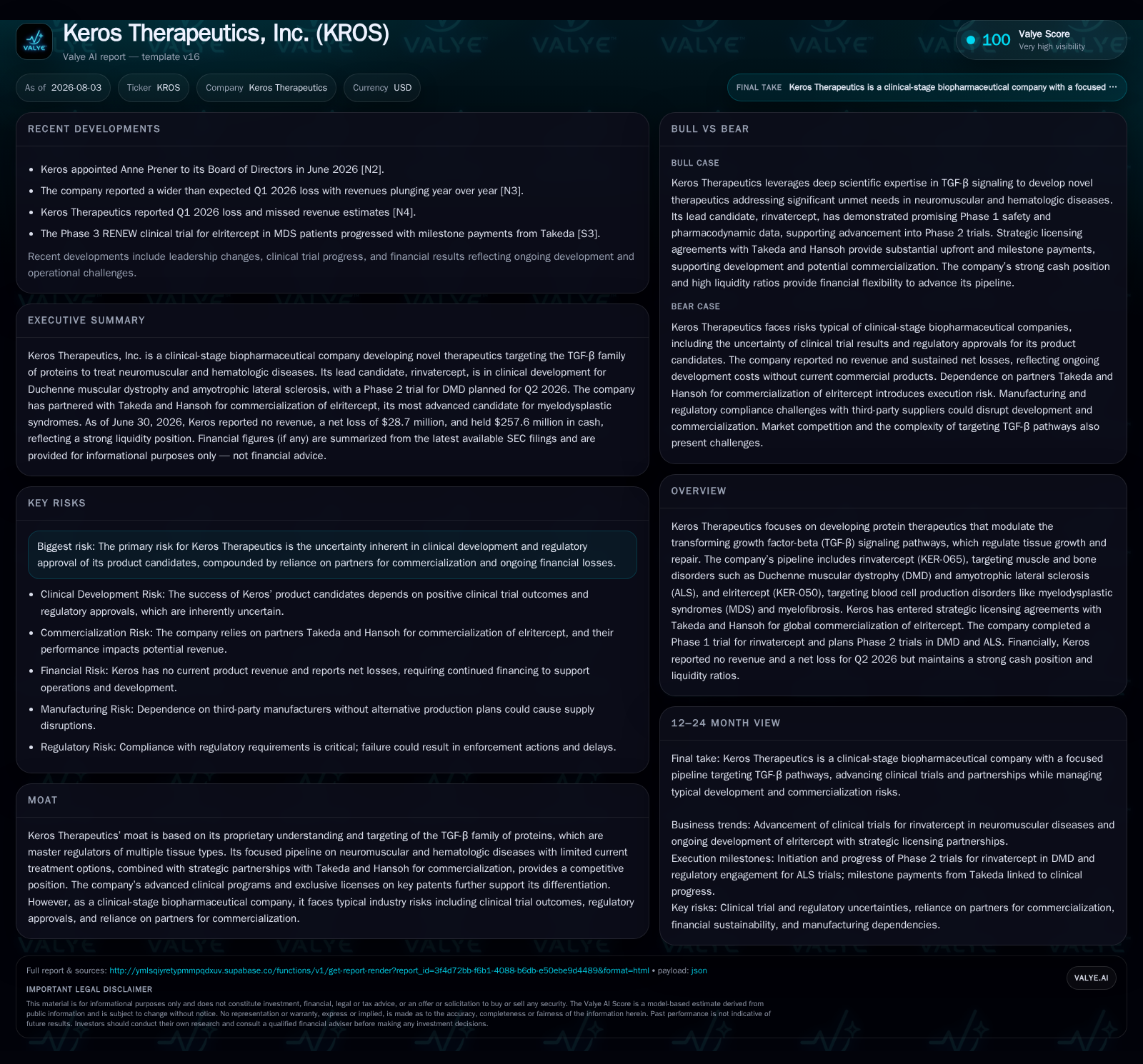
Keros Therapeutics is progressing its pipeline of protein therapeutics targeting the transforming growth factor-beta (TGF-β) pathways, with its lead candidates rinvatercept and elritercept advancing through clinical trials. The company’s strategic licensing agreements with Takeda and Hansoh underpin potential commercialization while operational focus remains on pivotal Phase 2 and 3 trials. Although Keros continues to operate at a net loss typical for clinical biotechs, it maintains a robust cash position providing runway to support planned development activities. Key risks include clinical, regulatory, and commercialization uncertainties inherent in biotech development and reliance on partners for market access.
Recent Operating Update
Keros Therapeutics reported its Q2 2026 financial results on August 3, revealing ongoing investment in its clinical pipeline without generating product revenue to date [S2], [S27]. The company has recently initiated its Phase 2 trial of rinvatercept (KER-065) in Duchenne muscular dystrophy (DMD) patients as planned for Q2 2026, marking a critical transition from Phase 1 safety evaluation towards efficacy assessment in target patient populations [S1]. Additionally, Keros aims to engage regulators in H2 2026 to finalize the design of a Phase 2 study for rinvatercept in ALS treatment [S1]. For its hematology-focused candidate elritercept (KER-050), Keros announced dosing of the first patient in the Phase 3 placebo-controlled RENEW trial for lower-risk myelodysplastic syndrome (MDS) patients during July 2025, triggering a $10 million milestone payment from licensees Takeda and Hansoh under their respective agreements [S1]. These developments underscore forward momentum through the clinical development milestones central to Keros’s value creation.
Business Model Analysis
Keros operates as a pure clinical-stage biotechnology company specializing in protein therapeutics that modulate the transforming growth factor-beta (TGF-β) family signaling pathways. These proteins orchestrate tissue growth and repair regulation across diverse biological systems such as skeletal muscle, bone, adipose tissue, heart muscle, and hematopoietic lineages [S1]. Its lead assets comprise two ligand traps based on engineered versions of natural TGF-β receptors fused to antibody Fc domains—the neuromuscular-targeted rinvatercept inhibiting ligands like myostatin to promote muscle growth, and elritercept designed to stimulate hematopoiesis by antagonizing ActRIIA receptor signaling involved in red blood cell and platelet maturation [S1].
Revenue generation for Keros primarily derives from milestone payments stipulated within its licensing agreements rather than product sales at this stage. Notably, an upfront payment and milestone triggered by Phase 3 commencement with Takeda provided substantial one-time income recognized in the fiscal year ending December 31, 2025 [F1], but no recurring commercial revenue has been recorded by mid-2026. The company’s capital allocation focuses heavily on research and development expenditures supporting ongoing trials along with regulatory planning. Manufacturing responsibilities rest predominantly with contract manufacturing organizations (CMOs), compliant with cGMP standards, reflecting an asset-light model common among early-stage biopharmas that mitigates fixed costs but requires robust quality oversight [S1].
Commercialization rights for elritercept have been exclusively licensed to Takeda outside mainland China, Hong Kong, and Macau, while Hansoh holds rights within Greater China territories [S1]. This bifurcated licensing approach aligns with typical industry practices where emerging biotech firms leverage large pharmaceutical partners’ market reach while mitigating regional regulatory complexity. Future commercial revenues depend heavily on partners’ success executing marketing strategies across these geographies.
Industry Structure & Competitive Position
Within the broader biotechnology sector focused on clinical therapeutics, Keros sits squarely among companies targeting unmet medical needs through biologic drug design around key signaling pathways—here specifically the multifunctional TGF-β axis. Comparables include clinical-stage firms like Acceleron Pharma or Global Blood Therapeutics which also develop novel protein therapeutics addressing neuromuscular or hematologic diseases through unique mechanisms of action.
Key competitive advantages derive from proprietary ligand trap engineering targeting distinct TGF-β subfamilies coupled with exclusive intellectual property rights secured via patents covering composition-of-matter and use claims [S1]. The company’s strategy emphasizes indication specialization: neuromuscular disorders such as DMD and ALS represent areas with severe unmet need yet limited approved therapeutics; similarly, MDS patients facing cytopenias often lack effective treatments especially in refractory cases. Keros's pipeline intends to carve differentiated spaces in these domains.
However, competition exists both from other biopharmaceuticals pursuing alternative molecular targets or modalities within these disease states and from biosimilars once regulatory exclusivities expire. The presence of large pharmaceutical licensees like Takeda validates mechanistic relevance but also places reliance risk: partner commercial execution effectiveness will materially impact eventual market penetration.
Growth Drivers
The immediate catalysts for Keros center around successful progression through late-stage clinical development:
- Enrollment pace and outcomes of Phase 2 studies for rinvatercept in DMD and ALS will provide critical proof points supporting further advancement or potential registration pathways.
- Completion milestones such as Phase 3 enrollment of elritercept’s RENEW trial underpin milestone payments inflows and advance commercialization timelines.
- Regulatory feedback on trial designs influences cycle times toward marketing approval.
- Expanding licensing partnerships or new collaborations could strengthen geographic reach or add pipeline diversification.
Enhanced understanding of TGF-β biology may enable next-generation product candidates targeting additional indications or leveraging optimized delivery formats. Furthermore, positive safety/tolerability data could enhance patient retention rates during trials—a key operational metric impacting trial success probability.
Risks & Constraints
As is characteristic of clinical-stage biotech enterprises like Keros, several risk vectors persist:
- Clinical Trial Uncertainty: Both lead candidates face inherent risks related to efficacy demonstration and safety outcomes. Delays or negative data can induce significant setbacks.
- Regulatory Pathways: Novel biologic mechanisms combined with complex disease indications can complicate interactions with agencies potentially requiring additional trials or post-marketing commitments.
- Manufacturing Dependencies: Outsourcing production to CMOs exposes supply continuity to third-party operational risks including compliance with stringent cGMP standards.
- Partner Reliance: Commercial success hinges on Takeda’s and Hansoh's efforts; failure or delays on their part would diminish revenue prospects.
- Financial Viability: Despite strong cash reserves ($258 million at Q2-end), sustained losses ($52 million net loss over six months ended June 30, 2026) necessitate prudent cash management amid rising expenses tied to multiple concurrently advancing programs [F1], [S2].
- Intellectual Property: Maintaining exclusivity against emerging competitors requires ongoing vigilance including potential litigation costs.
Regulatory reform uncertainty particularly outside the U.S., reimbursement challenges post approval especially given high-cost rare disease therapies, plus public health events impacting trial conduct add additional complexity layers [S4], [S6].
What to Watch Next
Investors and analysts should monitor several specific upcoming indicators:
- Interim data readouts from ongoing Phase 2 rinvatercept studies assessing safety signals and biomarker endpoints.
- Regulatory guidance engagements regarding ALS study design expected H2 2026.
- Enrollment progress metrics released publicly for elritercept’s pivotal Phase 3 trial reflecting recruitment feasibility.
- New partnership announcements that could widen commercial footprint beyond current licensees.
- Updates on manufacturing scale-up readiness particularly if accelerated approval approaches are pursued.
- Quarterly financials highlighting cash burn trends relative to operational milestones ensuring development continuity.
These factors collectively offer quantifiable markers anticipating potential inflection points supporting valuation reassessment.
Financial Profile Discussion
Keros reported negative operating performance consistent with early-stage biopharmaceutical companies still investing heavily into R&D without commercialized products. For the six months ending June 30, 2026, it recognized a net loss of $52.4 million contributing to an accumulated deficit surpassing $534 million since inception [S2]. However, strong liquidity underpins current operations with cash and equivalents totaling $257.6 million as of Q2-end accompanied by minimal short-term liabilities ($12.15 million), resulting in a very healthy current ratio near 22x [F1]. This ample runway supports planned increases in research spend necessary for multiple late-phase trials underway or planned within the coming year.
Keros historically recognized revenue primarily from upfront license fees affiliated with its agreement with Takeda but had no product sales income as of mid-2026 due to absence of approved therapies [F1]. Future revenue streams are expected to depend largely on milestone payments reflecting development progress under existing licenses while eventual product sales hinge upon successful regulatory approvals executed by licensing partners. The company's cost structure remains dominated by R&D expenses necessary to sustain clinical progression; accordingly, closely monitoring burn rate relative to cash reserves provides insight into funding sufficiency absent new capital raises or collaboration income increases.
In summary, while negative earnings reflect typical biotech dynamics at this stage of value creation focused on innovation delivery rather than commercialization returns, balance-sheet strength provides operating flexibility crucial during pivotal clinical phases ahead.
This analysis is based solely on publicly available information including recent SEC filings through August 3, 2026. It provides an industry-informed perspective centered on Keros Therapeutics' business model resilience amid developmental advances while acknowledging inherent sector-specific risks. It does not constitute investment advice or research views.
Disclaimer: This is research-only, informational analysis and not investment advice. It may include AI-generated interpretation and general industry context. Always verify important details using primary sources.

Comments