
FUBOTV’s Latest Quarterly Performance Highlights Scale Challenges and Integration Risks
Q3 2026 results underscore FUBOTV’s ongoing operating losses amid Hulu Live integration complexities and competitive pressures in live sports streaming.
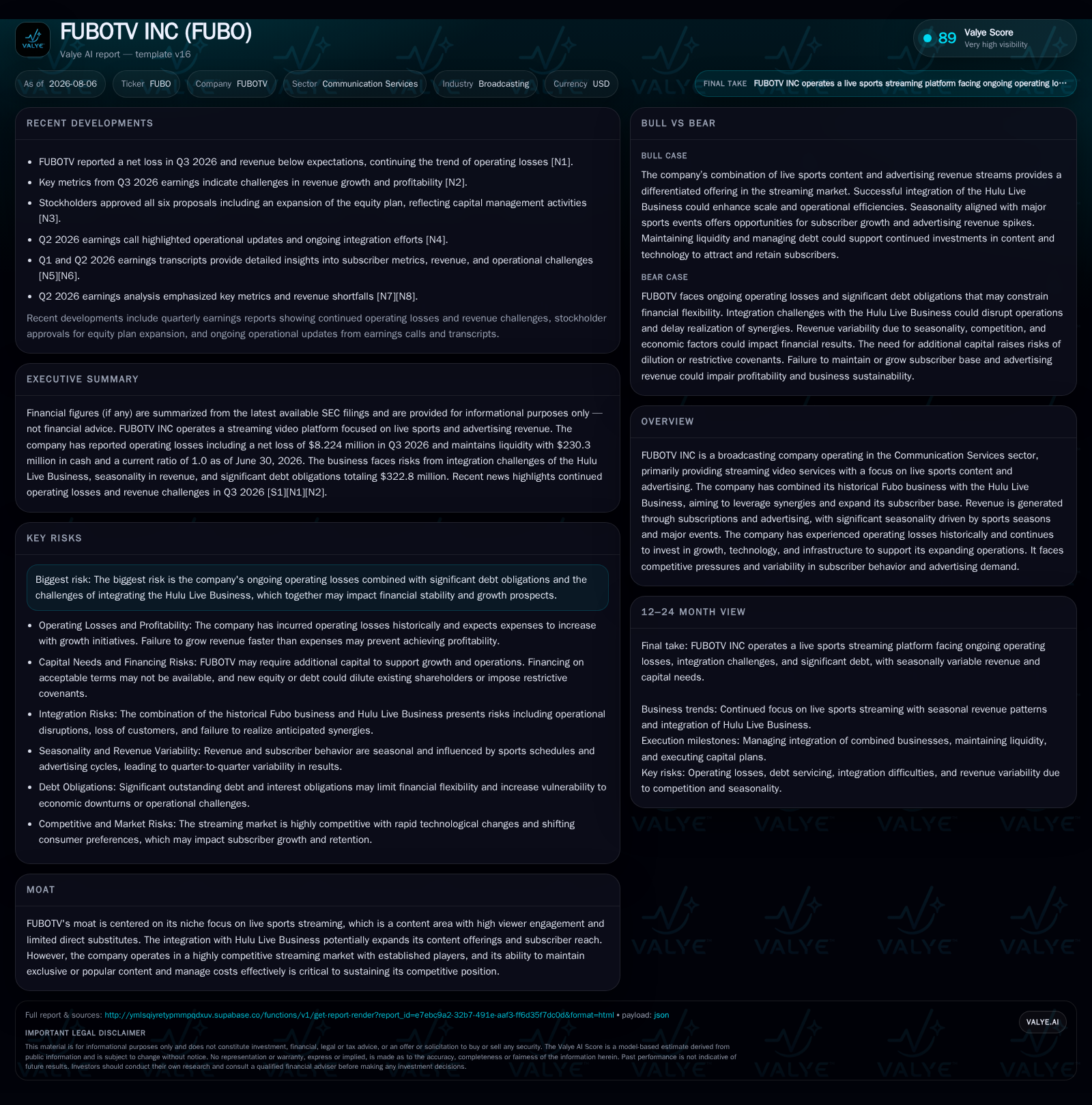
In its Q3 2026 filing, FUBOTV Inc. revealed continued operating losses driven by fixed content costs and integration expenses following its Hulu Live Business combination [S2]. The hybrid subscription and advertising revenue model faces volatility from fluctuating ad demand and stiff competition from larger virtual MVPDs [S29]. Content licensing fees, especially for live sports rights with inherent seasonality, weigh heavily on profitability. High debt levels and liquidity constraints add financial strain amid uncertain capital markets [F1, S6]. Sustained subscriber growth, advertising performance, and successful platform integration remain critical upcoming milestones.
Q3 2026 Operational Highlights Reveal Integration Strains and Revenue Challenges
FUBOTV's latest quarterly filing for the period ended June 30, 2026 presents a picture dominated by persistent operating losses compounded by the complexities inherent in integrating the Hulu Live Business following their combination [S2]. Despite the strategic intent to unite two complementary streaming services — one focused on live sports (Fubo) and another on broader linear programming (Hulu Live) — the process has absorbed significant management attention and resources. Near-term operating expenses remain elevated due to fixed contractual obligations on content rights fees and substantial marketing outlays necessary to support subscriber acquisition in a highly contested market. Seasonality tied to live sports schedules continued to influence revenue patterns, creating volatility in subscriber engagement metrics during the quarter.
The company reported stagnation or modest decline in certain subscriber cohorts relative to peers like YouTube TV or Sling TV who benefit from broader brand recognition or diversified content ecosystems [S2]. Ad revenue generation also lagged some expectations, reflecting wider sector trends of fluctuating advertising demand tied to macroeconomic uncertainty and shifts in digital video ad pricing [N1][N2]. This dual challenge of revenue mix pressure against a backdrop of ongoing merger-related investment highlights operational scalability as an immediate hurdle.
Hybrid Monetization Model Navigates Subscription Growth Versus Ad Revenue Volatility
FUBOTV operates a hybrid revenue model blending subscription fees with advertising monetization to diversify income streams. The Q3 disclosures reveal that this model remains vulnerable: while subscription revenue provides recurring cash flow stability, average revenue per user (ARPU) is sensitive to marketing promotions aimed at offsetting industry-wide high subscriber churn rates seen among vMVPD competitors [S2][S29]. Advertising revenue depends heavily on fill rates and CPMs (cost per thousand impressions), which fluctuate based on seasonality of key sporting events and broader digital ad marketplace dynamics.
Advertising price erosion observed during softer economic conditions has pressured overall ARPU expansion efforts. Compared to advertising-focused platforms like Roku or Peacock, FUBOTV's pricing power is constrained by the niche nature of live sports content versus more general entertainment inventory. This limits upside on yield improvements until larger scale or exclusive content leverage materializes. Consequently, margin enhancement relies on achieving efficient customer acquisition cost (CAC) control balanced against lifetime value (LTV) amidst aggressive subsidy environments.
Content Licensing Costs and Sports Rights Shape Profitability Constraints
A dominant fixed cost driver for FUBOTV is its content acquisition strategy centered on live sports rights—a volatile expense category laden with multi-year contractual commitments for premier leagues and events. These content rights fees represent a substantial portion of operating expenses, irrespective of short-term subscriber fluctuations tied to seasonality or competitive switching behavior [S2][S29]. The timing of payments for these contracts does not always align smoothly with revenue inflows leading to cash flow mismatch risks.
Moreover, the integration of Hulu Live adds complexity since its own linear programming licenses entail separate obligations that must be managed carefully within consolidated financial planning. Failure to optimize content mix or achieve scale efficiencies could exacerbate margin compression further if sports seasons underperform relative to expectations or if renewal negotiations increase fee baselines.
Competitive Dynamics of Live Sports Streaming Among vMVPDs and OTT Platforms
FUBOTV's competitive landscape is crowded by other virtual MVPDs such as YouTube TV, Sling TV, and prior iterations of Hulu Live before integration. These entities often benefit from deeper financial resources enabling them to subsidize subscriptions aggressively or bundle offerings with telecom or internet service packages. Additionally, entrenched players like ESPN+ or DAZN maintain exclusivity controls over marquee sports rights impacting FUBOTV's content differentiation power.
Subscriber loyalty remains fragile across this segment due to low switching costs typical in OTT platforms and episodic engagement linked tightly to seasonal sports calendars. Churn spikes during off-peak periods can erode ARPU gains unless counterbalanced by compelling original programming investments like Fubo Sports Network initiatives highlighted in recent filings [S29]. The scale challenge involves achieving sufficient subscriber density not only to improve negotiating leverage on content fees but also to enhance advertising inventory attractiveness through higher fill rates.
Growth Prospects Linked to Content Expansion, Geographic Reach, and User Experience
Despite short-term headwinds, potential avenues for growth include expanding exclusive live sports content rights portfolios targeting underserved regions or emerging sports verticals where competition is less intense. Increasing geographic footprint beyond core U.S. markets could unlock new subscriber segments but introduces regulatory variability and increased infrastructure spending requirements.
Investments in platform infrastructure aimed at reducing latency issues and improving streaming quality are critical given consumer sensitivity around service reliability. Enhanced user experience through personalized research views leveraging AI/ML techniques may augment engagement metrics over time. Partnerships or bundling arrangements with complementary OTT services represent additional levers for increasing ARPU via packaged offerings aligned with consumer trends towards multi-service subscriptions.
Risks Related to Capital Structure, Seasonality, Regulatory Pressures, and Platform Stability
Seasonal reliance on key sports events induces volatility in subscriber additions as well as advertising CPMs compounding earnings predictability issues. Regulatory risk includes exposure to FCC penalties arising from over-the-air broadcast operations for their owned linear network subject to indecency rules; vagueness in enforcement standards increases compliance uncertainty [S4][S5][S8]. Evolving regulations concerning online consumer protection laws impose additional operational costs potentially affecting subscription retention if automatic renewal disclosures are mishandled.
Platform outages or technological disruptions within complex integrated streaming environments could trigger customer dissatisfaction thereby accelerating churn during critical subscription windows—representing a non-negligible retention risk vector.
Key Upcoming Catalysts: Subscriber Trends, Advertising Metrics, and Integration Updates
Investors should keenly watch forthcoming updates on:
- Subscriber count trajectories aligned with commencement of major league seasons which materially impact engagement levels.
- Advertising CPM trends reflecting adjustments in digital marketing budgets post-economic cycle inflections.
- Progress reports concerning deeper integration milestones of Hulu Live services into FUBOTV’s technology stack which affect cost synergies realization. These KPIs will serve as primary barometers confirming if the hybrid monetization strategy can sustainably generate sufficient top-line growth amidst operating cost pressures [S3][N1][N2][S29].
Financial Profile Discussion: Operating Cash Flow, Debt Leverage, and Liquidity Position
Financially, the company continues facing challenges converting top-line into positive operating income given fixed high content costs coupled with investment-heavy integration phases [F1][S2][S6]. As of June 30, 2026, cash and equivalents stood at approximately $230 million while total debt aggregates near $380 million resulting in a net debt figure around $150 million—reflecting leverage levels typical for capital-intensive streaming businesses but necessitating careful liquidity management [F1].
The restrictive covenants embedded within convertible note agreements limit strategic financial flexibility potentially delaying response agility against sudden competitive or regulatory shifts. Therefore, maintaining adequate cash runway while progressing toward narrowing losses through economies of scale remains a major financial management priority going forward.
This analysis synthesizes FUBOTV Inc.'s Q3 2026 operational disclosures amid evolving industry dynamics without suggesting investment decisions. Readers should consider all risks outlined herein alongside official company documents.
Disclaimer: This is research-only, informational analysis and not investment advice. It may include AI-generated interpretation and general industry context. Always verify important details using primary sources.

Comments