
Charles Schwab Leverages AI and Technology to Cement Competitive Advantage in Brokerage Services
Q2 2026 results reveal momentum in client asset growth and AI-driven operational efficiency, reinforcing Schwab’s integrated financial platform amid market and regulatory pressures.
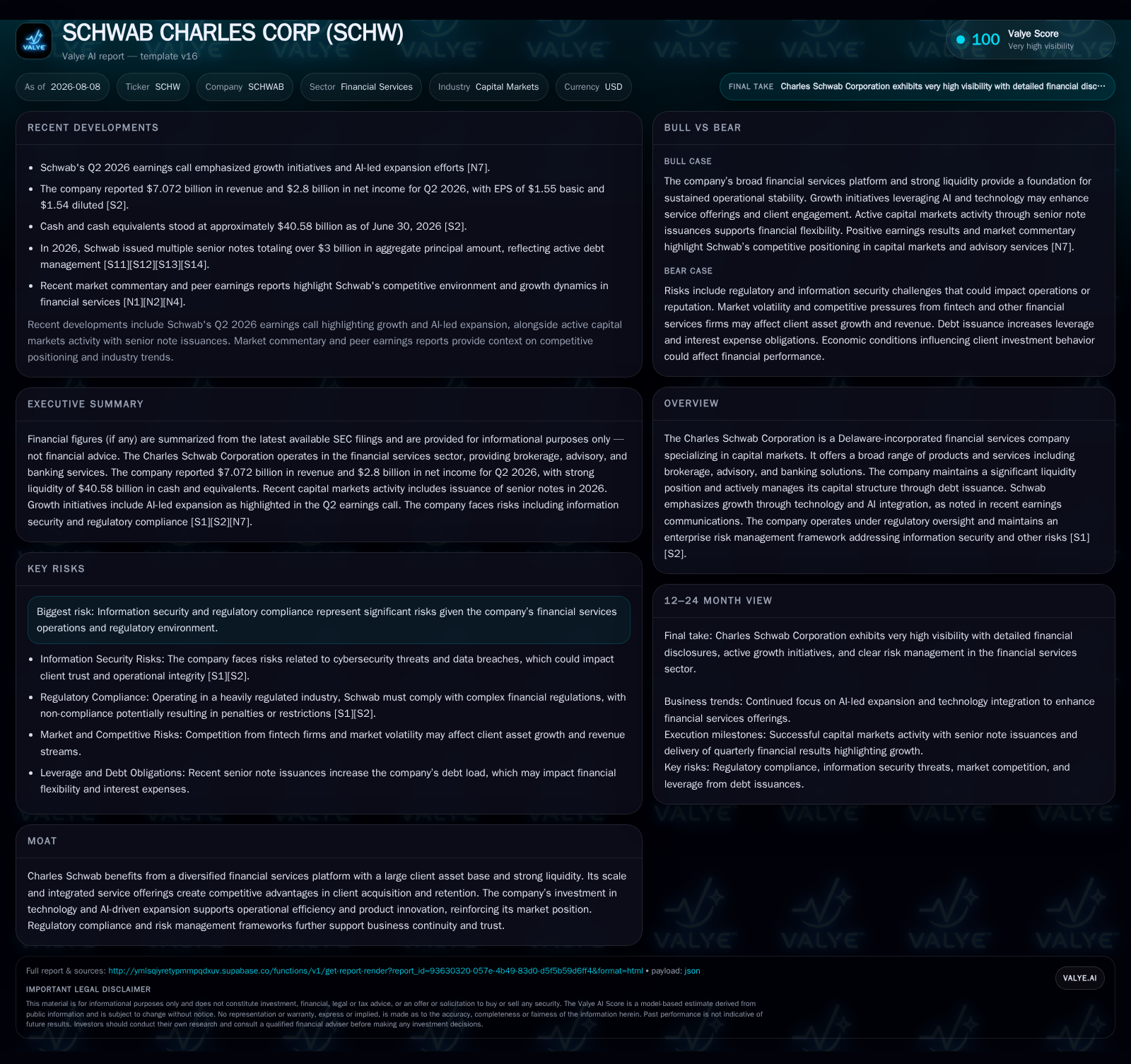
Charles Schwab's Q2 2026 filings show continued expansion in client assets, transaction volumes, and net interest income, underpinned by strategic technology and AI investments. The firm's diverse revenue base spans brokerage fees, advisory income, and banking services, benefiting from scale and platform integration relative to peers such as Fidelity Investments and LPL Financial. Enterprise risk management addressing cybersecurity and regulatory compliance remains a key governance focus. Going forward, monitoring net new assets, client retention rates, and technology adoption metrics will be critical to assessing sustained growth.
(Re)affirming Momentum: Insights from Q2 Filing on Schwab’s Growth Engines
Charles Schwab’s latest quarterly filing for Q2 2026 presents a solid operational picture with growing client asset bases supported by increased transaction volumes and net interest income that reflect ongoing demand across its core service lines [S2][S3]. The firm emphasized further integration of AI-driven tools during its July earnings call as a key enabler for both scaling client acquisition efforts and improving internal efficiencies [N1]. This aligns with earlier strategic priorities outlined in the 2026 annual report focused on technology-led expansion [S1]. Such developments translate to higher fee generation from brokerage services alongside expanded advisory revenues.
Notably, Schwab continues to succeed in expanding its assets under custody and administration, signaling sustained traction in attracting and retaining retail investors alongside institutional clients. This asset growth fuels brokerage fee income as well as transactional revenue, while incremental client accounts lift recurring advisory fees. Concurrently, banking operations contribute through net interest margin gains driven by asset-liability management practices.
Business Model Nuances Anchored in Diversified Revenue Streams and Tech Differentiation
At its core, Charles Schwab generates revenue through multiple interwoven channels: traditional brokerage fees from transactions executed on behalf of retail and institutional customers; advisory fees tied to assets managed or overseen by Schwab-affiliated portfolio managers; net interest income derived from client deposits less funding costs; plus securities lending revenues stemming from leveraging client holdings [S1]. These lines benefit from the scale of Schwab’s extensive client asset base which drives economies across trading platforms and servicing infrastructure.
Technology is a strategic differentiator—AI integrations are explicitly driving improvements in customer relationship management workflows, trade execution speeds, personalized product research views, and fraud detection systems [N1]. This increases client retention rates by enhancing user experience while simultaneously compressing cost-to-income ratios by automating previously manual processes. Investments in cloud architecture and data analytics enable scalable product innovation pipelines that sustain competitive positioning relative to peers such as Fidelity Investments—known for their broad service suite—and LPL Financial which emphasizes wealth advisory prowess.
Competitive Moats Rooted in Platform Scale, Client Retention & Regulatory Mastery
Schwab’s competitive advantages stem from the breadth of its integrated platform spanning retail brokerage services through digital channels coupled with substantial advisory services and embedded banking products [S1]. The aggregation of Assets Under Custody creates a formidable network effect attracting additional clients seeking bundled solutions. Client retention benefits from seamless onboarding processes enhanced by AI-powered interfaces that lower switching costs.
Moreover, the firm’s comprehensive enterprise risk management framework addresses regulatory compliance rigorously while promoting robust cybersecurity defenses—a critical moat given increasing information security threats documented in risk disclosures [S1][S2]. By proactive capital structure optimization via recent senior note issuances totaling over $3 billion combined this year [S15][S26], Schwab balances liquidity with flexibility to invest further in innovation or navigate market volatility without undermining credit stability. This risk-profile control aids trust establishment with clients compared to discount brokers like TD Ameritrade which may offer lower fees but lack equivalent full-service integration.
Advancing Growth Trajectory: Technology Adoption & Core Client Asset Dynamics
The linkage between AI-fueled technology adoption and growth trajectories is evident in measurable KPIs reported for the quarter such as increased net new assets inflows alongside expanding total client accounts [S2]. Transaction volumes also rose driven by elevated market activity but importantly supported by Schwab’s enhanced electronic trading platforms reducing friction.
This organic expansion is supplemented by product cross-selling opportunities facilitated through richer customer data analytics that target relevant advisory or lending offerings appropriately. The resulting mix shift towards higher-margin advisory fees bodes well for sustainable profitability improvement amid a still competitive capital markets environment dominated by firms like LPL Financial specializing solely on advisory services.
Guardrails Against Risks: Regulatory Compliance & Cybersecurity as Vital Pillars
While growth prospects remain strong, structural headwinds persist notably around tightening regulatory scrutiny governing consumer protection, data privacy mandates, and capital requirements [S1][S2]. Schwab’s enterprise risk management team incorporates these evolving regulations into firm-wide policies minimizing potential compliance breaches which could result in costly sanctions or reputational damage.
Information security remains paramount given increasing cyber threats targeting financial institutions. The company maintains extensive controls including layered encryption protocols, continuous threat monitoring systems, employee awareness training programs alongside contingency planning for business continuity [S1]. Viewed strategically rather than overhead costs, these measures enhance resilience thereby shielding client confidence which is vital for long-term retention.
Investor Radar: Critical Performance Indicators And Milestones Ahead
Forward-looking metrics deserving attention include ongoing net new assets flow trends as direct drivers of recurring fee revenue potential alongside the pace of new client account openings which reflect market penetration success. Monitoring changes in transaction volumes will signal resiliency amidst volatile equity markets where trading activity can fluctuate significantly.
Additionally, technical milestones such as rollout phases for new AI tools or platform upgrades will serve as bellwethers for operational leverage gains. Liquidity ratios should be tracked carefully especially given recent debt issuance activities aimed at optimizing the capital structure without elevating leverage unduly [F1][S2]
Financial Profile Discussion: Current Balance Sheet Strength Enhances Strategic Flexibility
As of June 30, 2026, Charles Schwab held approximately $40.58 billion in cash and equivalents against total debt issuance near $22.97 billion resulting in a net cash position around $17.6 billion [F1]. This robust liquidity profile provides a significant buffer supporting ongoing investment initiatives including technology expansions while allowing debt maturities to be managed prudently.
Capital raises executed earlier this year added $3+ billion in senior notes across staggered maturities enhancing refinancing optionality [S15][S26]. Maintaining this balance sheet strength is critical amid fluctuating market conditions impacting both asset valuations underlying custody fees as well as interest expense sensitivity linked to rate environments affecting net interest margins.
This financial resilience complements operational momentum to sustain Schwab’s market position among leading integrated capital markets service providers.
Charles Schwab's Q2 disclosure underscores a multi-pronged strategy anchored on technology-enabled client growth supported by steady diversification of revenue streams across brokerage fee income, advisory services, banking operations, and securities lending activities. Its expansive platform affords scale advantages that enhance client stickiness while prudent capital management buttresses durability against external shocks. Continued focus on enterprise risk governance mitigates compliance and cybersecurity threats integral to sustaining trust within an intensifying regulatory landscape. Upcoming quarters should clarify how effectively AI-driven enhancements convert into sustained KPIs such as net new assets gains and improved margin profiles relative to peer benchmarks.
Disclaimer: This analysis does not constitute investment advice or research views but offers a detailed interpretation based on publicly filed documents and industry knowledge.
Disclaimer: This is research-only, informational analysis and not investment advice. It may include AI-generated interpretation and general industry context. Always verify important details using primary sources.

Comments