
Vor Biopharma Pursues Hematologic and Autoimmune Therapy Advances Supported by Strong Liquidity
Vor Biopharma maintains clinical progress and financial strength while managing operational risks in a challenging biotech landscape.
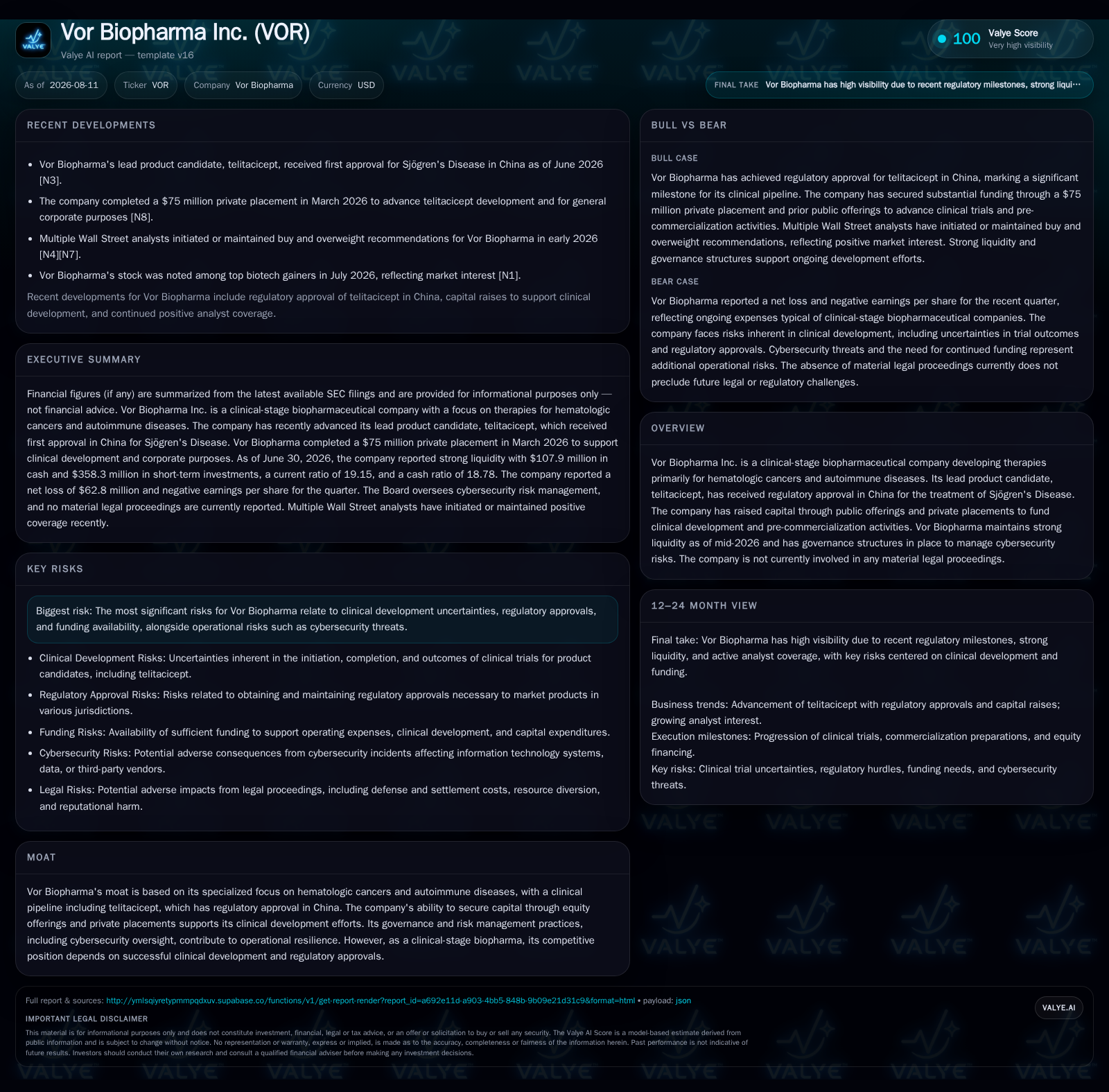
Vor Biopharma, a clinical-stage biopharmaceutical company focused on hematologic cancers and autoimmune diseases, reported in its latest quarterly filing ongoing development of its lead candidate telitacicept, which has regulatory approval in China for Sjögren's Disease. The company’s solid liquidity position as of mid-2026 supports continued R&D and pre-commercial activities. Governance efforts include active cybersecurity risk oversight, which is critical given industry operational vulnerabilities. Vor Biopharma's future hinges on clinical trial advancements, regulatory milestones, and capital efficiency amid typical biotech sector uncertainties.
Recent Operating Update
Vor Biopharma’s latest quarterly filing (Form 10-Q dated August 11, 2026) does not disclose major shifts in its business model or pipeline status but confirms continued investment in clinical-stage drug candidates and pre-commercial preparations focusing on hematologic cancers and autoimmune conditions [S2]. This steady progression suggests operational continuity without immediate infusion of commercial revenues beyond telitacicept’s existing Chinese approval. The report maintains consistent disclosures around research programs without signaling unexpected trial delays or regulatory setbacks.
The only notable personnel change reported recently is the resignation of Director Andrew Levin effective July 6, 2026, which the company states was not due to disagreements with management or the board [S3]. While any board turnover invites scrutiny into corporate governance stability—especially in early-stage biotechs—no red flags are evident at present.
Business Model Analysis
Vor Biopharma fundamentally operates as a clinical-stage biopharmaceutical entity specializing in developing novel biologic therapies targeting diseases with significant unmet needs within hematology and autoimmunity. Its business model centers around advancing multiple pipeline candidates through sequential clinical trial phases towards regulatory approvals [S1]. Currently, its lead product candidate telitacicept holds regulatory approval in China for Sjögren’s Disease—a notable milestone that transitions the asset from pure R&D toward potential commercialization, although geographic scope remains limited
Clinical-stage biotech companies like Vor typically have no meaningful product sales early on; revenue realization depends heavily on milestone payments from licensing deals or eventual market launches post-approval [F1]. Meanwhile, consistent capital raises through equity offerings or private placements fund expensive multi-year clinical trials and manufacturing scale-up planning. Vor’s disclosed strong liquidity profile underpins this model by ensuring sufficient cash runway to sustain ongoing R&D expenditure and scale-up activities without immediate product revenue streams
Customer payors are likely to be healthcare providers or insurance reimbursement bodies once products enter the market. Pre-commercialization involves regulatory submission cost absorption, early manufacturing qualification, and potentially building selective commercial partnerships. These dimensions reflect typical industry dynamics where clinical validation drives value creation before monetization can ramp.
Industry Structure and Competitive Position
Within the biotechnology industry ecosystem, Vor Biopharma occupies an upstream research-and-development role characteristic of many clinical-stage specialty biotech firms focusing on biologic therapies for serious diseases. Its explicit focus on hematologic malignancies and autoimmune indications positions it within a niche that combines high unmet medical need with significant scientific complexity.
Industry peers include other clinical-stage companies developing cell therapies or biologics for similar indications—though direct competitor comparisons are limited here due to lack of public detailed trial data or approved products outside telitacicept. The successful regulatory milestone achieved in China enhances Vor’s credibility relative to peers still seeking first approvals. However, broadening geographic approvals (e.g., FDA or EMA) remains essential for competitive viability globally.
Capital efficiency is a key performance metric here; Vor's balance sheet liquidity—as reflected by over $107 million cash reserves and an enviable current ratio above 19—compares favorably against typically cash-constrained early-stage peers prone to frequent dilutive financings [F1]. High cash reserves reduce near-term refinancing risk and permit controlled R&D spend pacing.
Governance adherence to cybersecurity risk oversight protocols highlights operational maturity uncommon among smaller biotechs. Dedicated roles such as Head of Digital/Data/Technology overseeing Information Security Management Systems (ISMS) align with best practices demanded by regulators and industry standards aimed at safeguarding sensitive clinical data integrity during trials [S1]. This focus mitigates one systemic operational risk class that could disrupt development timelines or invite regulatory sanctions.
Growth Drivers
Vor's forward-looking growth depends heavily on several key vectors:
- Clinical Trial Advancements: Progression of existing candidates beyond early-phase trials into pivotal phases will increase the likelihood of subsequent regulatory submissions. Accelerated patient enrollment rates or positive interim data releases can be important leading indicators here.
- Regulatory Approvals: Expanding telitacicept’s label indications or securing approvals outside China would markedly enhance commercial prospects.
- Partnerships and Licensing Deals: Strategic collaborations providing milestone payments can bolster capital inflows while sharing commercialization burdens—a common route to mitigate late-stage development costs.
- Pipeline Diversification: Adding differentiated product candidates or new therapeutic modalities targeting related hematologic or autoimmune diseases expands the growth runway beyond any single asset dependency.
- R&D Investment: Sustained or increased R&D spending supports innovation but requires balance against cash burn rates.
- Operational Resilience: Strong governance including cybersecurity safeguards supports uninterrupted data collection vital to credible trial outcomes.
These drivers collectively hinge on successfully navigating complex scientific development challenges typical to the biotechnology sector.
Risks and Watchpoints
Vor faces an array of risks common across clinical-stage biotechnology firms:
- Clinical Development Uncertainties: Trial failures or significant delays remain a foremost risk given reliance on investigational therapies without guaranteed safety/efficacy profiles.
- Regulatory Approval Risks: Beyond China’s approval for telitacicept, gaining acceptance by other global regulators involves unpredictable timelines and stringent evidentiary demands.
- Funding Availability: Despite current healthy liquidity, future capital raises may be needed depending on trial costs and commercialization strategies; adverse market conditions could dilute existing shareholders or constrain operations.
- Intellectual Property Challenges: Protection of proprietary technology is critical; infringement disputes could distract management resources or limit freedom to operate.
- Cybersecurity Threats: Breaches impacting sensitive information could damage reputation or trigger compliance investigations despite established mitigation frameworks [S1].
- Commercial Execution Capabilities: Should products reach commercialization stages beyond China approval, limitations in marketing infrastructure might impede rapid adoption.
- Leadership Turnover: Director departures signal governance transitions necessitating monitoring for consistent strategic direction [S3].
What to Watch Next
Key upcoming indicators signaling Vor’s trajectory include:
- Updates on patient enrollment metrics across ongoing trials which provide forward visibility into timely data readouts. - New Investigational New Drug (IND) applications or regulatory filings outside China expanding geographic footprint. - Announcements regarding new licensing arrangements or partnership agreements enhancing financial flexibility or accelerating development/commercial execution. - Quarterly updates reflecting changes in R&D intensity balanced against operating losses informing burn rate trends. - Governance developments following recent board member resignation; potential appointments maintaining oversight quality [S2][S3]
Monitoring these developments will clarify whether Vor sustains momentum toward eventual commercial stage transformation or encounters execution bottlenecks common within its peer group.
Financial Profile Discussion
As of June 30, 2026, Vor Biopharma held approximately $108 million in cash and cash equivalents against current liabilities near $25 million yielding a very strong current ratio exceeding 19—indicative of solid short-term financial health uncommon among biotech peers at comparable development stages [F1]. This liquidity base underwrites continuing R&D spend vital for advancing pipeline assets without immediate pressure for dilutive equity issuance.
Operating losses remain substantial given intensive investment required prior to realizing any product sales; operating income was negative $371.6 million as of year-end 2025 with net losses close to $696 million reflecting typical burn patterns pre-commercialization for companies pursuing multiple complex biologic therapies [F1]. Sustaining this level of investment necessitates prudent capital stewardship paired with strategic financing initiatives over time.
The company's governance emphasis on cybersecurity risk oversight further supports long-term operational continuity essential for preserving asset value requiring extensive data integrity safeguards throughout lengthy developmental timelines [S1]. Overall, Vor exhibits financial positioning allowing measured advancement through costly developmental stages while mitigating most imminent refinancing risks for at least the near term.
Disclaimer: This is research-only, informational analysis and not investment advice. It may include AI-generated interpretation and general industry context. Always verify important details using primary sources.

Comments