
United-Guardian Initiates Sexual Wellness Sales and Expands Distribution Amid Patent-Protected Pharmaceutical Demand
UNITED GUARDIAN INC advances growth with entry into sexual wellness market and strengthens pharma product formulary presence.
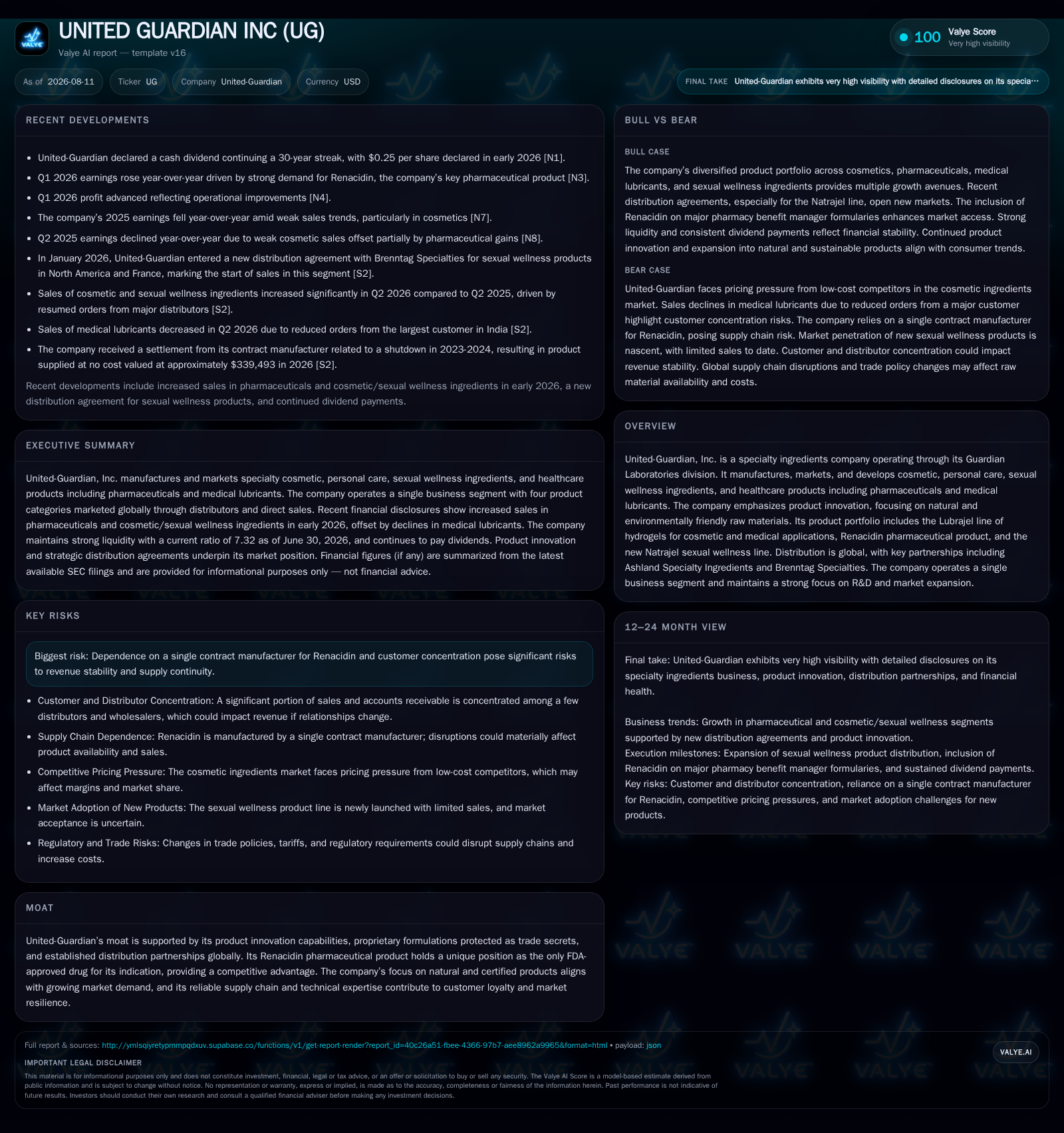
In Q2 2026, United-Guardian began nominal sales in its newly launched sexual wellness segment through the Natrajel line, supported by a strategic distribution agreement with Brenntag Specialties targeting North America and France. Concurrently, the company secured formulary inclusions for its Renacidin pharmaceutical product with two major Pharmacy Benefit Managers, bolstering its unique market position. While global trade policy shifts remain a background risk, United-Guardian's innovation-driven product portfolio and distribution partnerships position it well within specialty ingredients for personal care and pharmaceuticals.
Recent Operating Update
United-Guardian’s latest Q2 2026 quarterly filing reveals meaningful operating progress anchored by the launch of its Natrajel® sexual wellness ingredients line, marking initial albeit nominal sales within this new segment [S2]. The company entered into a significant distribution agreement earlier in the year with Brenntag Specialties, a leading global chemicals distributor, providing access to the U.S., Canada, Mexico, and importantly France — a mature market known for personal care innovation. This partnership facilitates both the introduction of Natrajel products as well as expanded distribution of existing Lubrajel® hydrogels in these territories [S2].
Simultaneously, United-Guardian recorded tangible commercial gains in its core pharmaceutical product Renacidin®. Notably, during the first half of 2026, the company successfully secured inclusion of Renacidin on the formularies of two major Pharmacy Benefit Managers (PBMs), effective June and July respectively. This is a pivotal development recognizing Renacidin as an FDA-approved niche urological therapy, which typically improves payer coverage, physician prescribing adoption, and thus revenue durability in pharma specialty ingredients [S2]. The ongoing outreach to healthcare professionals signals a strategic shift toward market education to leverage this regulatory advantage.
Additionally, the company reported an improved net gain on marketable securities relative to prior year quarters driven by equity mutual fund appreciation and realized gains from early 2026 disposals—an ancillary positive impacting financial performance [S2]
Business Model Analysis
United-Guardian operates predominantly through its Guardian Laboratories division as a midstream specialty ingredient formulator and manufacturer supplying cosmetic actives, personal care additives, sexual wellness components, and pharmaceutical-grade medical lubricants. Revenue primarily arises from selling proprietary specialty formulations such as hydrogels (Lubrajel), sexual wellness ingredients (Natrajel), and Renacidin under its FDA-approved pharmaceutical product category.
The business model leverages in-house R&D capabilities focused on product innovation emphasizing natural raw materials to capture growing consumer preference trends aligned with sustainability. This R&D focus delivers proprietary formulations protected largely through trade secrets rather than extensive patents (aside from Renacidin), supporting competitive differentiation against foreign competitors often competing on price with potentially inferior quality or efficacy [S1].
While most products are manufactured internally at its Hauppauge facility (cosmetic actives and lubricants), Renacidin is produced via a contract manufacturer — adding operational dependency risk but enabling specialization required to meet pharmaceutical regulatory standards [S1].
Revenue mechanics hinge on expanding distribution reach via partnerships (e.g., Brenntag Specialties, Ashland Specialty Ingredients) providing access to geographically diverse customers spanning cosmetics producers to pharmacies. Pricing flexibility is influenced by competitive dynamics; United-Guardian faces pricing pressures from Asian and European entrants but counters this with quality leadership and volume discounting strategies through distributor networks [S1]. The incorporation of Renacidin on drug formularies mediated by PBMs creates a channel for recurring pharmaceutical product sales largely immune to direct commodity-like price competition.
Industry Structure & Competitive Position
United-Guardian situates itself in an industry characterized by specialty chemical ingredient developers targeting cosmetics, personal care, sexual wellness, and niche pharmaceuticals. Innovation cycles are moderately long due to formulation development complexity and regulatory hurdles especially for pharmaceutical ingredients requiring FDA approval.
Peers include specialist chemical manufacturers emphasizing natural formulations such as Ashland Specialty Ingredients that also function as distributors facilitating wide market access. Globally prominent chemical distributors like Brenntag play critical roles in bridging ingredient suppliers with end-market manufacturers. Competitive pressures emanate largely from low-cost Asian producers who offer commoditized alternatives that may not match United-Guardian’s formulation sophistication or FDA certification status.
The company's defensibility derives from its unique patented Renacidin offering — the only FDA-approved drug for its indication — anchoring stable pharmaceutical revenue streams less vulnerable to pricing erosion and generic substitution. Additionally, proprietary trade secrets embedded within its cosmetic actives portfolio foster switching costs among customer formulators concerned with product quality consistency and compliance.
Nonetheless, the company contends with typical industry challenges: contract manufacturing reliance for Renacidin heightens operational risk; customer concentration can impair revenue stability; international tariff fluctuations add supply chain costs; and modest scale compared to multinational peers limits bargaining power.
Growth Drivers
Several structural tailwinds underpin United-Guardian’s growth prospects:
- The sexual wellness ingredient market expansion driven by shifting demographics and consumer openness provides high-CAGR growth potential relative to mature skin care segments. Early-stage nominal sales of Natrajel signal nascent penetration ready for scaling via Brenntag’s extensive network [S2].
- Increasing consumer demand for natural and environmentally friendly raw materials aligns directly with United-Guardian’s R&D emphasis on green formulations fostering brand relevance across cosmetics and personal care segments [S1].
- Regulatory accomplishments such as expanded PBM formulary inclusions facilitate broader prescription use of Renacidin in urology clinics boosting pharmaceutical revenues while creating insurance reimbursement pathways [S2].
- Geographic expansion through new distribution channels into North American markets plus France opens access to innovative European cosmetic markets poised for growth in specialty ingredients.
- Rising healthcare awareness increases demand for medical lubricants—another product layer offering incremental volume progression.
Risks & Growth Constraints
The company must navigate several cautionary factors:
- Contract manufacturing dependence for Renacidin represents a single point of failure affecting product availability should operational issues arise at third-party sites.
- Concentrated customer relationships could impact revenue if large buyers reduce orders or switch suppliers under pricing pressure or new innovations.
- Shifts in U.S. trade policies leading to tariffs or retaliatory measures by trading partners continue to inject cost volatility on imported raw materials or components complicating supply chain management despite some tariff relief recently negotiated [S1].
- Intense competition from lower-priced Asian/European ingredient makers requires continued investment in innovation or volume discounts which may compress gross margin expansion.
- Regulatory delays or changing approval requirements can slow time-to-market or add costs especially in sexual wellness or pharma categories.
- Market acceptance risk persists for new lines like Natrajel if customers do not adopt proprietary formulations quickly enough due to entrenched incumbent preference or slow awareness building.
What to Watch Next
Key milestones will provide insight into execution progress:
- Sales ramp-up pace for Natrajel sexual wellness products across North American distribution points will gauge commercial viability beyond initial nominal volumes [S2].
- Additional PBM formulary approvals or healthcare provider outreach success could accelerate Renacidin usage impacting pharma segment revenues positively.
- Updates on supply chain stabilization efforts amid evolving global trade policies influencing raw material sourcing costs would indicate operational resilience.
- Pipeline announcements around further new proprietary formulations focused on natural ingredients or innovative applications could signal sustained R&D output capacity.
- Gross margin trajectory reflecting effective pricing strategies versus input cost inflation will be critical operational markers given competitive pricing landscape.
Financial Profile Discussion
As of Q2 2026 fiscal close, United-Guardian demonstrates solid liquidity strength highlighted by cash & equivalents totaling approximately $2.39 million USD alongside current assets exceeding $12.7 million USD against current liabilities near $1.74 million USD resulting in a robust current ratio above 7x [F1]. This liquidity buffer provides operational flexibility amid supply chain uncertainty and emergent commercialization expenditures related to new product launches.
While latest operating income data lags until full-year reporting, historical profitability remains positive driven by specialty ingredient margins benefiting from proprietary science-based formulations rather than commodity pricing pressure [F1]. Cash flow adequacy combined with working capital sufficiency supports ongoing R&D spending critical for sustaining innovation-led differentiation intrinsic to business model defensibility [S1].
The absence of off-balance-sheet obligations further reinforces financial transparency and manageable leverage profile aligning with smaller-cap specialty chemical peers emphasizing steady growth rather than aggressive capital structure leverage [S2]. Given dividend payout continuation plans referenced in ancillary news sources [N1], capital allocation reflects balanced reinvestment aimed at strengthening market position alongside shareholder return policy considerations.
Disclaimer
This analysis is based solely on publicly available information up to August 11, 2026. It is intended solely for informational purposes without providing investment advice or research views. Readers should conduct their own due diligence before making any decisions.
Disclaimer: This is research-only, informational analysis and not investment advice. It may include AI-generated interpretation and general industry context. Always verify important details using primary sources.

Comments