
Magnolia Bancorp Focuses on Bi-Weekly Fixed-Rate Mortgages in Louisiana Amid Market Concentration
Recent quarterly results highlight Magnolia Bancorp's niche mortgage portfolio and capital constraints within Jefferson and St. Tammany Parishes.
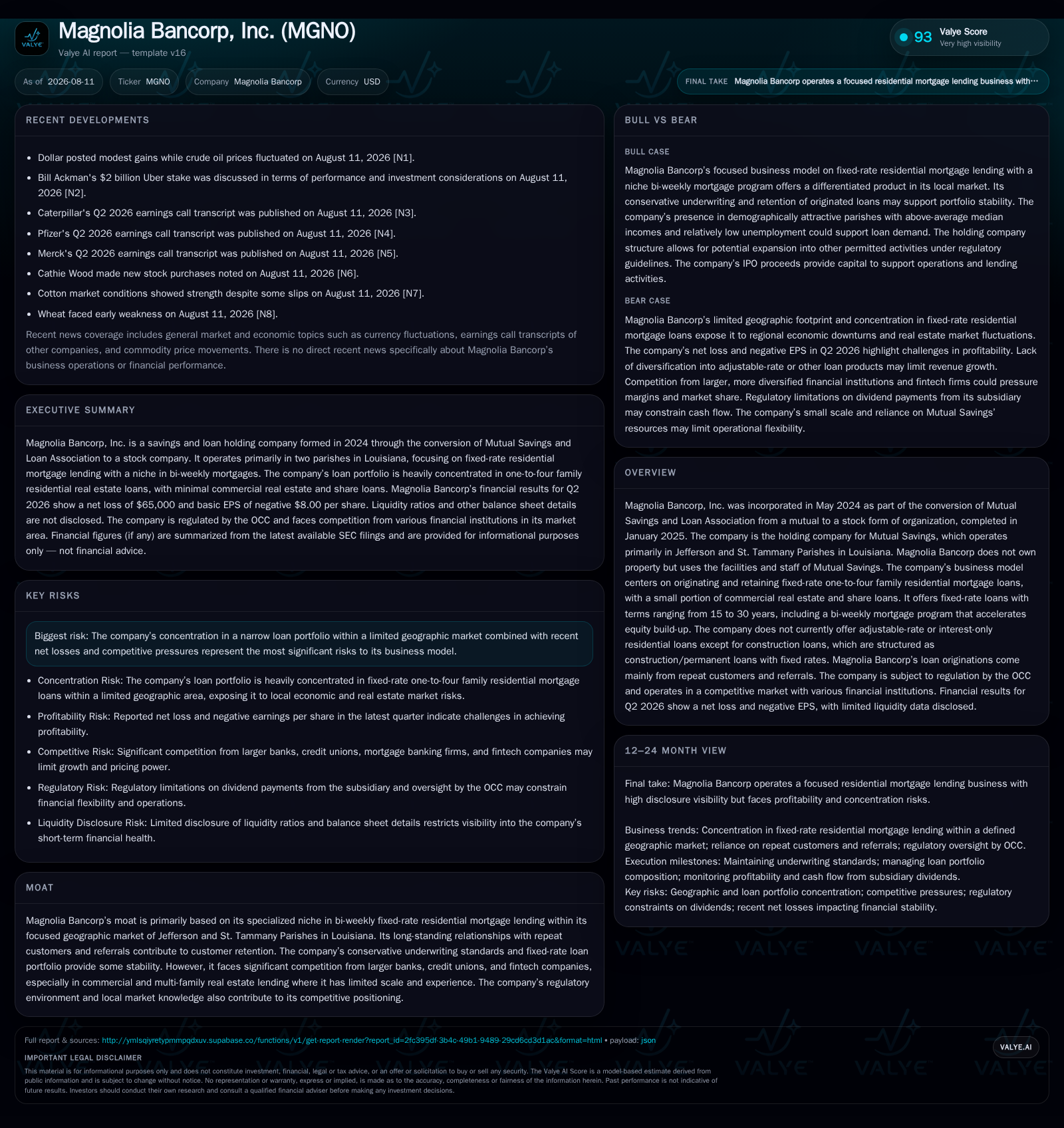
Magnolia Bancorp, Inc., formed through the conversion of Mutual Savings and Loan Association in early 2025, operates principally in two Louisiana parishes focusing on originating and holding fixed-rate residential mortgages with a distinctive bi-weekly payment program. The latest quarterly filing shows the company navigating a narrow geographic and product concentration coupled with net losses, competitive pressures from larger banks and fintechs, and regulatory limits on dividends and capital distributions. Magnolia Bancorp's conservative underwriting and specialized mortgage offerings support customer retention but also confine growth prospects absent expansion or diversification. Key watchpoints include loan origination trends, deposit dynamics, regulatory capital status, and the company's ability to leverage its niche product amid broader market competition.
Recent Operating Update
Magnolia Bancorp's latest quarterly report filed August 11, 2026 ([S2]) confirms continued operation as a focused savings and loan holding company primarily serving the Jefferson and St. Tammany Parish markets in Louisiana. The firm retains its niche orientation on fixed-rate one-to-four family residential mortgages. While the quarterly filing does not highlight new strategic shifts or material events impacting operations directly, it contextualizes earlier leadership transitions ([S3]) announced in mid-2026 that could influence future execution.
Importantly, the most recent annual disclosure (March 16, 2026 [S1]) provides foundational insight into Magnolia's business model post-conversion from its Mutual Savings predecessor, completed January 14, 2025. The conversion transitioned ownership to stock form, enabling public trading yet maintaining direct operational integration with Mutual Savings as a wholly owned subsidiary. The company relies on earnings primarily from its mortgage loan portfolio retained on balance sheet.
Business Model Analysis
Magnolia Bancorp generates revenue almost exclusively through net interest income derived from its fixed-rate mortgage loans held largely in portfolio rather than sold or securitized. These loans feature terms between 15 and 30 years with an innovative bi-weekly payment program designed to expedite borrower equity accumulation—a feature that differentiates its offering within its regional market. This product uniqueness can enhance customer retention by providing tangible financial benefits compared to standard monthly amortization schedules.
The company's deposit funding consists principally of certificates of deposit (40% of total deposits at December 31, 2025), alongside interest-bearing demand deposits and savings accounts ([S9]). This composition suggests moderate funding cost variability; CDs generally command higher rates than demand deposits but offer more stability. Maintaining a healthy loan-to-deposit ratio is critical for Magnolia's asset/liability management given its fixed-rate lending focus exposes margin sensitivity to interest rate fluctuations.
Loan origination strategy emphasizes conservative underwriting standards including third-party appraisals for collateral valuation ([S28]). The loan portfolio predominantly comprises one-to-four family residential mortgages with minimal commercial real estate exposure (accounting for only about $476 thousand in loans as per year-end figures), limiting risk diversification ([S16]). Construction loans exist but represent a very small fraction without significant volume growth reported recently.
Such concentration exposes Magnolia to regional real estate market cycles and credit risk localized within these parishes. Nevertheless, historically low delinquency for residential loans at end-2025 (only $136 thousand over 90 days past due) indicates sound credit quality management for now ([S27]).
Industry Structure and Competitive Position
As a small-scale thrift institution focused on specific parishes in Louisiana, Magnolia operates in an environment dominated by larger regional banks like Wintrust Financial or mortgage-specialized lenders such as Flagstar Bancorp that maintain broader geographical coverage with larger scale advantages. Additionally, fintech entrants expanding into streamlined residential mortgage origination intensify competitive pressure especially regarding pricing agility and digital customer acquisition.
Compared to these peers, Magnolia's moat rests on community relationships cultivated through repeat customers familiar with its bi-weekly mortgage offering—a value proposition not widely replicated elsewhere locally (). However, lack of adjustable-rate products restricts flexibility amid varying borrower preferences influenced by fluctuating interest rates. Similarly, near absence of multi-family or commercial real estate lending limits incremental revenue streams available to diversified peers.
On regulatory terms, Mutual Savings enjoys "well capitalized" status per OCC definitions as of late-2025 ([S10], [S25]), which enhances stability but also imposes prudent limits on capital distributions including dividend declarations critical for holding company cash flow. The regulatory capital framework includes capital conservation buffers that could restrict payout capacity if earnings falter or asset quality declines ([S6]).
Growth Drivers
Magnolia’s potential growth levers hinge on several measurable factors: increased local housing market activity driving loan origination volumes; enhanced adoption of bi-weekly mortgages incentivizing retention; sustained deposit growth necessitated by originations; and controlled credit loss provisions maintaining asset quality.
There is scope for moderate portfolio expansion via construction loan activities aligned with regional housing developments though historically this has been marginal. Innovations around digitally streamlining underwriting could improve efficiency ratios—operating expenses relative to revenue—a key KPI impacting profitability for community banks within this industry segment.
Demographic trends in Jefferson and St. Tammany Parishes impact demand structurally; population stability or growth supports ongoing residential mortgage need while economic shifts affect borrower creditworthiness.
Competitive pressures from larger banking organizations with broader product suites challenge client acquisition beyond established footholds. Fintech-originated loans potentially attract younger demographics favoring digital interactions issuing downward pressure on yield spreads due to scale efficiencies.
Additionally, regulatory compliance costs can strain smaller institutions disproportionately relative to their size. Management must navigate OCC oversight attentively including capital distribution restrictions tied directly to dividend policy at both parent holding company and operating thrift levels ([S5], [S7]).
What To Watch Next
Key milestones include monitoring quarterly loan origination volume trends reflecting both housing market activity and competitive positioning effectiveness as well as any indications management offers regarding broadening product mix or geographic reach beyond current Louisiana parishes.
Deposit base composition and growth rates will provide insight into funding cost sustainability while net interest margin movements will signal success managing interest rate risk inherent in fixed-rate lending models.
Capital adequacy reports in subsequent quarters are critical given regulatory dividend constraints influencing cash flow distribution policies impacting parent company returns.
Leadership changes following the June 2026 announcement ([S3]) warrant close attention regarding potential strategic recalibration or operational efficiency drives possibly affecting medium-term trajectory.
Finally, allowance for credit losses adjustments will help assess evolving credit risk perceptions especially if macroeconomic conditions pivot negatively affecting borrower repayment capacity locally.
Financial Profile Discussion
The underlying loan portfolio totaled over $30 million across residential fixed-rate mortgages predominantly backed by property within the defined geographic scope ([S16]). Allowance for credit losses remained modest reflective of low historical delinquency but prudently managed given concentration risks ([S27], [S28]).
Deposits stood at approximately $17 million at year-end 2025 with sizable certificate of deposit shares bearing higher yields than non-interest bearing accounts ([S9]). Liquidity access was supported by a line of credit with the Federal Home Loan Bank amounting to $12.7 million available though unused at that time ([S7]).
Capital ratios satisfied “well capitalized” criteria set forth by regulatory authorities affording operational stability but simultaneously imposing constraints on shareholder returns via dividends given requisite earnings retention policies under the capital conservation buffer regime ([S6], [S25]).
Overall financial posture highlights an institution managing conservative risk profiles while working through growth scale building challenges characteristic of micro-sized regional thrifts operating independently against larger banking entities.
This analysis draws solely on officially filed SEC disclosures up to August 11, 2026 supplemented by quantitative data from companyfacts [F1]. No investment research views or price targets are offered herein.
Disclaimer: This is research-only, informational analysis and not investment advice. It may include AI-generated interpretation and general industry context. Always verify important details using primary sources.

Comments