
Uwharrie Capital's Loan Portfolio Diversification and Resilient Profitability Reflect Strategic Strength
Recent quarterly results highlight Uwharrie Capital’s stable credit profile and liquidity amid sector challenges.
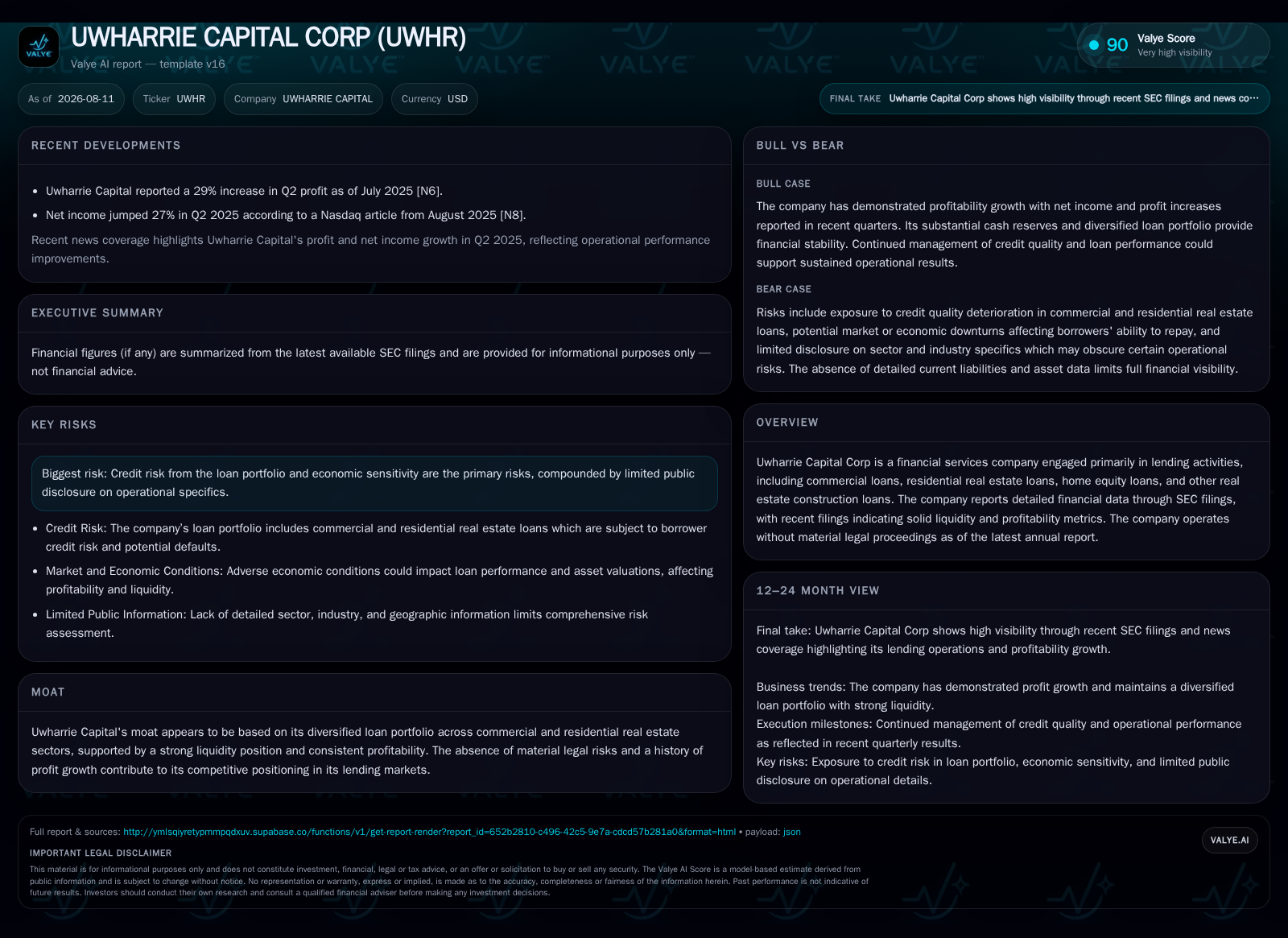
Uwharrie Capital Corp's latest 10-Q filing for Q2 2026 reveals a consistent loan portfolio composition across commercial, residential, home equity, and construction lending, underpinning its steady profitability. The company’s credit risk metrics, including non-performing loans and provisions, remain controlled, reflecting prudent underwriting and conservative reserves. Robust liquidity supported by investment securities held at amortized cost boosts net interest income while mitigating funding risk. Despite competitive pressures and interest rate headwinds in regional banking, Uwharrie leverages its diversified lending structure to sustain operating resilience.
Q2 2026 Quarter Reveals Loan Quality Stability Amid Moderate Growth
Diversified Lending Model Shields Uwharrie from Concentration Risks
Uwharrie's business model centers on providing various credit products tailored for individuals (home equity), real estate developers (construction loans), and businesses (commercial loans). Such diversification helps mitigate vulnerability to downturns concentrated in any one segment—common among smaller regional lenders. For instance, while residential real estate markets can be cyclical due to rate sensitivity or housing demand shifts, commercial lending generally follows broader business investment cycles. By managing exposure across these domains with measured growth in each subset—as supported by stable performing financing receivables balances—the company reduces potential earnings volatility stemming from sector-specific shocks or local economic disruptions [S1][S2]. This balanced risk allocation aligns with peer institutions like Central Bancompany and Nu Holdings that similarly pursue mixed loan books to bolster resilience.
Balancing Credit Risk Through Provisioning and Non-Performing Loan Management
Credit quality preservation is pivotal for sustainable profitability in Uwharrie’s lending model. The latest disclosures indicate that the allowance for loan losses adequately covers potential impairments reflective of current non-performing financing receivables levels. The steady NPL ratio underscores effective risk calibration despite some economic uncertainty that could pressure borrower repayment capacity [S1][S2]. Compared to regional banking peers who often experience fluctuating loan loss provisions in cycles influenced by macroeconomic factors, Uwharrie exhibits a conservative calibration in provisioning policies helping smooth earnings impact over time. This suggests disciplined underwriting practices reinforced by ongoing portfolio monitoring which collectively contribute to sustaining net income stability
Investment Securities Role in Supporting Liquidity and Interest Income
Beyond lending activities, Uwharrie capitalizes on holdings of investment securities classified as held to maturity at amortized cost—a strategy that accentuates liquidity management while generating supplementary interest income streams. As of June 30, 2026, these securities' amortized cost stands near $21.9 million with fair values closely aligned ($20.4 million approximately), evidencing limited market valuation swings or duration risks typically associated with trading portfolios [S2]. The firm reports modest net amortization of premium (~$68,000 this quarter), reflecting expected adjustments without material erosion of yield contribution. This investment posture supports core net interest margins by making productive use of excess liquidity without exposing the balance sheet significantly to mark-to-market volatility—critical for smaller banks managing rate sensitivity [S2].
Pressure Points: Interest Rate Environment and Competitive Dynamics
The prevailing interest rate context shapes Uwharrie's margin leverage given the direct influence on net interest margin (NIM), the predominant profitability engine for regional lenders. While rising rates generally benefit new loan yields boosting NIM temporarily, they can simultaneously elevate funding costs or depress legacy fixed-rate asset yields depending on repricing timing mismatches. Uwharrie's managed portfolio composition has allowed it to harness current favorable rate levels without marked margin compression observable during rapid tightening phases seen across the financial sector recently [S1][S2]. However, competition from regional banks actively expanding digital platforms or specialty finance firms innovating alternative lending solutions may impose pricing pressures or customer share challenges if left unchecked.
Growth Catalysts Involving Real Estate Activity and Credit Underwriting Improvements
Loan origination momentum is expected to trace underlying trends in economic expansion and regional real estate market activity—both foundational for construction financing and residential mortgage demand segments where Uwharrie maintains significant lending exposure. Enhanced underwriting technology adoption promises tighter risk assessment capabilities permitting better identification of profitable borrowers thus potentially expanding originations while controlling delinquencies—an essential advantage in a selective-growth environment [S1]. Additionally, leveraging cross-selling opportunities within existing customer relationships can deepen wallet share outside pure lending revenue through ancillary financial products typical among community-focused lenders.
Risks Ahead: Credit Defaults, Economic Sensitivity, and Regulatory Constraints
Despite current encouraging credit metrics, primary risks remain concentrated on borrower default events incentivized by macroeconomic downturns such as employment shocks or real estate price declines which could elevate non-performing loans beyond established reserves. Moreover, regulatory capital requirements impose constraints on balance-sheet growth flexibility; maintaining adequate tier 1 capital ratios is critical amidst evolving compliance landscapes influencing lending capacity or dividend strategies [S1]. Uwharrie's absence of material legal proceedings fortifies its reputation but does not insulate against unforeseen operational or compliance risks inherently present in tightly regulated lending institutions
Monitoring Upcoming Milestones: Earnings Updates, Loan Demand Signals, and Capital Ratios
Investors should watch forthcoming quarterly earnings announcements for confirmation of sustained net income trajectory amid changing external conditions reported on July 22, 2026 [S3]. Sequential reporting on impairment trends within loan balances will signal whether credit provision assumptions remain valid or require recalibration following potential economic shifts. Additionally, disclosures around tier 1 capital adequacy will provide insight into the company’s regulatory buffer enabling future lending growth initiatives.
Financial Profile Discussion: Liquidity Position, Profitability Metrics, and Capital Adequacy
This analysis synthesizes Uwharrie Capital Corp's public SEC filings illustrating a well-balanced regional lender navigating typical industry challenges through conservative credit practices augmented by strategic diversification across commercial and residential loan verticals. Its liquidity management via selected investment securities further strengthens operational resilience amid shifting rate environments. Key performance indicators such as stable non-performing loan ratios alongside growing net income highlight durable profit quality contingent upon ongoing vigilance over macroeconomic impacts and regulatory compliance.
Disclosure: This report does not constitute investment advice or research views but aims to provide an informed analytical perspective based solely on publicly available information as cited herein.
Disclaimer: This is research-only, informational analysis and not investment advice. It may include AI-generated interpretation and general industry context. Always verify important details using primary sources.

Comments