
How OBTC's ETF Structure Balances Bitcoin Exposure with Passive Management in Q2
Osprey Bitcoin Trust’s latest quarterly report reveals pronounced shifts in AUM and NAV driven by Bitcoin volatility, highlighting structural dynamics of its basket-based ETF model.
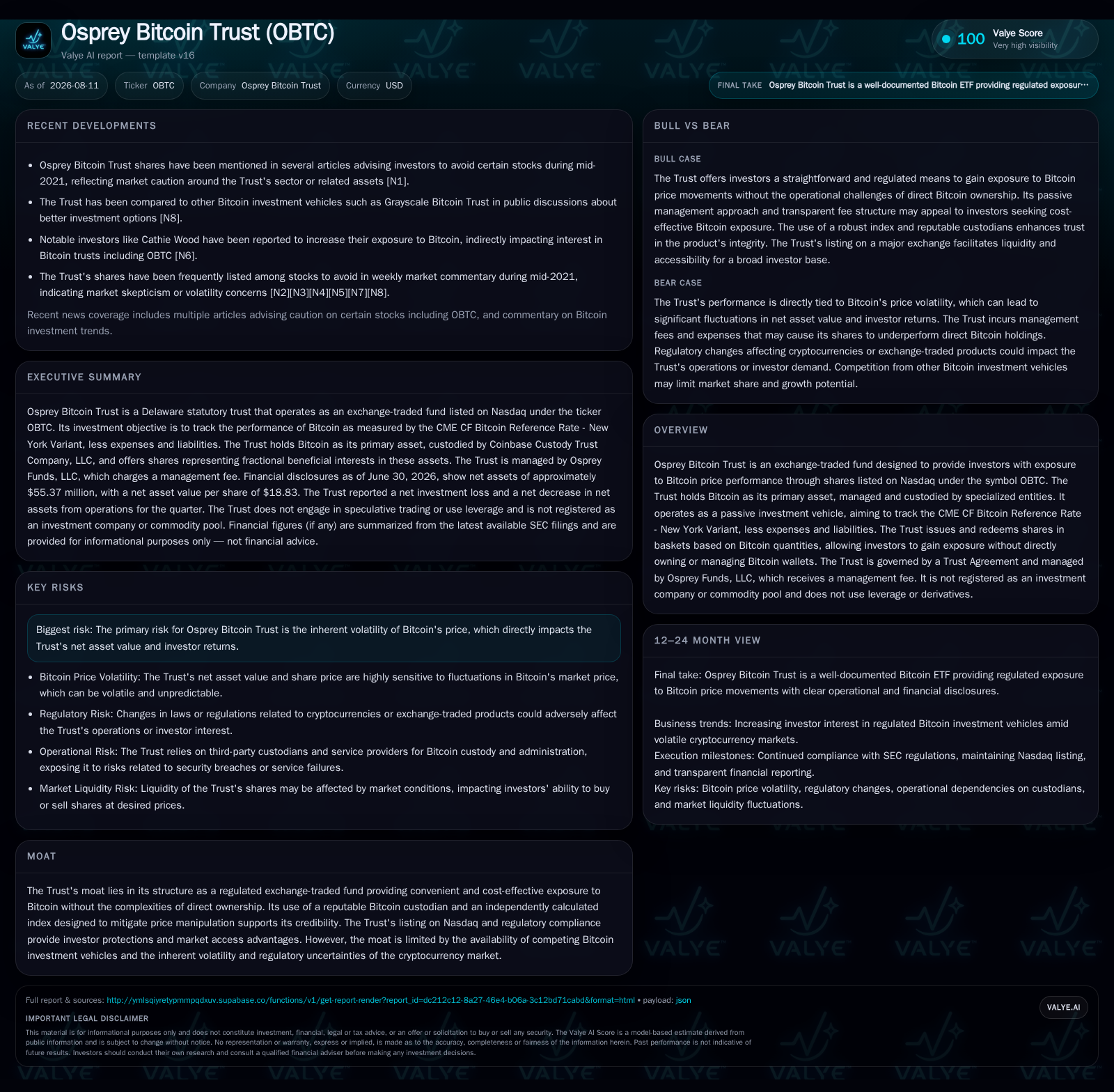
In its second quarter of 2026, Osprey Bitcoin Trust (OBTC) experienced a notable contraction in assets under management—from approximately $137 million at year-end 2025 to $55 million—primarily due to declines in Bitcoin prices. The net asset value per share decreased sharply from $28.12 to $18.83, underscoring the direct sensitivity of the trust's value to Bitcoin’s extreme volatility. Underpinning these movements, shares outstanding fell from about 4.86 million to 2.94 million as redemption activity increased amid shifting investor sentiment. OBTC operates as a passive, basket-based ETF tracking the CME CF Bitcoin Reference Rate - New York Variant, leveraging reputable custodianship by Coinbase Custody and a straightforward management fee model. The trust’s structure delivers indirect Bitcoin exposure with simplified custody demands but contends with competition from other digital asset products and regulatory uncertainties that continue to shape growth prospects.
Q2 Operating Update Reflecting Bitcoin Volatility Impact on AUM and NAV
Osprey Bitcoin Trust's Q2 2026 results illustrate the direct link between Bitcoin price movement and the trust's financial metrics. The trust's assets under management (AUM) fell dramatically from $136.7 million as of December 31, 2025, to $55.4 million by June 30, 2026 [S2]. This near-halving is attributed chiefly to Bitcoin price depreciation within the period rather than significant capital withdrawals alone, although shares outstanding also declined notably.
The net asset value (NAV) per share dropped from $28.12 to $18.83 across the same interval [S2], underscoring how bitcoin's extreme price swings directly translate into investor returns for this type of passive vehicle. Concurrently, shares outstanding contracted from approximately 4.86 million shares at year-end to about 2.94 million shares at quarter-end [S2]. This change indicates substantial redemption activity as investors recalibrated holdings amid market volatility.
These figures highlight the sensitivity of OBTC's balance sheet and share structure to external cryptocurrency price trends—a common characteristic among spot-Bitcoin ETFs that do not hedge or utilize derivatives.
OBTC’s Business Model: Passive Bitcoin Exposure Through Basket-Based ETF Shares
The Osprey Bitcoin Trust operates as a Delaware statutory trust offering an exchange-traded fund format for gaining indirect exposure to Bitcoin without requiring investors to directly manage wallets or private keys [S1]. Shares represent fractional undivided interests in the net assets of the trust—assets that consist primarily of actual Bitcoin held in custody [S1].
Share issuance and redemption occur exclusively via "baskets," typically comprising 10,000 constituent shares each, which correspond proportionally to underlying Bitcoin quantities adjusted for accrued but unpaid fees and liabilities [S1]. Authorized Participants—registered broker-dealers with formal agreements—facilitate creations or redemptions by delivering or receiving equivalent baskets of Bitcoin (or cash equivalents when applicable), maintaining liquidity and market efficiency.
Revenue generation hinges on management fees charged as a percentage of AUM; these fees cover administration, custody costs, and sponsor compensation [S1]. Since OBTC is a passive investment vehicle, it neither speculates on short-term price fluctuations nor employs leverage or derivatives, contrasting with some futures-based ETFs [S1]. This simplicity aligns with many institutional and retail investors seeking straightforward exposure without complex product structures.
"Trustworthy Custody"—The Role of Coinbase Custody in Digital Asset Security
Custodianship is a pivotal component in digital asset trusts' operational integrity and investor confidence. OBTC employs Coinbase Custody Trust Company, LLC as its exclusive custodian for Bitcoin holdings [S1]. Coinbase Custody is recognized within the industry for robust security protocols incorporating institutional-grade key management, regulatory compliance measures, and comprehensive insurance coverage against certain losses.
Such specialized custody mitigates risks related to theft or mismanagement often associated with direct cryptocurrency ownership—a critical moat element since investors delegate safekeeping responsibilities while retaining tradable claims through shares.
While no custodian arrangement can entirely eliminate risk given evolving cyber threats and regulatory landscapes, Coinbase Custody's role reflects a best practice among leading crypto trusts and ETFs.
"Tracking the Index": OBTC's Use of CME CF Bitcoin Reference Rate to Control Tracking Error
OBTC seeks to replicate Bitcoin’s performance as measured by the CME CF Bitcoin Reference Rate - New York Variant (the "Index"), an independently calculated benchmark aggregating executed trade flows across major spot platforms [S1].
This index selection is deliberate; it aims to minimize susceptibility to price manipulation inherent in less transparent or fragmented exchanges common in crypto markets. By referencing this composite index rather than a single platform price, OBTC intends to stabilize share valuation relative to underlying crypto prices and reduce tracking error—a principal KPI for such passive funds.
Investors benefit from index transparency and governance administered by CF Benchmarks Ltd., contributing credibility amidst persistent concerns about crypto pricing integrity.
"Competition and Fee Structure": Positioning Among Cryptocurrency ETF Peers Without Derivatives Leverage
Compared with peers like Grayscale Bitcoin Trust or futures-based ETFs such as ProShares Bitcoin Strategy ETF, OBTC emphasizes pure spot-Bitcoin exposure without engaging in derivative strategies that add return complexity but also increased risk. The absence of leverage restricts risk case related to margin calls but also removes upside amplification potential present in some competitors.
While specific management fee rates are not explicitly disclosed here, products targeting direct-held Bitcoins typically charge fees ranging between drag-inducing expense ratios (including custody) of approximately 0.50%–2%. OBTC’s revenue model follows this archetype by assessing fees on AUM that decline with market-driven asset fluctuations [S1], thereby linking profitability tightly with both assets size and underlying price trends.
The growing competitive landscape underscores the importance of fee efficiency alongside reliable price tracking. OBTC's decision not to use derivatives aligns with a segment of cautious investors prioritizing transparency and simplicity but may limit appeal among traders seeking enhanced yield opportunities through futures contracts.
"Growth Constraints Linked to Market Sentiment & Regulatory Uncertainty"
OBTC operates against a backdrop of heightened volatility in digital asset markets coupled with ongoing regulatory uncertainty highlighted extensively in its risk disclosures [S1], [S4], [S6]. These factors dampen institutional appetite during periods when governance frameworks remain fluid across U.S., state, and international jurisdictions.
Notable historical episodes such as the bankruptcies of Celsius Network and FTX over recent years reverberate through investor sentiment affecting capital inflows into all cryptocurrency-related investment vehicles including indexed trusts like OBTC [S1]. Heightened enforcement actions have precipitated increased costs around compliance while elevating perceived systemic risks thus constraining organic growth possibilities despite rising general interest in cryptocurrencies over time.
Moreover, without usage of leverage or derivatives strategies—which face separate layers of regulatory scrutiny—OBTC may be less susceptible operationally but simultaneously limited relative to funds willing or able to navigate those channels.
"What Investors Should Watch": Shares Outstanding Trends, Creation/Redemption Activity & Price Movements
Going forward, critical metrics include monitoring OBTC’s shares outstanding fluctuations indicative of investor sentiment shifts between entry (creation baskets) versus exit (redemption baskets) activities [S2]. Such data reflects real-time demand elasticity driven principally by perceptions around Bitcoin price directionality as modulated through fund-level structures.
Additionally, tracking NAV per share relative to the CME CF Index enables assessment of tracking error magnitude—a key determinant impacting investor confidence particularly when premium/discount volatility appears elevated relative to peers.
Liquidity trends observable through trading volume on Nasdaq further inform practical ease of entering or exiting positions against potentially volatile underlying market conditions.
Careful attention should be given also to any amendments announced via filings regarding custodial arrangements or fee adjustments that could materially impact operational cost bases or risk profiles.
This analysis leverages detailed insights from Osprey Bitcoin Trust's latest quarterly filing dated August 11, 2026 ([S2]), supplemented by foundational business context from its April 1, 2026 annual report ([S1]) alongside relevant industry knowledge regarding cryptocurrency ETFs operating within regulatory constraints characteristic of U.S.-listed digital asset securities vehicles. By connecting these dimensions we elucidate how OBTC’s structure channels Bitcoin price dynamics through a carefully governed passive ETF wrapper while contending with persistent volatility challenges and competitive pressures inherent in evolving crypto investment markets.
Disclaimer: This analysis is provided solely for informational purposes based on public SEC filings and does not constitute investment advice or research views.
Disclaimer: This is research-only, informational analysis and not investment advice. It may include AI-generated interpretation and general industry context. Always verify important details using primary sources.

Comments