
Future Vision II Advances Merger with MicroTouch Amid SPAC Closing Deadline
The SPAC approaches its mandatory business combination deadline with a pending merger poised to transform it into an operating IT services company.
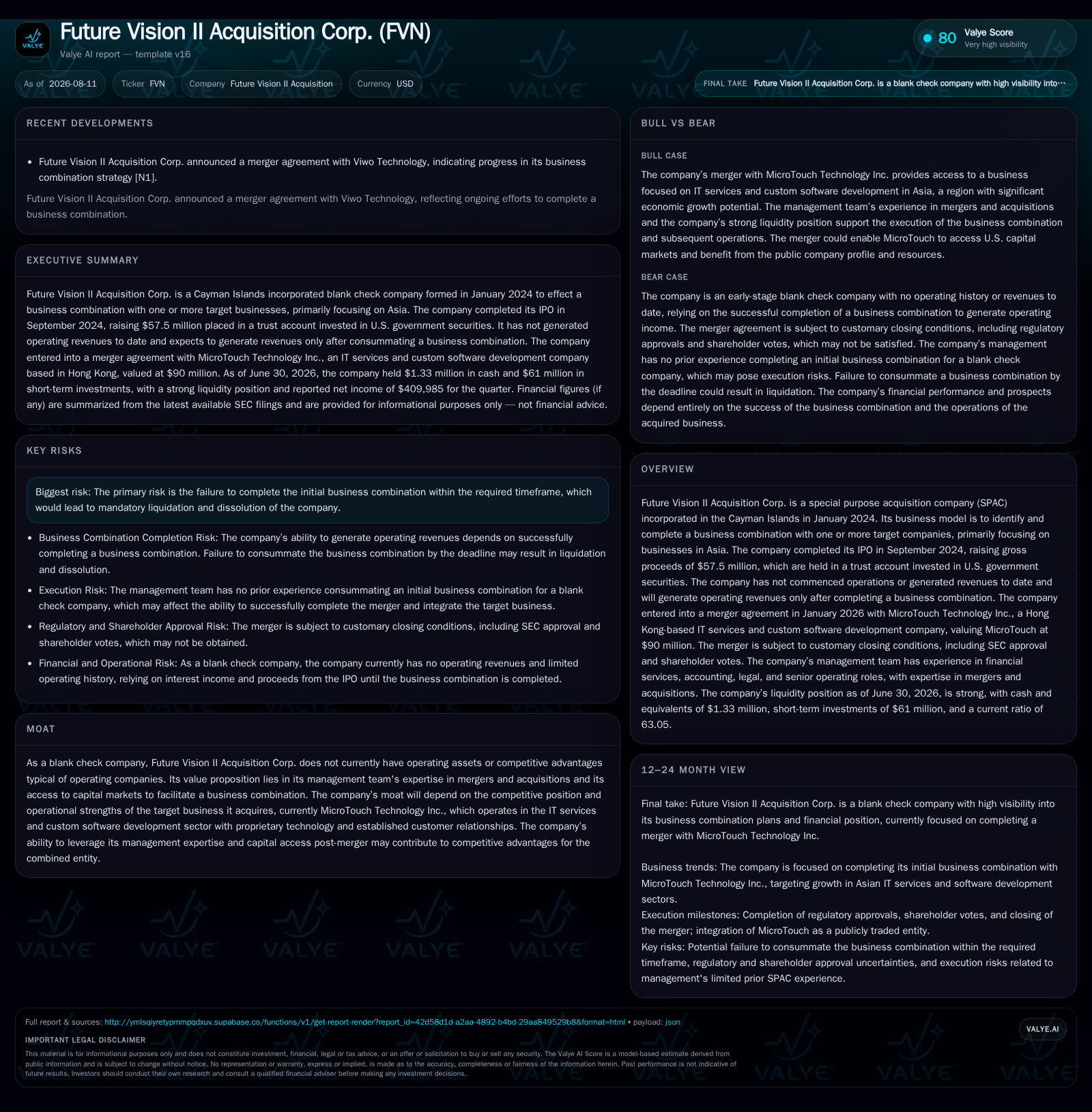
Future Vision II Acquisition Corp. (FVN) is progressing toward completing its initial business combination following a merger agreement with Hong Kong-based MicroTouch Technology Inc., targeting a $90 million valuation. As a blank check company, FVN has no operating revenues, holding IPO proceeds primarily in trust pending transaction close. The deal depends on customary closing conditions including SEC approval and shareholder votes as the September 13, 2026 deadline approaches. Failure to close by this date would trigger mandatory liquidation, underscoring execution risk. Post-merger, the combined entity will transition into a public IT services operator focused on growth markets in Asia.
Recent Operating Update and Transaction Status
Future Vision II Acquisition Corp.’s latest quarterly filing as of June 30, 2026 highlights its primary focus on executing an initial business combination [S2]. The company entered into a definitive merger agreement in January 2026 with MicroTouch Technology Inc., an IT services and custom software developer operating principally in Asia, targeting a transaction valuation of approximately $90 million [S16]. On July 23, 2026, shareholders voted on the proposed business combination and were offered redemption rights; about 3.758 million shares were validly tendered for redemption—a substantial portion but not enough to block the deal [S3], [S17]. The estimated redemption price per share was around $10.97 but remains subject to final adjustment based on two business days prior to closing, introducing some uncertainty regarding exact cash outflows [S3].
As of late July, the transaction had not closed. The company faces a hard deadline of September 13, 2026 to consummate the business combination per its governing documents [S1], [S16]. Failure to complete by this date mandates liquidation and dissolution of the SPAC entity, elevating execution risk considerably. Management expresses intent to finalize the transaction before this deadline.
Business Model and Operational Context
Incorporated as a Cayman Islands exempted company in January 2024, Future Vision II operates as a typical Special Purpose Acquisition Company (SPAC), raising capital via an initial public offering (IPO) to identify and merge with a private operating company [S1]. The capital raised—approximately $57.5 million gross including over-allotment—has been placed in a trust account invested predominantly in marketable securities that are legally restricted for use solely in consummating an acquisition or redeeming shares upon shareholder election [F1], [S1].
Pre-combination, Future Vision II has no operating revenues or commercial activities; its income derives almost entirely from interest earned on cash and securities held in trust [S1]. Operating expenses are minimal—$391,049 reported for full year 2025—reflecting costs associated with regulatory compliance, due diligence efforts, and administrative overhead typical for SPACs at this stage [F1]. Net income is primarily attributable to investment income from trust assets.
The investment thesis hinges entirely on successful deal closure that converts Future Vision II from a capital vehicle into an operating public company. The target company, MicroTouch Technology Inc., provides IT services and software solutions focused on Asian markets—regions characterized by robust economic growth driven by technological innovation and rising middle-class consumption [S1], [S16].
Industry Positioning and Competitive Landscape
SPACs serve as financial intermediaries facilitating private companies’ access to public markets through mergers rather than traditional IPOs, offering potentially faster timelines and flexibility. Future Vision II’s geographic focus on Asia aligns it with a subset of SPACs targeting high-growth emerging markets where digital transformation demand is accelerating.
Within this sector, Future Vision II competes indirectly with other SPACs pursuing technology-related targets in Asia as well as traditional IPOs and private equity firms supporting similar companies’ public listings. The competitive differentiation post-merger will depend largely on MicroTouch’s established proprietary offerings and client relationships in IT services—a sector benefiting from structural tailwinds such as increased digitization across industries in Asia [S1], [S16]. Operational execution post-closing will be critical since Future Vision II currently holds no operational assets or revenues.
Growth Drivers
Key catalysts include:
- Merger Completion: Finalizing the transaction transforms Future Vision II into an operating entity capable of generating revenue.
- Asia Market Momentum: Structural reforms and innovation adoption underpin expanding demand for IT services where MicroTouch operates.
- Management Expertise: Post-merger leadership aims to leverage industry experience to expand product offerings and capacity organically and via synergistic acquisitions [S1].
- Access to Capital Markets: Public listing facilitates raising additional capital for growth initiatives including marketing and R&D.
- PIPE Financing Potential: Supplementary PIPE investments could further bolster financial resources available post-merger.
Risks and Watchpoints
Notable risks include:
- Execution Risk: Approaching September 13 deadline imposes pressure; failure results in mandatory liquidation erasing shareholder value outside of trust distributions [S16].
- Redemption Risk: High redemption rates reduce funds available for combined entity operations post-merger [S3], [S17].
- Regulatory Uncertainty: SEC review processes and shareholder approvals remain potential hurdles.
- Dilution Concerns: Founder shares, deferred underwriting fees, and possible PIPE financing introduce dilution affecting shareholder interests.
- Integration Risk: Success depends on MicroTouch’s ability to operate effectively as a newly public company amid competitive pressures.
- No Pre-Merger Revenues: Investors’ returns depend entirely on successful completion of the business combination and subsequent target performance.
Upcoming Milestones
Investors should monitor:
- Progress on SEC approval processes impacting transaction timing.
- Final shareholder vote tallies including redemption statistics from July meeting [S3].
- Announcement of finalized per-share redemption price shortly before closing date [S3].
- Confirmation of business combination closing prior to September deadline transitioning from SPAC shell to operating public company.
- Early indications of operational performance from the combined entity validating growth assumptions embedded in the deal rationale.
These events will provide key signals about whether Future Vision II can navigate typical SPAC execution challenges successfully.
Financial Profile Discussion
As of June 30, 2026, Future Vision II reported current liabilities of approximately $984,233 and current assets of about $62.06 million, resulting in a strong current ratio of 63.05, indicating ample short-term liquidity relative to obligations [F1]. The company holds cash and equivalents of approximately $1.33 million as of December 31, 2024 [F1].
No long-term debt or off-balance sheet arrangements exist at present providing clear capital structure ahead of transaction close [F1]
This analysis integrates all publicly filed disclosures up through August 11, 2026 alongside sector context pertinent to SPACs navigating critical transaction deadlines, capital holding constraints, redemption dynamics, and operational transitions relevant to Future Vision II Acquisition Corp.'s path toward becoming an active IT services operator anchored in Asian growth markets. All forward-looking intentions remain subject to customary risks including regulatory approvals and shareholder consents that govern ultimate realization prospects.
Disclaimer: This is research-only, informational analysis and not investment advice. It may include AI-generated interpretation and general industry context. Always verify important details using primary sources.

Comments