
Sentient Brands' Acquisition Engine and Licensing Strategy Underpin Niche CPG Growth
Sentient Brands leverages acquisitions, exclusive licensing, and operational scale to target wellness and emergency preparedness segments amid liquidity challenges.
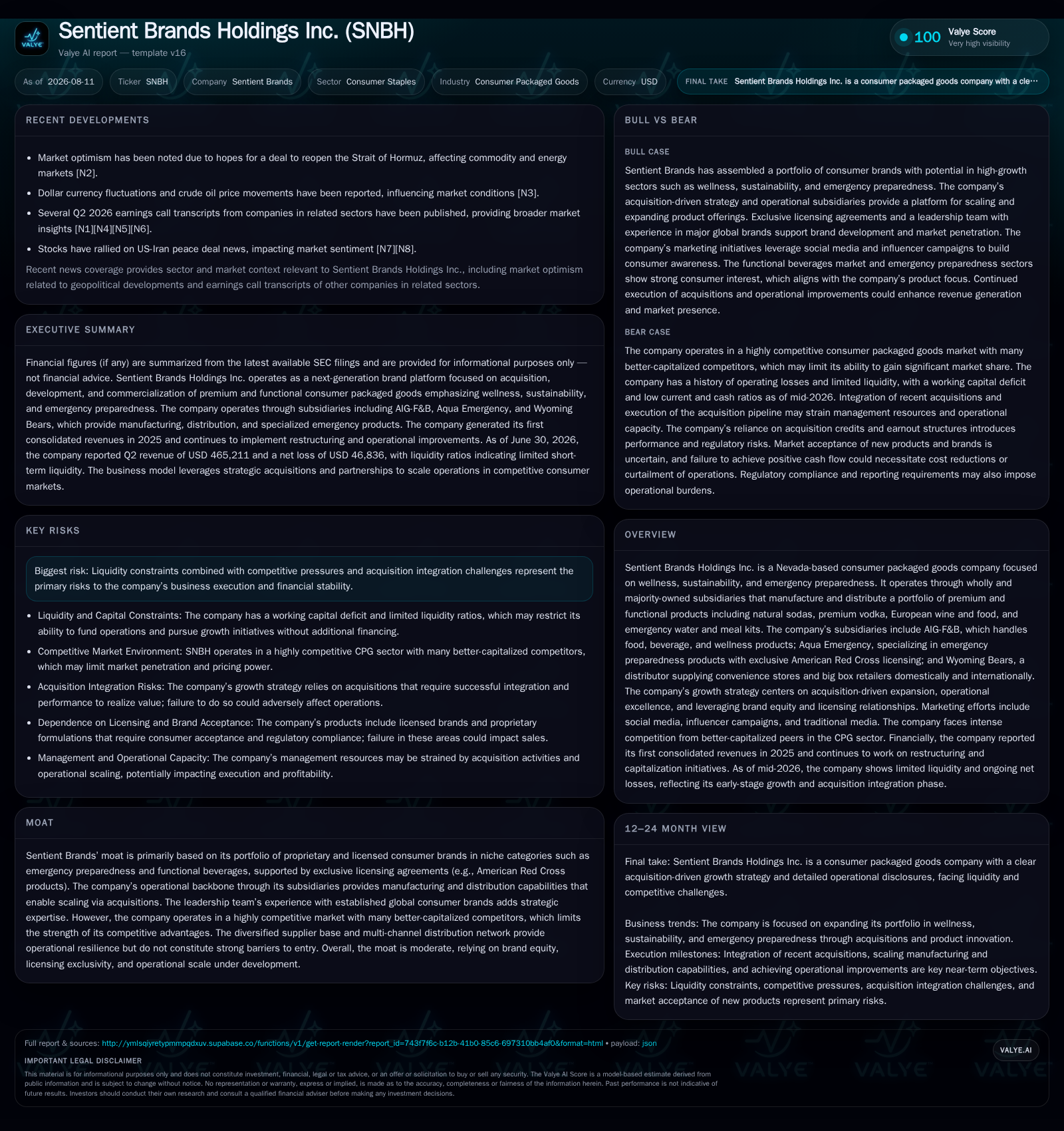
Sentient Brands Holdings Inc.'s latest quarterly filing highlights active execution of its acquisition-driven growth strategy, particularly in the wellness and emergency preparedness consumer packaged goods sectors. The company operates through subsidiaries that manufacture and distribute functional beverages, premium spirits, European foods, and licensed emergency products such as those under the American Red Cross brand. While its portfolio and exclusive licenses provide a moderate competitive moat, significant working capital deficits and complex earn-out arrangements pose risks to near-term financial stability. Continued progress in expanding distribution reach, product innovation, and acquisition integration will be critical to realizing growth potential.
Latest Quarterly Developments Highlight Acquisition Momentum Against Legal Contingency Backdrop
Sentient Brands Holdings Inc.’s August 11, 2026, 10-Q filing reveals critical updates on ongoing executive-led initiatives to address legacy issues from past corporate actions. The company entered into two confidential pre-filing settlement agreements with former management members as part of a “Compliance and Restitution” effort authorized by the Board of Directors [S2][S3]. This initiative aims to recover assets through cancellation of shares identified as improperly issued and to pursue potential legal remedies for breaches related to historical transactions. Notably, approximately 455,496 restricted shares have been surrendered for cancellation under these agreements [S3]. This is a strategic move mitigating dilution risk amid prior equity issuance controversies.
These legal resolution steps also reflect operational focus on stabilizing governance controls as Sentient executes its acquisition-driven growth strategy. The cooperation commitments from former management are intended to aid recovery litigation but are early-stage with uncertain timing or outcomes. While the announcements signal commitment to addressing embedded risks, they highlight material contingencies that investors should monitor given potential impacts on capitalization.
Multi-Subsidiary Ecosystem: Coordinating Manufacturing, Distribution, and Licensed Brand Assets
Sentient operates through a layered subsidiary structure involving wholly and majority-owned entities orchestrated to manage product development, manufacturing, branding, and distribution within niche CPG categories [S1][S4]. AIG-F&B (AIGFB), a wholly-owned Nevada-based subsidiary acquired in mid-2025 via asset purchase from American Industrial Group (AIG), forms the core manufacturing base for food, beverage, and wellness lines. Products include shelf-stable natural sodas like Original New York Seltzer®, functional nutrition items such as Arctic Frost® vodka and Burlone® European wines [S1][S8]. Owning upstream production assets grants important margin control but adds integration complexity across different product formats.
Aqua Emergency (AE NV), fully acquired by year-end 2025 after an initial majority stake purchase in July 2025, specializes in engineered shelf-stable emergency water and meal kits under an exclusive American Red Cross license [S1][S8]. This license endows Sentient with proprietary rights rare among typical emergency preparedness suppliers that generally compete without affiliation to major humanitarian brands. AE NV’s client base includes government agencies at various levels as well as NGOs—channels requiring compliance rigor unique among consumer products.
Wyoming Bears (WYB), acquired effective January 1, 2026 after extensions of control transfer timing during late 2025, serves as a specialized distributor supplying convenience store chains and large retailers domestically and internationally [S4][S8]. WYB’s broadened commercial reach supports Sentient’s omnichannel distribution model bridging retail shelves with institutional sales while allowing access to geographic expansion.
Together these subsidiaries create an operational backbone enabling scalability via acquisition integration but demand coordinated management of diverse supply chain complexities spanning beverage formulation to regulated emergency products.
Exclusive Licensing for Emergency Preparedness: Differentiating Brand Moat in a Crowded CPG Market
Perhaps Sentient’s most defensible strategic asset is its exclusive licensing agreement granting Aqua Emergency the rights to produce American Red Cross® branded emergency water and meal-ready-to-eat (MRE) products [S1][F1]. This exclusivity provides an important moat given regulatory challenges for shelf stable consumables in disaster response markets coupled with the prestige associated with the humanitarian brand.
While many competitors offer emergency preparedness supplies targeting government procurement or retail sales channels, few hold comparable licensed endorsements that enhance credibility for federal/state/local contracts or NGO partnerships. However, this moat is moderate since larger players with broader capital bases can compete aggressively through price or scale advantages. The licensing arrangement raises barriers through brand equity protection yet does not eliminate competition risks especially as new entrants innovate in long shelf-life materials or formulations.
Maintaining compliance standards demanded by such licensing ensures continued access but also adds cost layers limiting margin optimization relative to typical private labels. Consequently, the unique licensed portfolio differentiates Sentient but requires operational excellence to uphold regulatory certifications vital for federal/state purchasers.
Operational Backbone Enables Omnichannel Reach But Cost Pressures Persist
Wyoming Bears’ distribution capabilities underpin Sentient’s multi-channel market penetration efforts [S1][F1]. The company services convenience stores—important middlemarket retail outlets—as well as big box retailers who represent volume buyers requiring reliable logistical support. International shipments further diversify revenue streams but bring currency exposure and regulatory complexity.
Complementing brick-and-mortar access are direct-to-consumer e-commerce platforms leveraged mainly by wellness-oriented beverage brands like Arctic Frost vodka or Original New York Seltzer natural sodas [S24]. Government procurement contracts channel emergency preparedness items directly into institutional supply pipelines where timely delivery under strict standards is paramount.
Despite broad distribution reach supporting brand penetration KPIs (such as number of retail/wholesale partners served), gross profitability remains constrained. Operating losses reflect elevated customer acquisition costs combined with costs from supply chain realignments during the transition toward drop-ship manufacturing models designed to reduce inventory holding on subsidiary balance sheets [S16]. Managing these pressures while scaling sales will be critical for future operating income improvements.
Acquisition Strategy Driving Growth But Integration Complexity And Earn-Out Liabilities Weigh
Sentient’s growth thesis hinges on acquiring high-margin businesses within target categories such as health & wellness beverages and emergency products [S1][S4]. Consideration for these acquisitions typically involves issuing “Acquisition Credits,” which are share-based compensation contingent upon achieving revenue/EBITDA earn-out milestones over several years [S4].
This performance-contingent structure balances upfront cash outflows against incentivizing targets’ post-acquisition success but introduces financial statement timing risk. Failure to meet earn-out metrics delays or negates credit conversion into common stock whereas successful achievements increase diluted equity count progressively. The contingent nature complicates forecasting dilution impact while binding the company financially until milestones are resolved.
Integration challenges multiply given disparity across product lines—functional beverages have different supply chain demands than engineered emergency kits—and cultural assimilation among acquired management teams requires focused leadership time [S13]. These factors underscore tradeoffs inherent in fast-scaling via acquisition platforms seen also in larger players like Constellation Brands who face similar integration complexities alongside strong balance sheets.
Risks Lurk In Liquidity Constraints And Competitive Pressures
Financially Sentient faces notable liquidity stress marked by a working capital deficit exceeding $3.9 million at year-end 2025 heavily influenced by Acquisition Credit obligations amounting to roughly $2.6 million [S10][F1]. Its current ratio stands near 0.2 as of June 30, 2026—indicating short-term liabilities dramatically outweigh current assets including cash reserves of $144K [F1].
Such ratios underscore funding constraints aggravated by ongoing operating losses ($-1.02 million Operating Income Y/E 2025) that restrict organic cash flow generation needed for normal operations or further acquisitions [F1]
Moreover, competition from better-capitalized companies in functional beverages (like Keurig Dr Pepper) or emergency suppliers without licensing limits pricing power or speeds competing innovation cycles [S1]. Remaining agile despite these financial vulnerabilities necessitates operational cost controls alongside successful legal recoveries currently pursued.
Growth Levers: Innovation In Functional Beverages And Expanding Distribution Footprint
Sentient targets secular growth drivers spanning health-oriented functional beverages—such as low-sugar nutrient-enriched sodas—and sustainable premium spirits positioned toward mass-market affordability [S28]. Innovations may incorporate adaptogens or probiotics aligning with rising consumer trends favoring preventive nutrition.
Simultaneously expanding institutional packaging of shelf-stable emergency rations provides complementary growth vectors shaped by increasing government/NGO spend on disaster preparedness post-COVID era crises worldwide [S1]. These dynamics create recurring demand supported by regulatory certifications optimizing entry barriers.
Expanding distribution channels—including international export partnerships—and digital marketing via social media influencers further enable broader brand awareness amplification strategies designed to improve product sell-through rates over time.
However actualizing runway depends on successful new product launches meeting consumer expectations amid fierce competition characterized by high customer acquisition costs common across wellness markets.
Catalysts To Monitor: Earn-Out Milestones And Potential Legal Recovery Outcomes
Key upcoming milestones involve assessment points triggering conversion of Acquisition Credits into SNBH equity tied explicitly to predefined revenue or EBITDA thresholds over multi-year horizons [S4][S26]. Tracking earn-out achievement rates will illuminate effective integration success or required provision adjustments impacting financial statements.
Parallelly ongoing litigation strategies under “Compliance and Restitution” initiatives could materially adjust share counts through canceled securities recoveries or potential restitution proceeds from former management parties cooperating per settlement agreements dated July 1, 2026 [S3][S26]. Outcomes here bear significant implications for capital structure stability and shareholder dilution outlook.
Market participants would benefit from timely updates on dispute resolution progress alongside transparency regarding capital raising efforts addressing working capital gaps evident from recent financial disclosures.
Financial Profile Discussion: Liquidity Dynamics Frame Strategic Execution Challenges
Sentient's latest reported metrics reveal continued operating losses totaling approximately $1.02 million at year-end 2025 with net losses exceeding $1.2 million reflective of early-stage investment spending and acquisition costs [F1]. Cash on hand was about $144 thousand at June 30, 2026 while total debt was relatively low at approximately $15 thousand as of March 28, 2024, leaving net debt negative due to cash holdings but overshadowed by substantial current liabilities over $5 million driven largely by acquisition-related obligations [F1].
The resulting current ratio near 0.2 flags acute short-term liquidity stress requiring proactive capital sourcing either through equity issuance—which risks dilution—or tightened cost controls risking growth deferral [F1]
This financial profile typifies early-stage acquisition-driven CPG firms needing to balance rapid expansion investment against cash flow exhaustion before full operational leverage is realized. Maintaining sufficient liquidity will be crucial for sustaining ongoing manufacturing scale-up at subsidiaries while weathering competitive pressures prevalent within premium beverage and emergency preparedness markets known for margin sensitivity.
This analysis synthesizes all publicly filed regulatory documents through August 11, 2026. It abstains from forward-looking investment judgments focusing instead on current operating realities rooted firmly in disclosed data sources. Readers should consider monitoring subsequent filings for further clarity on litigation outcomes, earn-out progressions, financial position improvements, and integration milestones aligning with strategic aspirations outlined herein.
Disclaimer: This is research-only, informational analysis and not investment advice. It may include AI-generated interpretation and general industry context. Always verify important details using primary sources.

Comments