
Newmark Group Faces CEO Transition Amid Steady Commercial Real Estate Services Growth
Second-quarter 2026 results show operational resilience with a looming leadership change that could reshape strategic direction.
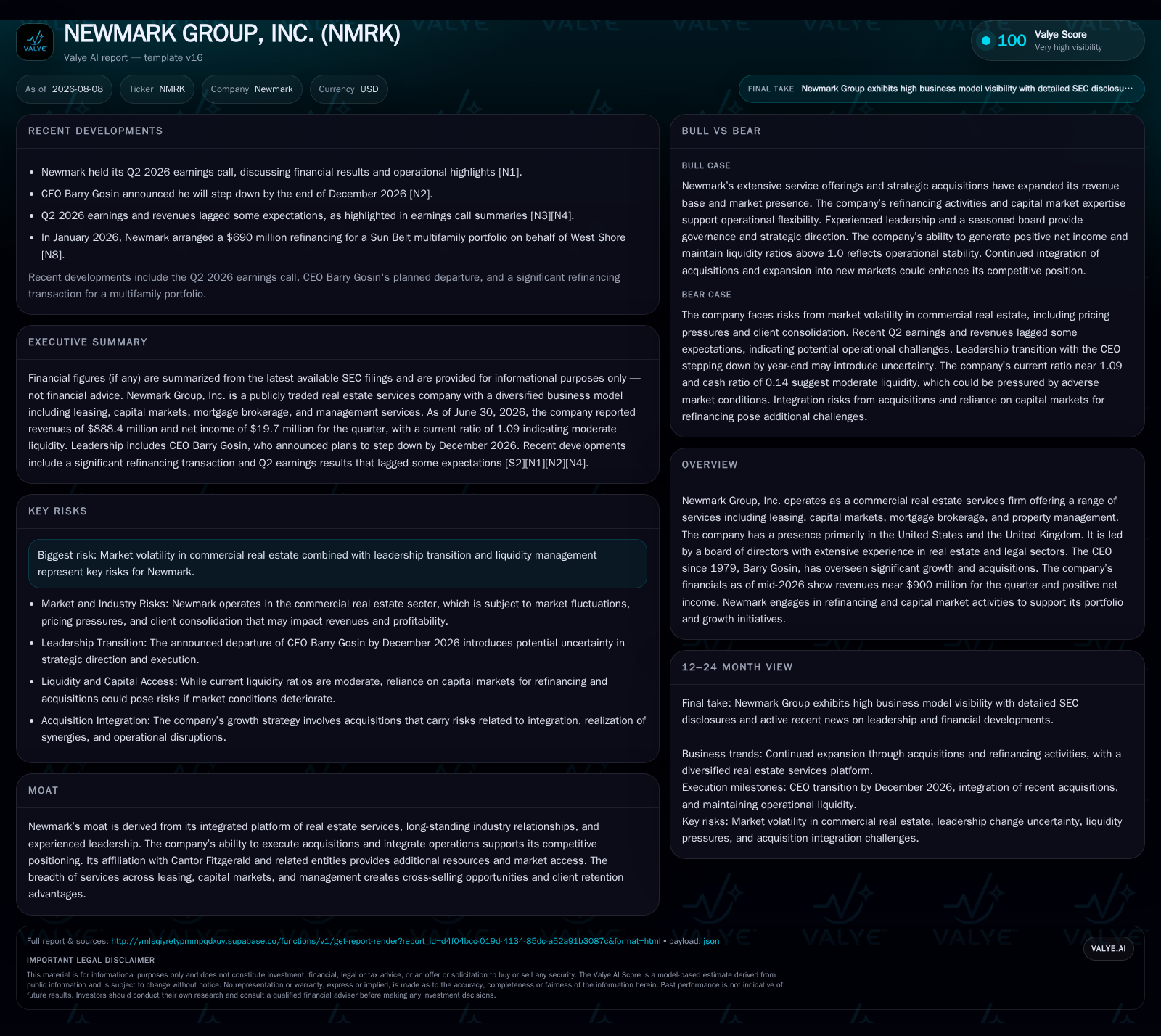
Newmark Group reported solid second-quarter 2026 operational results, maintaining robust revenue near $900 million and positive net income, driven by diversified commercial real estate services including leasing and capital markets advisory. The company's CEO Barry Gosin announced his planned year-end departure, shifting focus to Chairman of Newmark & Co., signaling a leadership transition with potential strategic implications. Newmark’s integrated service model, loyal client relationships, and affiliation with Cantor Fitzgerald underpin its competitive positioning amid industry cyclicality and interest rate sensitivities.
Recent Operating Update: Q2 2026 Performance and Leadership Change
Newmark Group's latest quarterly filing reports revenues sustaining near $900 million for Q2 2026, underscoring the firm's continued traction in core commercial real estate services during a complex macro backdrop [S2][F1]. This steady top-line performance occurred alongside positive net income outcomes, reflecting operational discipline within its diversified revenue mix of leasing commissions, capital markets advisory fees, mortgage brokerage commissions, and property management service revenues. Notably, the company disclosed a significant leadership update: CEO Barry M. Gosin announced he will step down on December 31, 2026, transitioning to the role of Chairman at Newmark & Company Real Estate Inc., the operating subsidiary. This move is designed to facilitate a smooth succession process while retaining institutional knowledge during the upcoming change [S3]. The Board expects to appoint a successor by year-end.
Gosin’s decades-long tenure has been pivotal in shaping Newmark's integrated platform approach and acquisition-driven growth trajectory. His continued presence as Chairman suggests an intent to maintain strategic continuity during what could be a critical inflection period for the company.
Business Model: Integrated Commercial Real Estate Services Platform
Newmark operates primarily as a full-service commercial real estate services firm spanning brokerage transactions (leasing commissions), capital markets advisory (sales and refinancing deals), mortgage brokerage (loan placement fees), and property management contracts delivering recurring fee income [S1]. Clients typically comprise property owners seeking leasing or sales representation, institutional investors requiring capital markets insights and financing solutions, and occupiers needing tenant representation or portfolio consulting.
Revenue generation hinges on transactional volume — measured in square footage leased or sold, number and value of capital markets deals closed — coupled with recurring management fees for assets under administration. Newmark's ability to cross-sell services across these lines enhances overall client retention and broadens wallet share. For example, a landlord using Newmark for property management may also engage its teams for leasing or refinancing advisory.
The firm's affiliation with Cantor Fitzgerald extends competitive advantages through additional deal flow channels, access to capital market expertise, and greater resource depth that a pure standalone brokerage cannot replicate easily. This integration supports higher-margin capital markets transactions which can offset cyclical softness in leasing demand.
Operational KPIs such as average lease term negotiated, occupancy rates in managed properties, and utilization rates of brokers directly impact revenue efficacy and margin sustainability—although explicit current-period KPI disclosures are limited in the filings.
Industry Structure and Competitive Positioning
The commercial real estate services space is characterized by cyclical sensitivity influenced by macroeconomic growth trends, interest rate fluctuations impacting financing activity, and evolving tenant preferences affecting leasing dynamics. Firms compete on breadth of service offerings, geographic reach, specialist expertise in sectors like office or industrial real estate, technological adoption for data analytics and client engagement, as well as reputation among institutional clients.
Relative peers include CBRE Group and JLL — giants with global footprints leveraging technology-heavy platforms — Cushman & Wakefield emphasizing capital markets strength, Savills with international advisory focus, and Marcus & Millichap specializing in investment sales brokerage. Compared to these peers, Newmark represents a scaled specialist with substantial US and UK presence but less international breadth than some rivals.
Newmark's moat centers on its integrated services platform enabling cross-selling synergies; long-standing leadership cadre fostering deep client relationships; plus Cantor Fitzgerald affiliation augmenting capital markets execution prowess. However, it faces competition from both large diversified incumbents deploying advanced tech-enabled productivity tools and nimble boutique firms targeting niche segments.
Growth Drivers
Structural industry growth levers for Newmark include economic expansion driving new commercial space demand and portfolio optimization efforts by corporate occupiers seeking efficiency gains via outsourcing leasing and property management functions. Additionally, rising capital market transaction volumes — fueled by refinancing waves amid fluctuating interest rates — present opportunities for enhanced mortgage brokerage and advisory revenues.
Newmark's capability to capture these trends benefits from its cross-selling model which increases client engagement depth across multiple service lines. Geographic expansion into fast-growing US urban centers alongside strengthening UK foothold supports incremental growth potential. Furthermore, ongoing technology investments aimed at improving broker productivity and customer experience can further differentiate service quality [S1].
Regulatory shifts or tax policy changes incentivizing real estate deal activity could provide tailwinds if harnessed effectively through strategic advisory services.
Risks and Watchpoints
The firm remains exposed to cyclical downturns typical of commercial real estate cycles which compress transaction volumes reducing brokerage commissions temporarily. Interest rate volatility impacts refinancing activity directly affecting mortgage brokerage loan volumes — a significant revenue component subject to macro policy shifts.
Leadership transition risk is material given CEO Gosin’s central role; successor selection quality will influence client confidence retention crucial for sustaining deal origination momentum [S3]. Liquidity management warrants attention as Newmark carries approximately $867 million total debt against $260 million cash balances resulting in net debt around $607 million [F1].
Competitive pressures from larger global firms leveraging broader service ecosystems and technology investments challenge Newmark’s growth pacing. Client concentration risks from dependence on large accounts could lead to volatility if key relationships weaken. Regulatory complexities around real estate financing demand vigilant compliance which incurs operational costs.
Technology-driven disruption presents ongoing threat; failure to enhance digital capabilities risks losing efficiency advantages versus peers focused on data analytics driven service delivery.
What to Watch Next
Key milestones include identification of CEO successor before year-end 2026; tracking management’s communication regarding transition plans will inform stability assessment [S3]. Operationally, monitoring second-half 2026 earnings releases will reveal resilience of transactional volumes amid anticipated macroeconomic uncertainties.
KPIs such as quarterly transaction volume growth (square footage leased or deals closed), capital markets deal value progression, mortgage brokerage loan origination trends, client retention rates post-CEO changeout, and property management fees trajectory serve as actionable indicators of execution success.
Capital structure developments including any refinancing initiatives or new credit facilities will signal financial flexibility status ahead of maturities. Management commentary about margin leverage opportunities through technology investments or cost rationalization holds importance for medium-term profitability outlook.
Financial Profile Discussion
As of June 30, 2026 balance sheet snapshots reveal $260 million in cash equivalents supporting liquidity against total debt approximating $867 million—implying net debt near $607 million [F1]. Revolving credit agreements linked with Cantor Fitzgerald underpin access to liquidity while interest obligations on debt remain manageable given stable operating income trends noted through recent quarters [S2]. The company's capacity to maintain positive net income amidst uncertain market conditions suggests operational efficiency but requires ongoing scrutiny especially as debt maturities approach.
It aims to clarify Newmark Group’s operating posture amidst evolving executive leadership while framing competitive positioning within broader commercial real estate services dynamics.
Disclaimer: This is research-only, informational analysis and not investment advice. It may include AI-generated interpretation and general industry context. Always verify important details using primary sources.

Comments