
Golden Growers Cooperative Prepares for Dissolution With Sale of ProGold Stake
The Cooperative’s latest 10-Q confirms advancing liquidation plans centered on selling its ProGold joint venture interest and winding down operations.
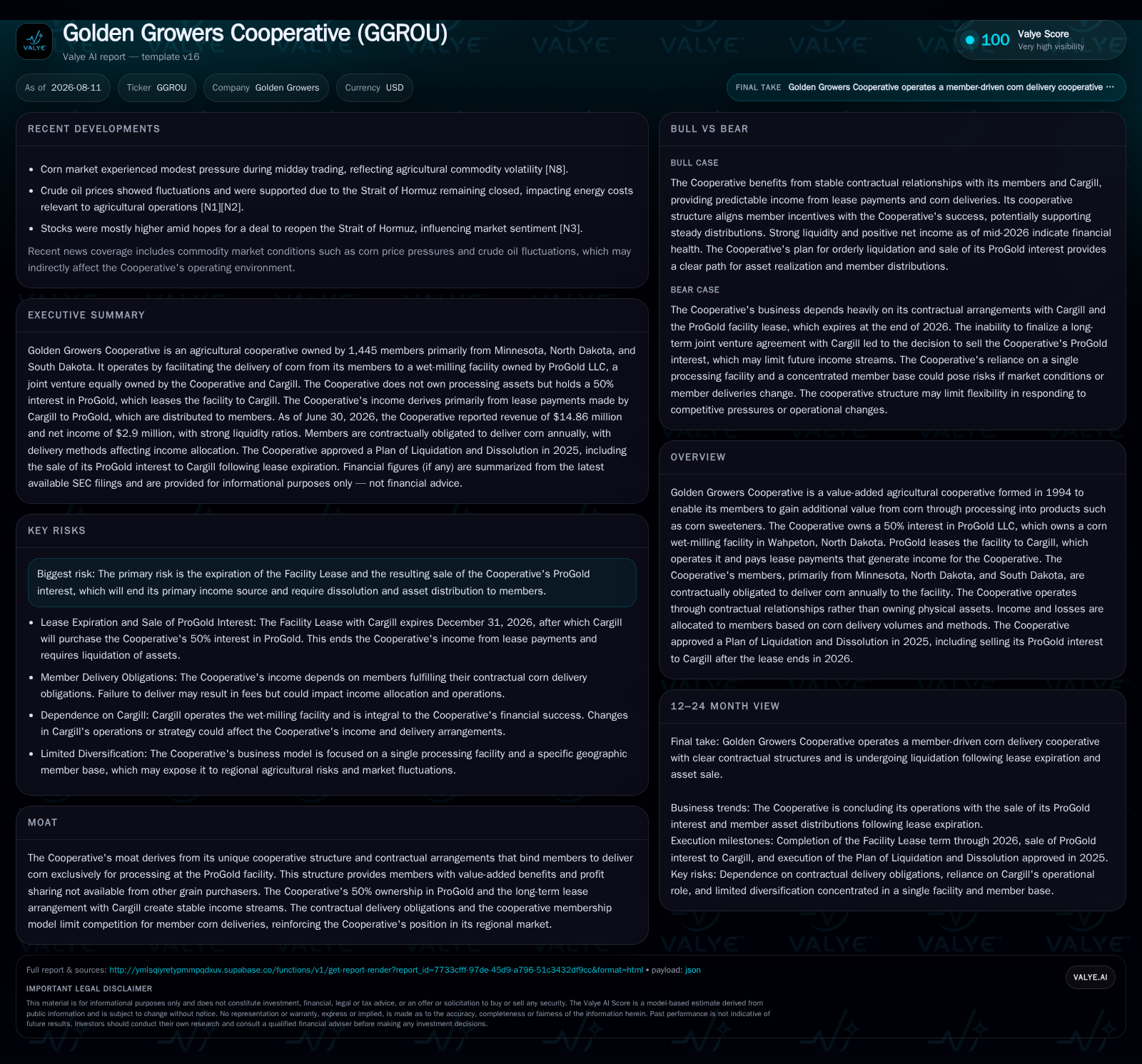
Golden Growers Cooperative’s August 2026 quarterly filing reinforces its strategic pivot toward dissolution following the expiration of the lease on its core wet-milling facility. The Cooperative’s business model relies heavily on its 50% stake in ProGold LLC, which owns the corn wet-milling plant leased to Cargill. Stable lease payments from Cargill have historically underpinned member distributions, derived from contractual corn delivery obligations. With the lease expiring at year-end 2026 and no new joint venture agreement reached, the Cooperative is executing a Plan of Liquidation, including asset sale and final member distributions.
Quarterly Update Signals Imminent Cooperative Dissolution Steps
Golden Growers Cooperative’s August 2026 Form 10-Q reiterates that it is progressing according to its approved Plan of Liquidation and Dissolution following strategic decisions made at the 2025 Annual Meeting [S2], [S9]. Central to this plan is the expiration of the operating lease between ProGold LLC—a joint venture equally owned by the Cooperative and Cargill—and Cargill’s operation of the Wahpeton, North Dakota wet-milling facility by December 31, 2026 [S16]. With no new joint venture agreement finalized by this deadline due to prevailing economic conditions over recent years, Cargill is set to exercise its contractual right to purchase Golden Growers’ 50% membership interest in ProGold for $81 million plus half of remaining lease payments through year-end [S16]. This transaction will terminate the Cooperative's primary income stream generated from lease payments currently paid by Cargill.
This represents a material inflection point: after decades of stable revenue via leasing arrangements supporting distributions to members, the Cooperative moves into an asset liquidation phase. The Plan stipulates distributing proceeds from this sale alongside other assets back to members post creditor obligations [S9]. The latest filing underscores a finite timeline on core earnings derived from facility leasing, signaling a significant transformation in operating metrics going forward.
Golden Growers’ Cooperative Safeguards Value Through Joint Venture Ownership and Leasing
Golden Growers operates predominantly as an agricultural cooperative that aggregates member-produced corn for processing into value-added products such as corn sweeteners through joint venture ownership rather than owning or operating processing facilities directly [S1]. Established in 1994 with members primarily in Minnesota, North Dakota, and South Dakota, Golden Growers entered into partnership with American Crystal Sugar Company to form ProGold LLC—a Minnesota limited liability company—which built the wet-milling plant in Wahpeton [S1].
ProGold owns the wet-milling facility but leases it entirely to Cargill under a long-term operating lease first signed in 1997 and extended through December 31, 2026 [S1], [S16]. ProGold's board equally represents the Cooperative and Cargill and requires majority approval for major transactions [S22]. Lease payments from Cargill provide steady cash flow streams distributed to Golden Growers' members based on their proportional corn deliveries [S11]. This structure creates a moat centered on joint venture governance and contractual revenue sharing rather than direct operational control—distinct from integrated processing companies but common among agricultural cooperatives seeking scale advantages without capital-intensive plant ownership.
Contractual Delivery Obligations Secure Corn Supply Amid Structural Changes
A key pillar supporting Golden Growers' income model is its members' contractual obligation to provide approximately 15.5 million bushels of corn annually for processing at the ProGold facility [S21], [S23]. Members hold units within the cooperative proportional to their expected deliveries and sign uniform member agreements obligating them either to physically deliver corn directly (Method A) or authorize the cooperative—with Cargill acting as agent—to arrange delivery (Method B) [S23]. These arrangements help ensure consistent supply continuity critical for sustaining lease revenues until dissolution.
Members electing Method A incur incentive payments for physical delivery (currently $0.05 per bushel), reinforcing compliance; those choosing Method B pay an agency fee ($0.02 per bushel) reflecting services rendered by Cargill as agent [S23]. The cooperative allocates income among members based both on volume delivered and delivery method pools—with at least 15% of income allocated to Method A members even if they constitute fewer bushels—to incentivize direct delivery [S24].
Significantly, these contractual frameworks impose real switching costs; noncompliance results in fees charged both by Cargill agent services and indemnities for purchase of shortfalls on behalf of defaulting members [S23].
Comparative Industry Positioning: Cooperative Income Models Versus Direct Processing Equity
Golden Growers falls within a category of agricultural cooperatives that leverage joint venture stakes combined with leasing arrangements rather than directly owning or operating large-scale wet milling plants typical of companies like Archer Daniels Midland (ADM) or Ingredion Incorporated. ADM exemplifies vertically integrated models owning multiple processing facilities with direct operational control generating returns through product sales across diverse end markets. In contrast, Golden Growers’ cooperative model captures value primarily via structured income-sharing agreements tied to an asset operated by an experienced processor partner—Cargill—who assumes operational risks.
Among peer cooperatives managing value-added operations, American Crystal Sugar Company offers a useful comparison. Like Golden Growers, American Crystal Sugar operates as a grower-owned cooperative involved in owning processing assets but faces different scale dynamics and market exposure linked directly to sugar production rather than corn sweeteners. Both emphasize providing members benefits through profit sharing rather than acting solely as commodity marketers.
Golden Growers’ strategy reduces capital expenditure requirements and operational complexities associated with plant management; however, it inherently ties future profitability and cash flow stability to continued partnership viability with Cargill and facility uptime [S21]. This reliance deepens challenges amid facility aging considerations prompting increased maintenance expenditures funded through joint venture governance processes
Growth Prospects Before Dissolution: Limited but Rooted in Member Delivery Stability
With liquidation underway due to lease expiry without renewal, meaningful long-term growth avenues are constrained. However, near-term performance depends critically on maintaining strong member compliance with delivery obligations that sustain steady volumes facilitating full receipt of annual $16 million lease payments from Cargill processing operations through December 2026 [S16], [F1].
Stable or improving corn market prices can further bolster member income shares by elevating underlying economic returns trapped within cooperative profit allocations tied to actual bushels delivered [F1], [S23]. The cooperative also seeks operational efficiencies via low management overhead—employing just one full-time employee including CEO/CFO functions—as well as leveraging established service agreements with Cargill minimizing expenses related to logistics coordination [S17], [S24].
Continued attention on regulatory compliance costs remains warranted given environmental regulations potentially triggering capital projects at the aging facility; while non-material currently, these charges reduce distributable income proportionally among members until winding up [S21], [S17].
Risks Stem from Lease Expiry, Asset Sale Execution, and Member Compliance
The closure arising from Facility Lease expiration constitutes Golden Growers’ principal structural risk: losing the operating lease eliminates stable lease revenue inflows foundational to patronage distributions driving member incomes. Despite provisions requiring sale of ProGold interest at $81 million plus residual rents if no new JV agreement is forged by December 31, 2026 [S16], execution timing presents dilution risk if delays occur.
Member attrition or failure to meet delivery commitments could compound revenue erosion prior to asset disposition thus reducing ultimate proceeds available for distribution [S23]. Though contracts minimize such risks today through stringent delivery obligations with penalty mechanisms enforced by Cargill agent role, transitional periods often prompt uncertainty affecting volumes delivered
Operational disruptions at the wet-milling facility—whether due to aging infrastructure requiring expensive maintenance or external shocks—may induce temporary reductions in utilization damaging profitability prior to wind-down completion. Additionally, any disputes arising within joint venture governance frameworks could complicate consensus required for timely sale closure or capital improvement approvals necessary through year-end operation phases.
Upcoming Milestones: Key Dates for Lease Expiration and Asset Transfer Monitoring
December 31, 2026 stands as a decisive milestone marking expiry of the current Facility Lease between ProGold LLC and Cargill that governs operation of the Wahpeton plant central to Golden Growers’ equity value generation model [S16]. Following this date—and absent new agreement—the Operating Agreement obligates Cargill to acquire Golden Growers’ membership interest within thirty days delivering definitive conclusion regarding ongoing income streams and asset ownership structure.
Closely monitoring confirmations from both parties about timeliness in executing transfer documents alongside any capital expenditure initiatives will serve as critical demand-side indicators evaluating orderly completion versus potential execution risk or delays withholding final distributions. Subsequent disclosures will also illuminate how proceeds are allocated among members relative to outstanding liabilities during wind-up phases [S9], [S16].
Financial Profile Discussion: Income Streams Receding Toward Wind-Down
As captured in recent financial data ending June 30, 2026, Golden Growers reported net income attributable largely from joint venture profit sharing supported by lease payments from Cargill totalled at $16 million annually through the current Facility Lease term [F1], [S2], [S16]. Revenue figures reflect $62.3 million recognized at fiscal year-end December 31, 2025 consistent with ongoing cooperatively structured cash flows reinvested or distributed proportionally across member interests committed via contractual deliveries.
Liquidity remains ample relative to obligations with current assets near $2.44 million against minimal current liabilities approximating $12 thousand yielding an exceptionally high current ratio over 200x indicating sufficient capacity for managing winding up administrative expenses associated with dissolution activities alongside member payoff scheduling [F1]. Operating income recorded was approximately $5.8 million during prior reported periods reflecting relatively steady margin profiles before planned cessation.
Golden Growers Cooperative exemplifies how agricultural cooperatives in value-added corn processing leverage joint venture ownership combined with operating leases managed by major agribusiness partners such as Cargill Inc. This hybrid approach balances scale benefits without bearing direct processing complexity until structural events force planned exit. Its latest quarterly update underscores imminent settlement milestones constraining future growth but reinforcing commitment toward orderly realization of member equity value amid regional market stability backed by binding delivery contracts.
Investors observing cooperative agricultural aggregates can reference Golden Growers against other cooperatives managing joint ventures like American Crystal Sugar Company or fully integrated processors like ADM for understanding differing risk/reward trade-offs driven primarily by governance structures governing asset control versus partnership revenue-sharing models prevalent in Midwest US grain-processing sectors.
Disclaimer: This analysis is provided for informational purposes only and does not constitute investment advice or research views regarding any securities mentioned herein.
Disclaimer: This is research-only, informational analysis and not investment advice. It may include AI-generated interpretation and general industry context. Always verify important details using primary sources.

Comments