
Ambiq Micro Advances Ultra-Low Power Edge AI with Elevated Margins and Design Win Momentum
Ambiq Micro’s latest quarter highlights growing demand for its SPOT® technology despite industry cyclicality and ongoing operating losses.
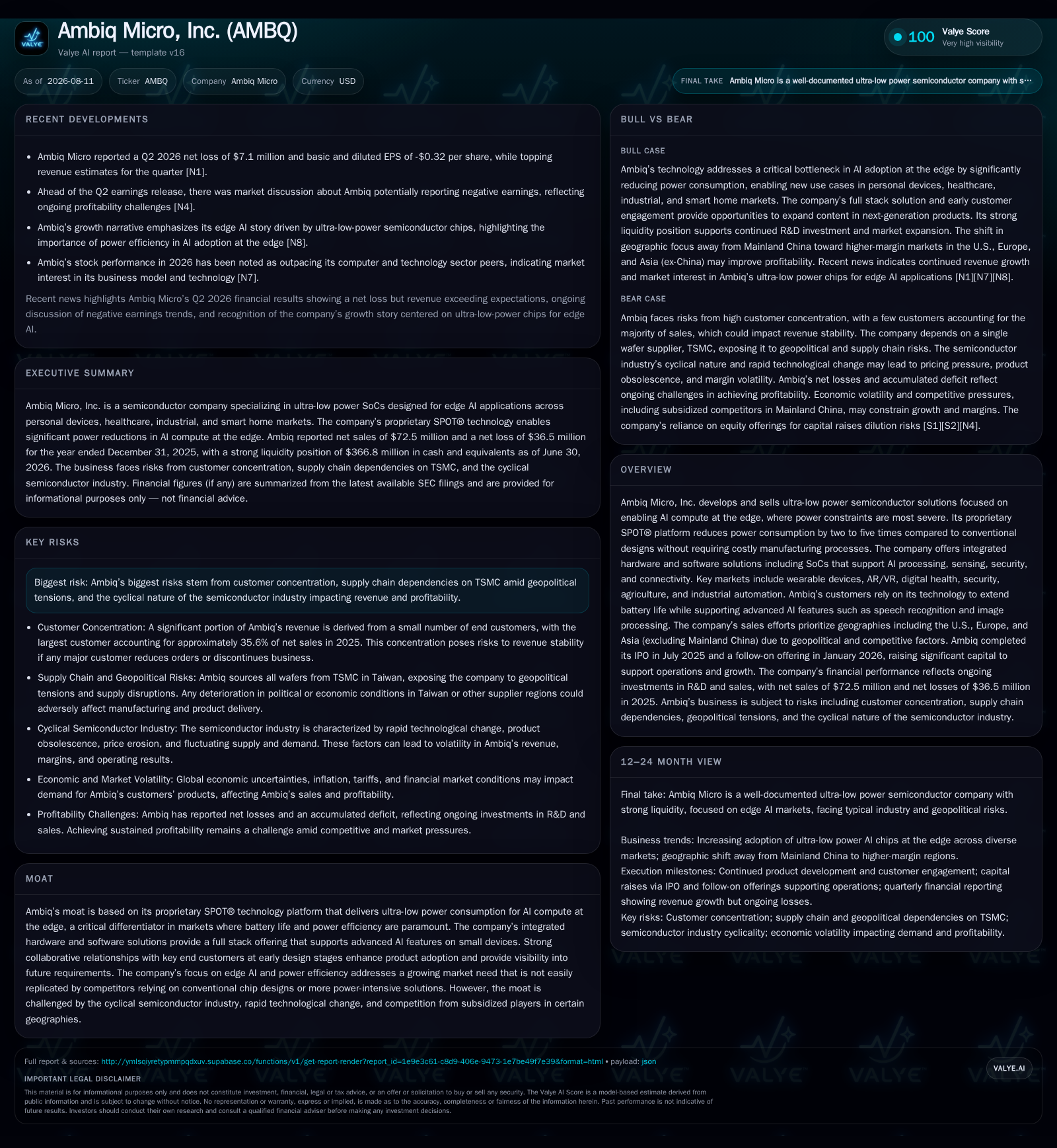
In Q2 2026, Ambiq Micro reported revenue growth ahead of estimates and improved gross margins driven by strategic focus outside Mainland China and higher-margin design wins. The company continues heavy investment in advancing its proprietary ultra-low power SPOT® platform targeting edge AI applications across wearables, AR/VR, and industrial automation. While operating losses persist due to elevated R&D and SG&A spending associated with public company transition, cash reserves remain robust, supporting growth initiatives amid semiconductor supply chain risks. The key influencers for future performance will be sustained design win expansion, geographic balance, and supply chain stability.
Recent Operating Update: Q2 Highlights Confirm Strategic Momentum
ductor innovators.
Business Model: Proprietary Ultra-Low Power Architecture Fuels Edge AI Differentiation
Ambiq Micro operates as a fabless semiconductor firm designing and selling integrated system-on-chip (SoC) solutions tailored for ultra-low power consumption in edge AI applications. Its proprietary SPOT® technology platform achieves two to five times lower power usage relative to conventional chips without relying on expensive fabrication techniques—a critical advantage in battery-dependent portable environments like wearables and AR/VR headsets [S1]. Revenue is primarily generated through direct product sales to device OEMs who integrate Ambiq’s chips into consumer electronics and industrial automation products. Early-stage collaboration with customers during their design cycles facilitates design wins—key leading indicators of future volume adoption—and enhances Ambiq’s ability to tailor hardware-software integrated solutions supporting advanced AI inference tasks such as speech recognition and image processing on small form factors [S7][S22].
This model demands consistent R&D innovation, as evidenced by sustained spend levels above $38 million annually focused on next-generation products like the Atomiq chip series designed to improve performance per watt metrics further [S12]. Selling, general & administrative expenses have also risen following the company’s transition to a public entity due to compliance costs and investor relations activities [S14]. Ambiq mitigates capital intensity by outsourcing wafer fabrication primarily through established foundries such as TSMC yet faces risk exposure from this supply dependence [S25].
Industry Structure and Competitive Position: Fabless Edge AI Chips with Focused Geographic Strategy
The semiconductor segment targeting edge AI is characterized by intense competition predicated on delivering incremental gains in power efficiency alongside robust integration of sensing and connectivity modules within compact SoCs. Ambiq competes mainly with other fabless designers specializing in low-power AI chips such as Ambarella or Intel Movidius but distinguishes itself through its SPOT® platform that substantially reduces energy consumption without compromising compute capabilities.
A significant structural constraint arises from reliance on foundry capacity at firms like TSMC—an industry leader whose geopolitical entanglements could impact supply stability adversely. Additionally, customer concentration presents risk; a few large OEMs accounted for more than 90% of sales in recent years indicating that shifts in any single customer’s product roadmap could disproportionately affect revenues [S22]. However, close collaboration during early design phases creates switching costs that may help lock in these customers long-term.
Geographically the company focuses on selling predominantly in the U.S., Europe, Taiwan, Singapore, and certain parts of Asia excluding mainland China to avoid heightened trade tensions while capturing growth from multiple dynamic regions [S1][S7]. Accelerating demand from wearable technology adoption coupled with growth in markets like industrial IoT positions Ambiq well if it can scale accordingly.
Growth Drivers: Expanding Market Demand for Battery-Efficient Edge AI Solutions
Multiple industry trends empower Ambiq’s long-term opportunity set. Increasingly powerful AI functions are migrating to battery-constrained devices requiring drastic improvements in power efficiency—precisely Ambiq’s forte. Wearables including fitness trackers require extended battery life without sacrificing real-time health monitoring features powered by embedded sensors processed locally using AI compute cores rather than cloud backends.
Additionally, AR/VR applications require compact chips delivering efficient sensory fusion and image processing while maintaining user comfort via minimized heat generation tied closely to power draw. Industrial automation including smart agriculture relies on ruggedized sensors executing inferencing onsite to reduce latency and safeguard data privacy—a growing concern encouraging localized AI processing over cloud alternatives.
These diverse applications collectively drive escalating demand for integrated SoC solutions that combine sensor integration, connectivity modules (e.g., BLE or Wi-Fi), security features, and robust AI inference engines within a tiny energy envelope. Early engagement with key OEMs also helps anticipate evolving requirements faster than peers enabling design wins which act as critical revenue predictors given long product development cycles typical in this space [S7][S22]
Risks and Watchpoints: Concentration, Geopolitical Supply Chain Dependencies & Cyclicality
Ambiq faces several inherent sector risks:
- Customer concentration remains high; top three end customers comprised over 80% of net sales recently meaning business volatility can be material if any large client curtails orders unexpectedly or switches suppliers [S22].
- Heavy dependence on third-party foundries such as TSMC exposes manufacturing continuity risks especially amid escalating U.S.-China trade tensions impacting chip supply worldwide [S25][S18].
- Semiconductor cyclicality related to fluctuating end-market demand can result in notable swings in order volumes causing underutilized capacity or inventory build-up affecting margins.
- Rapid technological advancements necessitate continuous R&D investment with no guaranteed returns potentially diluting resources or leading competitors developing breakthrough competing architectures challenging SPOT®’s relevance.
- Transitioning into public company status has heightened administrative overheads contributing to ongoing operating losses which must ultimately translate into sustainable profitability through scaled volume gains to achieve long-term financial stability [S14].
Monitoring how Ambiq manages supply chain robustness while diversifying its customer base beyond a handful of large OEMs will be crucial. Sustained success depends significantly on securing incremental design wins translating into volume production ramp-ups amidst macroeconomic uncertainties.
What To Watch Next
Key upcoming milestones include:
- Announcements or evidence of new major design wins especially outside existing core accounts would provide positive signals about growing adoption beyond concentrated customers.
- Progress toward next-generation SPOT® platform products incorporating improved power efficiency or feature sets attractive across high-growth use cases.
- Updates on supply chain status particularly regarding foundry capacity commitments amid geopolitical challenges affecting key regions.
- Quarterly financial metrics focusing on revenue growth rates outside Mainland China segments alongside gross margin trends that would confirm effective product mix enhancements.
- R&D spend trajectory relative to revenue gains signaling improving operating leverage potential crucial for eventual path to profitability.
- Any changes in liquidity position or capital raise plans highlighting financial runway adequacy are also relevant given operating cash burn patterns documented.
Financial Profile Discussion
As of June 30, 2026, Ambiq reported cash and equivalents totaling approximately $366.8 million against current liabilities around $26.1 million yielding a very strong current ratio near 15.95 reflecting robust short-term liquidity available for ongoing investments [F1]. These cash reserves provide a solid buffer allowing continuation of heavy research & development spending critical for sustaining competitive advantage at this stage of business maturation [F1][S2][S12].
The company raised significant proceeds through an IPO completed mid-2025 followed by a follow-on equity offering early 2026 totaling nearly $180 million net proceeds after underwriting fees bolstering balance sheet strength vs prior periods [S4][S23]. Continued elevated SG&A expenses relate mainly to public company costs incurred post-IPO including regulatory compliance and investor outreach overheads expanding alongside stock-based compensation allocations [S14].
Maintaining disciplined capital allocation balancing R&D acceleration with prudent expense management will be pivotal as Ambiq aims eventually toward narrowing operating losses through scaled revenue traction supported by design win conversion cycles with tier-one OEMs exposed across diversified geographies.
This analysis synthesizes publicly filed financial data as of August 11, 2026 along with detailed company disclosures providing informed insight into Ambiq Micro’s unique niche within the evolving ultra-low power edge AI semiconductor sector without expressing investment research views.
Disclaimer: This is research-only, informational analysis and not investment advice. It may include AI-generated interpretation and general industry context. Always verify important details using primary sources.

Comments