
Purple Innovation’s Proprietary Polymer and Omni-Channel Expansion Shape Competitive Sleep Products Position
Purple Innovation leverages patented Hyper-Elastic Polymer technology and vertically integrated manufacturing to drive differentiated comfort products amid listing risks.
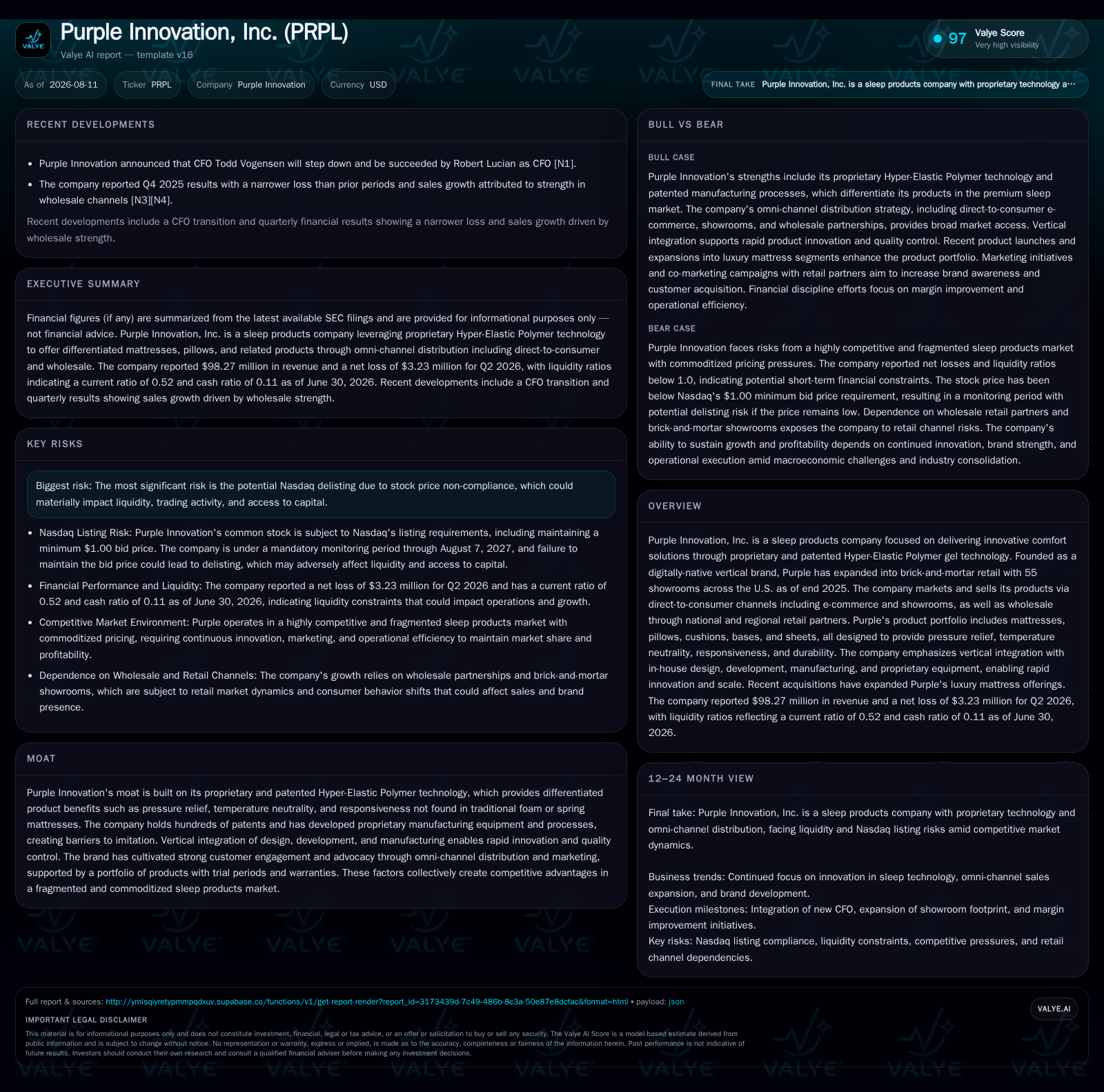
Purple Innovation, a digitally-native mattress and sleep products company, continues expanding its omni-channel footprint with 55 U.S. showrooms complementing direct-to-consumer e-commerce and broad wholesale partnerships. Its proprietary Hyper-Elastic Polymer gel technology underpins product differentiation by delivering pressure relief, temperature neutrality, and responsiveness uncommon in foam-based competitors. Despite solid brand engagement and innovation capabilities, operational challenges are evident with losses reported in the latest quarter and a constrained liquidity profile. The company remains at risk of Nasdaq delisting over share price compliance but maintains current listing with stringent monitoring. Growth depends on sustaining innovation, expanding retail and wholesale channels, optimizing customer acquisition costs, and managing warranty liabilities.
Recent Operating Update
Purple Innovation’s latest quarterly filing for Q2 ended June 30, 2026, reveals ongoing operational headwinds with revenue trailing expectations alongside a loss for the period [S2][S3][N1]. The company reported cash and equivalents of $23.3 million as of quarter-end but faces a challenging liquidity posture highlighted by a current ratio of 0.52 due to current liabilities outweighing current assets [F1]. This profile underscores constraints on short-term operating flexibility despite scale. Importantly, Purple recently received formal notification from Nasdaq confirming compliance with the minimum $1.00 bid price listing rule after prior noncompliance issues but is subject to mandatory monitoring through mid-2027 which presents persistent stock liquidity risk [S2]. Given this backdrop, Purple’s near-term focus appears anchored on stabilizing top-line momentum while controlling costs tied to customer acquisition and warranty claims.
Business Model Overview: Proprietary Technology Meets Omni-Channel Sales
Purple Innovation’s business model centers on its patented Hyper-Elastic Polymer gel technology—a distinctive material engineered to offer pressure relief, temperature neutrality, and responsive support that traditional foam or spring mattresses typically cannot match [S1]. This proprietary technology creates a product moat enforced by hundreds of patents alongside specialized injection molding manufacturing equipment built internally to scale production efficiently. Vertical integration enables rapid design iteration and quality control advantages rare among peers reliant on commoditized materials.
Revenue streams are diversified across three main channels. Direct-to-consumer (DTC) encompasses sales via Purple.com e-commerce platform, branded retail showrooms (55 locations nationwide as of end 2025), customer contact centers, and online marketplaces. Wholesale distribution supplements this by placing products within large national furniture and specialty retailers such as Mattress Firm (the largest partner since its partnership launch in 2017), Ashley Furniture, Costco, Big Sandy, Raymour & Flanigan, among others [S1]. Through omni-channel distribution, Purple seeks to balance wide market access with engaged customer experiences.
Monetization hinges primarily on sales of mattresses complemented by ancillary sleep comfort products like pillows, cushions, adjustable bases, and premium sheets designed around the core polymer comfort theme. This assortment allows potential upselling opportunities leveraging existing brand trust. All mattresses carry extended warranties (up to ten years) plus generous trial periods to reduce buyer hesitation—features that promote consumer confidence but introduce warranty claim cost risks that must be carefully managed [S1]. The company’s marketing engine leans on data-driven outreach across digital channels supported by word-of-mouth from passionate customers who advocate Purple’s unique sleep experience.
Industry Structure and Competitive Position
The sleep products industry is fragmented yet intensely competitive with players spanning digitally-native brands (Casper Sleep Inc., Tuft & Needle), traditional manufacturers (Tempur Sealy International), wholesale retailers (Mattress Firm), and sleep tech innovators (Sleep Number). Purple occupies a distinctive niche blending proprietary material science with vertical manufacturing integration—a contrast to foam-focused bed-in-a-box rivals frequently outsourcing production.
Purple’s patented polymer technology creates credible differentiation by addressing critical consumer demands for pressure point relief without heat retention common in conventional foams. This aligns well with increasing consumer awareness around sleep health driving demand for premium comfort solutions. However, innovation lead must be sustained by continuous patent developments and manufacturing advances given rapid competitive responses possible in a commoditized category.
Key operating metrics framing comparative performance include same-store sales growth at showrooms indicating channel health; direct-to-consumer revenue proportion reflecting brand affinity; average order value influencing overall economics; customer acquisition cost (CAC) effectiveness impacting profitability; warranty claim rates critical for gross margin stability; and inventory turnover rates affecting working capital efficiency.
Growth Drivers
Several structural drivers underpin Purple’s growth prospects:
- Increasing consumer prioritization of sleep quality fosters demand for innovative comfort technologies combining pressure relief with temperature regulation — attributes delivered by Purple’s Hyper-Elastic Polymer [S1].
- Expansion of omni-channel retail footprint including launching new showrooms boosts brand visibility while catering to different buyer preferences between physical touchpoints versus online convenience.
- Scaling direct-to-consumer e-commerce sales facilitates higher margin business via brand-owned platforms leveraging personalized marketing insights.
- Deepening wholesale relationships across prominent national chains secures broader market penetration beyond self-operated stores.[S1]
- Ancillary product ecosystem upsell potential with pillows, bedding accessories designed using signature material compounds increases average order values.
- Brand advocacy cultivated via repeat customers and evangelists lowers incremental CAC through organic word-of-mouth amplification.
Successful navigation of these factors particularly hinges on maintaining product innovation cadence enabled by vertical integration while carefully managing capital invested into showroom openings versus expected returns.[S1]
Risks and Constraints
Despite technological strengths, Purple faces notable risks:
- Nasdaq listing risk remains critical despite current compliance; failing bid price requirements during the mandatory monitoring window would trigger delisting consequences severely impacting liquidity and capital access [S2].
- Highly competitive mattress segment risks pricing pressure especially as legacy manufacturers and emerging bed-in-a-box brands accelerate innovation cycles.
- Warranty liability exposure from long-duration coverage necessitates vigilant claims tracking; unexpected upticks could compress margins materially given thin industry targets on gross profit rates [S1].
- Supply chain disruptions could hamper proprietary polymer raw material sourcing or manufacturing throughput affecting delivery reliability.
- The relatively low current ratio implies working capital constraints potentially limiting agility in investing for growth or absorbing shocks [F1].
- Channel conflict risks exist between DTC ambitions aiming for higher margins versus wholesale partners seeking volume discounts creating internal strategic tension.
- Marketing cost inflation can raise CAC above sustainable thresholds especially if conversion rates deteriorate amid saturating digital advertising markets [S1].
- Consumer preference shifts away from high-priced premium mattresses amid economic volatility could constrain demand.
What to Watch Next
Investors and analysts should monitor key upcoming indicators for clearer trajectory insights:
- Quarterly same-store sales trends at showrooms will reveal underlying retail channel health post-expansion efforts.
- Direct-to-consumer revenue percentage dynamics relative to wholesale channel shifts will indicate margin leverage potential.
- Customer acquisition cost alongside online traffic conversion rates will demonstrate marketing efficiency improvements or challenges under competitive digital spending environments.
- Warranty claim rate trends over ensuing quarters will impact gross margins signaling product quality durability or latent defects.
- Further updates on Nasdaq compliance status during the panel monitoring window through August 2027 represent significant market-access risk factors [S2]
Financial Profile Discussion
From a financial perspective as of Q2 2026-end, Purple Innovation holds approximately $23.3 million cash while carrying total debt estimated near $100 million based on best available trailing data points [F1]. The company’s current assets are approximately $114.5 million against current liabilities amounting to about $219.7 million yielding a tight current ratio near 0.52—below commonly accepted thresholds indicating potential short-term liquidity stress [F1]. This ratio underscores constrained operational liquidity requiring careful working capital management.
In sum, Purple Innovation stands out in the sleep products sector through its unique combination of patented polymer technology married to an omni-channel distribution approach featuring showrooms plus broad wholesale relationships. While innovation powers its product differentiation moat supporting premium positioning within a fragmented mattress market landscape, recent financial results reveal execution challenges with profitability yet to be achieved amidst capital-intensive expansion phases. The looming Nasdaq monitoring introduces an external constraint affecting equity stability that management must navigate prudently alongside ensuring supply chain robustness and marketing efficiency gains. Future performance will be closely tied to how effectively these risks are mitigated while building sustained revenue momentum across all sales channels.
Disclaimer: This is research-only, informational analysis and not investment advice. It may include AI-generated interpretation and general industry context. Always verify important details using primary sources.

Comments