
Momentus Inc.'s Proprietary Propulsion and Modular Design Propel Commercial Space Ambitions
Momentus’ latest quarterly filing underscores progress in orbital missions, capital strategy, and technology development that position it for growth in commercial space infrastructure.
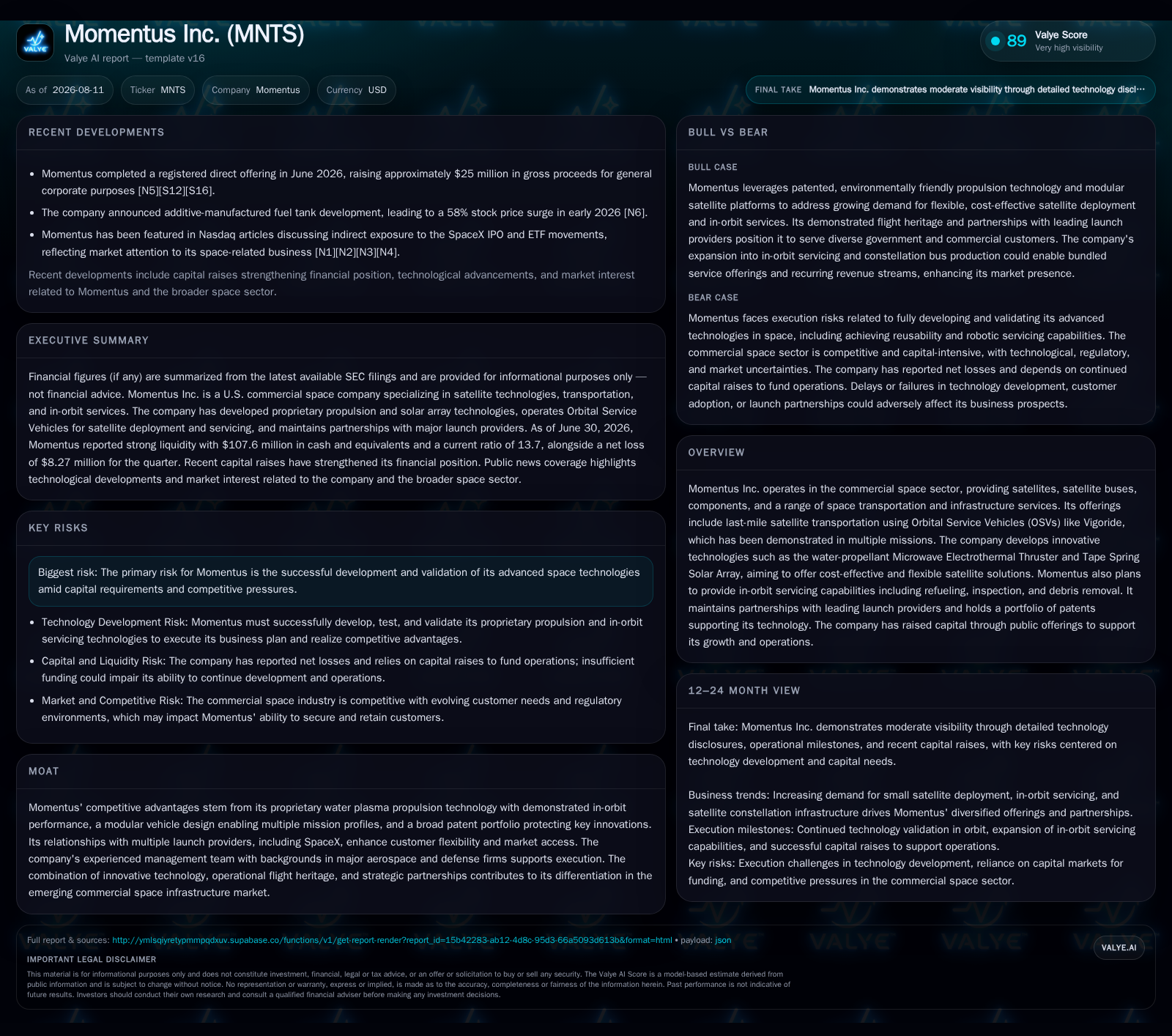
In its August 2026 quarterly filing, Momentus Inc. reported ongoing advancements in operational deployment of its Orbital Service Vehicles (OSVs) and secured a $75 million at-the-market equity sales agreement enhancing liquidity. Core technologies such as the Microwave Electrothermal Thruster (MET) powered by water plasma and modular satellite buses featuring the Tape Spring Solar Array (TASSA) underpin the company’s last-mile delivery and planned in-orbit servicing offerings. While capital intensity remains a constraint amid persistent operating losses, strategic partnerships with multiple launch providers including SpaceX bolster schedule flexibility and customer reach. Monitoring additional mission completions and technology readiness milestones will be critical near-term signals for validating Momentus’ emerging role in the commercial space transportation sector.
August Quarter Update Signals Progress in Orbital Missions and Capital Strategy
Momentus’ latest SEC Form 10-Q filed August 11, 2026 documents tangible operational progress anchored by continued deployments of its proprietary Orbital Service Vehicles (OSVs). The company maintains demonstrated in-orbit performance of its water-propellant Microwave Electrothermal Thruster (MET), notably via commercial flight heritage of its Vigoride vehicle which has executed multiple last-mile satellite transportation missions [S2]. This milestone validates key technology readiness levels (TRL), a critical KPI reflecting Momentus' ability to reliably deliver payloads to target orbits. Such operational flight data strengthens customer confidence—a vital factor for market adoption in this capital-intensive sector.
Complementing this progress on the operational front are financing activities sharpening Momentus’ financial runway. On June 18, 2026, the company announced an at-the-market (ATM) equity sales agreement allowing issuance up to $75 million in Class A common stock through A.G.P./Alliance Global Partners as sales agent [S3]. This arrangement provides Momentus with flexible capital raising capability without fixed dilution timing, essential given the high burn rates industry-wide. This financial maneuver aligns with typical sector dynamics where upfront R&D investment precedes sustainable revenue generation from space transport contracts.
Proprietary Propulsion and Modular Platforms Sharpen Momentus’ Competitive Edge
Momentus’ core technological moat arises from its water plasma-based MET system powered by a safe, non-toxic propellant alternative to customary hydrazine or other volatile chemicals prevalent in satellite propulsion [S1]. Water as propellant affords handling ease across ground-to-orbit logistics while enabling efficient thrust for versatile mission profiles including precise orbital delivery and potential reboost services. The MET’s demonstrated specific impulse differentiates it within peer smallsat transporters focusing on low-cost operability.
Additionally, Momentus designs its OSVs with modularity central to versatility—enabling rapid configuration changes for varied payload types or mission parameters [S1]. A key innovation under development is the Tape Spring Solar Array (TASSA), offering lighter weight, cost-effective solar power generation with retractable deployment that shields arrays from micrometeoroid debris and offers maneuverability flexibility. This modular approach permits scalable integration of hosted payloads or servicing equipment—a significant strategic advantage compared to rigid satellite bus competitors lacking such adaptability [S1]. Moreover, this modularity potentially lowers manufacturing cycle times and costs per mission.
The company’s extensive patent portfolio covering propulsion mechanisms and innovative component designs fortifies this competitive positioning by protecting intellectual property—a pivotal barrier to entry in high-tech aerospace domains.
Strategic Alliances with Launch Providers Reduce Scheduling Risks and Enhance Customer Reach
Momentus collaborates with multiple leading launch providers, including SpaceX among others, to deploy its Orbital Service Vehicles on rideshare or dedicated missions [S1][S2]. These alliances serve dual purposes: expanding customer options for launch cadence and preventing bottlenecks associated with single-provider dependencies. In an industry often vulnerable to manifest delays or technical postponements, diversified launch partnerships improve schedule robustness—an important buying criterion for customers seeking timely satellite deployment.
More broadly, these relationships grant Momentus indirect market validation as established launch operators vet OSV compatibility within existing vehicle integration frameworks. While companies like SpaceX also offer direct last-mile delivery capabilities via their own systems—which positions them as both partners and potential competitors—the ability of Momentus’ OSVs to offer refined propulsion-based orbit tailoring adds differentiation within niche last-mile transport services.
Addressing Emerging Demand Through In-Orbit Servicing Initiatives and Technology Innovation
Beyond satellite transportation revenues generation, Momentus is advancing plans to capture value from nascent but growing needs for in-orbit servicing—comprising satellite refueling, inspection, debris removal, and hosted payload accommodation [S1]. Given satellite constellations' limited lifespans and increasing orbital congestion, regular maintenance missions become commercially attractive.
The company’s technological roadmap builds toward incremental TRL improvements facilitating autonomous servicing capabilities leveraging their MET power system efficiency coupled with modular attachment points enabled by OSV architecture [S1]. Such service expansions could transition Momentus from transportation-only player into comprehensive space infrastructure provider—a transformation aligning with broader industry trends spearheaded by peers like Northrop Grumman’s Rendezvous & Proximity Operations or Astroscale's debris cleanup initiatives.
Market demand fundamentals support this shift as satellite operators seek ways to extend asset lifetimes cost-effectively while meeting emerging regulatory demands for debris mitigation. Momentus' execution against these plans will materially influence future valuation uplift.
Capital Intensity Constraints Amid Funding Availability: Risks & Opportunities Ahead
Capital allocations primarily fuel propulsion system refinement, OSV flight testing programs, TASSA development efforts, and extension into servicing technologies [S1]. The recently established $75 million ATM equity facility offers flexible capital raising capacity but introduces dilution risk inherent when accessing public markets under variable share price conditions [S3]. Management commentary underscores ongoing efforts to balance growth aspirations with prudent capital discipline given competitive aerospace investment landscapes.
Other risks include technology validation uncertainties—space environment testing exceeding laboratory results—and potential delays linked to reliance on third-party launch schedules that can cascade into deferred revenue realization [S1]. Competitive pressures from incumbent aerospace giants deploying proprietary servicing platforms add further market-entry challenges requiring sustained technological leadership.
"What Comes Next": Key Milestones and Market Indicators for Near-Term Performance
Investors and industry watchers should monitor several tangible near-term indicators shaping Momentus’ trajectory:
- Additional successful launches deploying Vigoride OSVs demonstrating consistent payload mass delivery accuracy,
- Deployment cycles and operational durability assessments of Tape Spring Solar Array prototypes,
- Expansion of contract backlog signaling growing customer acceptance,
- Patent filings tracking enhancement of proprietary technology portfolios,
- Regulatory progress promising smoother commercial operations,
- Frequency improvements in launch cadence facilitated by multi-partner collaborations. These datapoints collectively serve as bellwethers validating technology maturation stage transitions from experimental toward scalable commercial utility [S2][S1]. Falling short on these markers may heighten execution risk premia given the sector’s capital commitments.
Financial Profile Discussion: Liquidity Strength Supports Continued Execution Amid Losses
The newly arranged ATM offering facility supplements traditional private placements facilitating adaptive equity issuances aligned with capital expenditure needs without locking into fixed interest debt or dilutive one-time placements disproportionately impacting shareholder bases [S3]. However, long-term profitability remains an aspirational target requiring enhanced revenue mix from servicing contracts alongside scaled transport volumes.
This analysis synthesizes Momentus Inc.’s recent quarterly disclosures and annual filing insights within the broader commercial space infrastructure landscape without providing investment advice. It emphasizes key technological competencies alongside prevailing risks associated with capital-intensive operations amid evolving market demand drivers.
Disclaimer: This is research-only, informational analysis and not investment advice. It may include AI-generated interpretation and general industry context. Always verify important details using primary sources.

Comments