
PLAYSTUDIOS Integrates Loyalty Rewards to Sustain Engagement Amid Revenue Challenges
The company's hybrid model of free-to-play social gaming tied with real-world rewards defines its differentiation and growth hurdles.
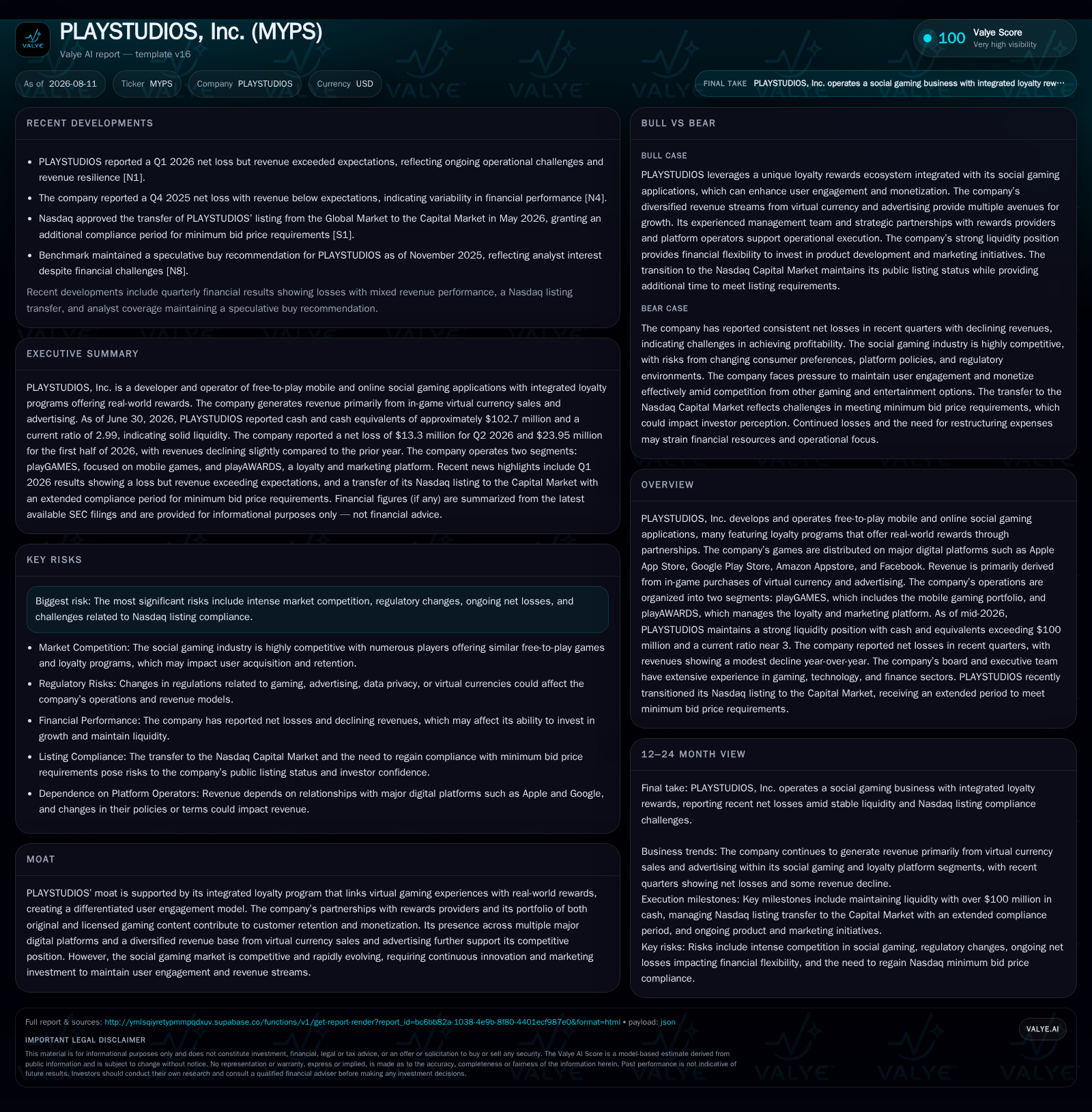
PLAYSTUDIOS continues to leverage its integrated loyalty program linking virtual gaming with tangible rewards, a distinctive approach in the competitive social gaming sector. Despite this, recent quarterly results show modest revenue declines and ongoing net losses, reflecting challenges in user engagement and monetization amid intense industry competition. The company’s robust liquidity provides runway for continued marketing and content investment, while platform dependency and regulatory risks remain significant considerations.
Recent Operating Update: Q2 2026 Financials Highlight Monetization Pressures
Operating losses remain entrenched through recent periods with no immediate signs of narrowing in the quarterly disclosures, which underlines the structural cost burden of marketing spend and content development outpacing revenue gains—a common pattern among mobile gaming firms facing high customer acquisition costs during intensifying competition [F1][S2]. The contemporaneous 8-K further confirms that while reported results were disclosed publicly via press channels concurrently with the filing date, no transformative operational shifts were announced which might recalibrate near-term growth dynamics or margin expansion prospects [S3].
Business Model: Hybrid Gaming with Loyalty Incentives
PLAYSTUDIOS operates primarily two segments: playGAMES, focused on developing and distributing free-to-play mobile social games across platforms including Apple App Store, Google Play Store, Amazon Appstore, and Facebook; and playAWARDS, which manages the loyalty marketing platform offering real-world rewards tied to player activity within games [S1]. This hybrid business model monetizes through virtual currency sales—players purchase these to enhance gameplay—and advertising revenue generated via in-game ads.
What sets PLAYSTUDIOS apart is its integrated loyalty program linking virtual engagement directly with tangible prizes such as travel offers or merchandise credits. This linkage aims to boost player retention and increase conversion rates from casual users into paying customers by increasing perceived value beyond digital entertainment alone. Such integration adds complexity to revenue mechanics as the success hinges on partner relationships with rewards providers plus the ability to drive both in-app purchase volume and advertising impressions effectively.
Revenue generation thus depends on several operating variables: daily/monthly active users who engage frequently enough; the average revenue per user (ARPU) dictated by purchase propensity; conversion rates from free to paying users; advertising fill rates and click-throughs; as well as sustained partnership agreements enabling attractive rewards programs that differentiate PLAYSTUDIOS’ offerings from pure gameplay competitors [S1]. However, none of these KPIs are specifically quantified in the latest reports.
Industry Structure & Competitive Position
The interactive digital entertainment space is fragmented yet dominated by scale players such as Zynga, Glu Mobile, and Playtika who benefit from broader content portfolios, larger user bases providing network effects, higher marketing budgets allowing greater acquisition reach, and diversified monetization channels. Within this milieu, PLAYSTUDIOS' unique selling point remains its loyalty-driven engagement model that combines gameplay with real-world incentives—a hybrid approach less common among direct peers.
This integrated loyalty system constitutes a form of moat by creating switching costs rooted in reward accumulation potential unique to PLAYSTUDIOS' ecosystem. It also diversifies revenue beyond strictly virtual currency purchases or advertising impressions by leveraging brand partnerships via playAWARDS. However, sustaining this advantage demands continuous innovation in reward offerings and game titles suited for recurring use.
Distribution through major digital marketplaces exposes PLAYSTUDIOS to platform dependency risks: any change in app store policies or fee structures directly impacts business economics. Moreover, advertising revenue is subject to fluctuations based on market-wide ad spend trends within social/mobile ecosystems. Thus competitive positioning depends not only on content appeal and loyalty program strength but also on adept navigation of platform rules and dynamic digital ad markets.
Growth Drivers
Fundamental industry growth drivers supporting PLAYSTUDIOS' prospects include global smartphone penetration growth fueling mobile game audiences alongside rising consumer preferences for social gaming experiences tying real-world incentives into digital landscapes. Expansion of the loyalty programs remains pivotal—enhancing partner reward catalogs can amplify recurring user engagement by strengthening perceived value beyond gameplay alone.
Innovation pipeline around new game designs incorporating advanced social features may improve player session length and frequency—key engagement metrics that underpin revenue potential through higher ARPU or improved conversion funnels from free users to payers. Increasing mobile advertising budgets globally also provide an avenue for incremental yield through refined placement strategies within games.
Strategic partnerships with brands for reward provision diversify income streams away from pure sales or ads alone—mitigating cyclical exposure inherent in consumer spending patterns. Additionally, advances in data analytics capabilities allow more targeted marketing spend optimized toward retaining high lifetime value (LTV) customers instead of broad-based user acquisition.
Risks and Growth Constraints
Headwinds remain substantial given intense competition driving up customer acquisition costs (CAC) which may erode profitability if offsetting ARPU gains do not materialize promptly. Dependency on external platforms (Apple/Google/Amazon) subjects PLAYSTUDIOS to risk from policy shifts or increased commissions reducing net revenue per transaction.
Regulatory uncertainty looms around virtual currency treatment given rising scrutiny over potential gambling-like characteristics in certain jurisdictions—this may prompt compliance requirements restricting flexibility or increasing operating expenses. Data privacy regulations also affect targeting capabilities crucial for effective advertising monetization.
User base saturation or dwindling engagement are structural threats common across mature free-to-play mobile games where novelty fades without regular content updates. Moreover, reliance on third-party reward suppliers necessitates sustained partnership quality without concentration risk.
Finally, continuing net losses raise concerns over sustainability absent meaningful operating leverage or meaningful margin improvement initiatives.
What To Watch Next
Key operational milestones include disclosure or indications around:
- Player engagement trends measured via DAU/MAU ratios alongside user retention rates at critical Day 1/7/30 intervals;
- Conversion metrics transitioning free players into paying consumers;
- ARPU trajectory including split between virtual currency sales versus advertising revenues;
- Updates on loyalty program expansions or new brand partnerships;
- Content release cadence impacting user refresh rates;
- Any changes announced regarding platform distribution policies affecting monetization;
- Regulatory developments related to virtual currency classification or data protections impacting business models.
Cash reserves topping $102 million as of Q2 end create a buffer supporting continued marketing for user growth campaigns essential in this sector's freemium model environment where upfront CAC precedes longer-term monetization realization [F1][S2]
While net income remains negative reflecting significant follow-on investment phases typical for socially oriented mobile game developers aiming for scale breakthroughs rather than immediate profitability [F1], sustaining this requires tight controls on customer acquisition costs relative to lifetime value expansion through successful retention tactics. The company’s intangible assets include sizable goodwill linked to its content IP portfolio plus internal-use software accounting for game development capabilities—a critical resource underpinning product refreshes needed to maintain relevance [F1].
Overall financial condition aligns broadly with peer dynamics seen among mid-tier mobile gaming firms balancing heavy front-loaded marketing expenses against latent monetization potentials via vibrant community-building loyalty models.
This analysis integrates publicly filed company information corroborated by industry norms without investment research views or forecasts. Readers should consider evolving market conditions impacting competitive dynamics since these factors heavily influence PLAYSTUDIOS’ financial trajectory going forward.
Disclaimer: This is research-only, informational analysis and not investment advice. It may include AI-generated interpretation and general industry context. Always verify important details using primary sources.

Comments