
Fulton Financial Leverages M&A and Regional Footprint to Sustain Margin and Credit Stability
Fulton's recent quarterly filing highlights steady net interest margin and integration progress with Blue Foundry amid disciplined credit risk management.
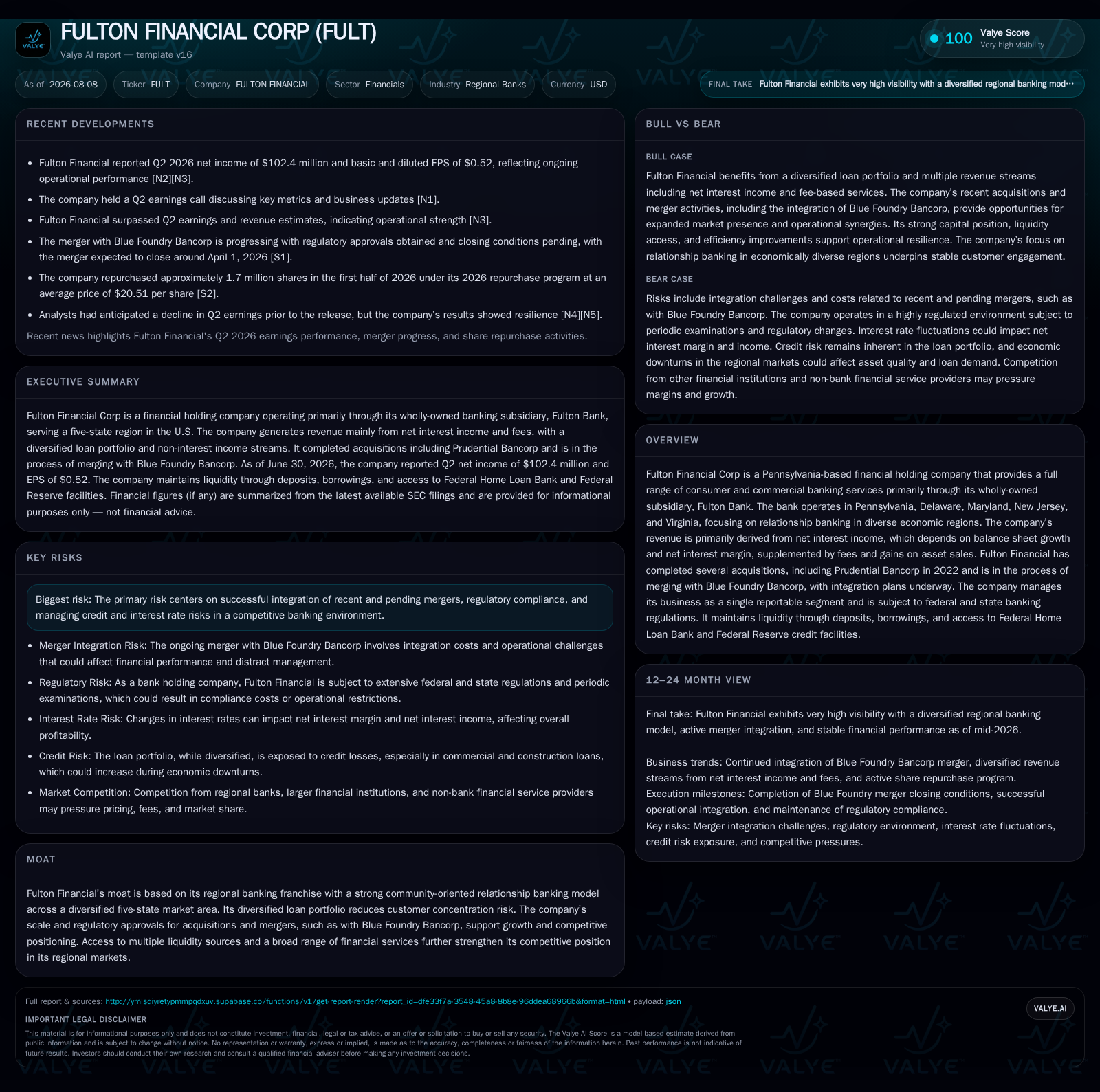
In its latest quarter ending June 30, 2026, Fulton Financial Corp reported stable net interest margin supported by balanced loan and deposit growth within its regional banking footprint spanning five states. The company is advancing the merger integration with Blue Foundry Bancorp as planned, aiming to enhance scale and market presence in key northeastern markets. Credit quality metrics remain sound with conservative loss provisions amidst competitive pressures on deposit costs. Ongoing share repurchases reflect capital confidence, while regulatory capital remains well above minimum thresholds. Fulton's relationship banking model focusing on commercial loans across diverse sectors underpins resilience in a fluctuating interest rate environment.
Recent Operating Update
The merger with Blue Foundry Bancorp officially closed in April 2026, with the subsequent bank-level merger scheduled for the third quarter of the year. This pending integration represents a critical milestone in scaling Fulton’s footprint within its five-state concentration—Pennsylvania, Delaware, Maryland, New Jersey, and Virginia—and deepening its presence in economically diverse regions such as Philadelphia and New Jersey where Blue Foundry has established customer relationships [S1], [S2]. The integration plan includes IT platform harmonization and branch consolidation efforts, with direct costs expensed as incurred.
Deposit growth continues at a modest pace but faces competitive market dynamics that require incremental pricing increases on core deposits. While these elevated funding costs typically compress net interest margin, Fulton's balanced loan growth, predominantly commercial and commercial real estate exposures diversified across manufacturing, healthcare, agriculture, and service sectors, mitigates margin erosion risks [S1], [S2]. The bank’s relationship banking focus fosters retention and cross-selling opportunities supporting fee income streams beyond net interest revenue.
Business Model and Strategic Position
Operating solely through Fulton Bank, the Company offers comprehensive retail and commercial banking services emphasizing personalized relationship banking tailored to client needs within its regional markets. This model leverages close customer contact to tailor credit solutions primarily composed of commercial loans (including mortgage and construction lending), consumer loans, and deposit products.
Fulton's revenue predominantly derives from net interest income—the difference between interest earned on loan assets and investments versus interest paid on deposits and borrowings—augmented by fee income from fiduciary services and other non-interest sources [S1]. Loan-to-deposit ratio management is integral to preserve liquidity while maximizing earning asset yield without excessive wholesale borrowing.
Strategic acquisitions have been central to Fulton’s growth trajectory: Prudential Bancorp in 2022 broadened its New Jersey market presence; Republic First acquisition in 2024 enhanced its Philadelphia footprint; now Blue Foundry Bancorp's absorption aims to accelerate scale benefits in these densely populated northeastern corridors. These transactions augment Fulton’s balance sheet while presenting integration challenges typical of regional banks seeking operational synergy without client attrition [S1], [N1].
Industry Structure and Competitive Landscape
Fulton Financial operates within the regional banking sector characterized by intense competition for commercial client relationships and deposits among peers such as Regions Financial Corporation, M&T Bank Corporation, PNC Financial Services Group, KeyCorp, and Citizens Financial Group. Although these institutions vary in scale, geographic focus, or product breadth, all contend with similar regulatory frameworks governing capital adequacy, liquidity requirements, and asset quality monitoring.
Regional banks like Fulton must navigate fluctuating interest rates affecting net interest margins while managing credit quality risks inherent to diverse loan portfolios exposed to cyclical sectors like construction or commercial real estate. Customer loyalty via relationship banking acts as a defensive moat against encroachment by larger banks or fintech competitors targeting commoditized products.
Fulton’s multi-state presence across mixed urban-suburban economies offers exposure benefits: diversified economic drivers limit concentration risk compared to banks reliant on single metropolitan areas or industries. Regulatory compliance requires maintaining capital buffers above government minima—in Fulton’s case well-capitalized status with CET1 over 12% sustains operational flexibility for future organic growth or acquisitions [S11].
Growth Drivers
Key growth levers include:
- Continued expansion of loan balances in core markets driven by commercial lending demand supported by regional economic activity.
- NIM optimization through precise asset-liability duration management amid evolving interest rate conditions.
- Fee income improvement from wealth management offerings facilitated by cross-selling capabilities acquired through M&A.
- Realizing integration cost savings from recent mergers enhancing efficiency ratios.
- Strategic use of share repurchase programs signals disciplined capital allocation aligned with shareholder value enhancement [S2], [N1].
- Technology investments aimed at streamlining customer experience bolster retention and reduce operational expenses over time.
Monitoring loan portfolio diversification across sectors reduces single-industry sensitivity while leveraging local industry clusters maximizes relationship penetration.
Risks and Watchpoints
Integration risks remain significant given the scale of transactions with Blue Foundry; execution missteps could impact customer satisfaction or lead to cost overruns. Additionally, an uncertain economic backdrop might pressure credit quality especially if one or more exposed industries experience downturns.
Interest rate volatility poses ongoing challenges to net interest margin sustainability—rapid deposit rate increases without commensurate loan repricing would strain profitability [S8]. Fulton must continuously optimize balance sheet mix alongside prudent credit loss provisioning to shield earnings.
Competitive intensity in deposit gathering may escalate funding costs beyond current expectations as larger institutions deploy aggressive pricing or fintech disruptors attract younger demographics for low-cost transactional accounts.
Regulatory compliance demands persistently high capital ratios potentially constrain capital returned via dividends or buybacks during stressed conditions.[S11]
What to Watch Next
Upcoming milestones include:
- Completion of Blue Foundry Bank merger at the bank subsidiary level expected in Q3 2026; post-merger operational synergy realization will be an important metric.
- Quarterly updates on net interest margin trajectory amid evolving Fed policy interest rates impacting asset yields and funding costs.
- Loan portfolio performance benchmarks such as non-performing loans ratio and charge-offs will signal credit risk trajectory.
- Deposit growth rates relative to local economic indicators reflecting funding base stability under competitive pressures.
- Announcements regarding further strategic acquisitions or technology platform enhancements underpinning long-term growth.
- Capital return program activity providing clues on management confidence regarding earnings visibility post-merger.
Financial Profile Discussion
Year-to-date common stock repurchases totaled approximately 1.7 million shares costing around $35.6 million under an authorized $150 million repurchase program active until early 2027—the continuation of this program suggests management's commitment to disciplined capital deployment amid measured earnings growth outlooks [S2]
This analysis synthesizes details exclusively from recently filed SEC documents and contemporaneous earnings-related disclosures relating specifically to Fulton Financial Corporation without speculative extrapolation beyond documented evidence.
Disclaimer: This is research-only, informational analysis and not investment advice. It may include AI-generated interpretation and general industry context. Always verify important details using primary sources.

Comments