
United Parks & Resorts Confronts Labor Market and Leverage Challenges While Leveraging Brand and Zoological Assets
The company’s Q2 2026 update highlights operational headwinds in labor retention amid strong brand-driven visitation and a capital-intensive growth outlook.
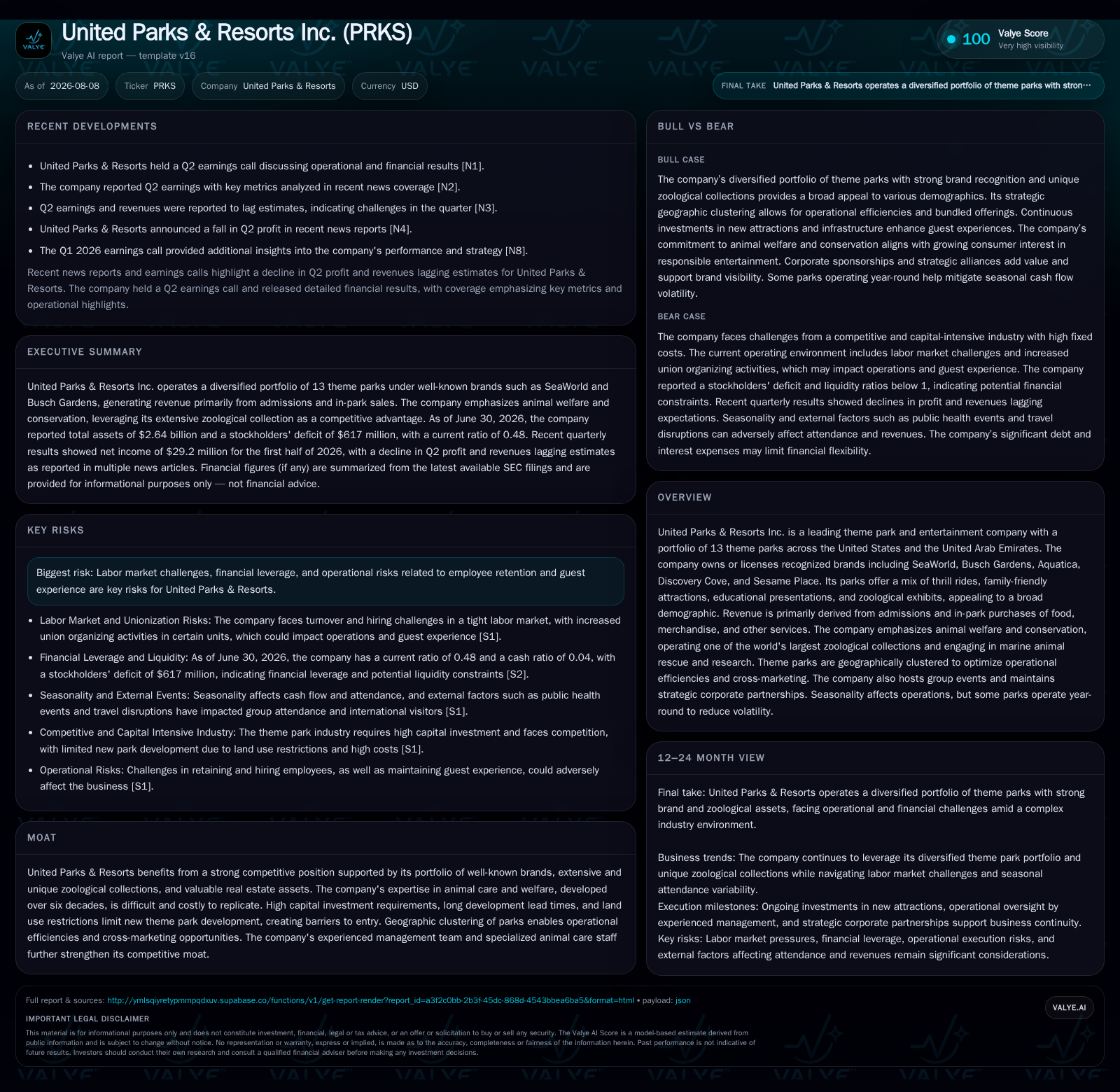
United Parks & Resorts Inc. (PRKS) reported second-quarter 2026 results that reflect ongoing pressure from challenging labor markets and increased union organizing efforts, impacting operations and guest experience. The company operates 13 parks under well-known brands like SeaWorld and Busch Gardens, generating revenue primarily from admissions and in-park spending on merchandise and food. Its competitive moat is anchored in brand recognition, unique zoological collections, and geographic clustering that enhances operational efficiency. Despite solid attendance and per capita revenue trends, the business faces risks related to high financial leverage and the need for substantial capital expenditures to maintain attraction quality and drive growth. Monitoring labor stability, capital investment execution, and debt management will be critical for future performance.
Recent Operating Update: Q2 2026 Highlights
United Parks & Resorts reported Q2 results on August 7, 2026 [S2], supplemented by an August 4 event filing detailing operational conditions [S3]. The company confirmed ongoing challenges within the labor market manifesting as elevated employee turnover rates in certain positions and regions. Notably, there has been increased union organizing activity at various park units. These dynamics pose risks to the guest experience due to potential staffing shortages or disruptions. Management emphasizes the active involvement of the Board—particularly the Chairman—in overseeing key operational decisions during this complex environment.
Capital expenditures remained elevated at $138 million during the quarter [S24], reflecting investments aimed at preserving ride appeal and park attractiveness amid a competitive landscape requiring constant innovation and maintenance. Although exact attendance figures were not disclosed for Q2 2026, steady visitor engagement aligned with strong brand strength suggests resilience despite labor headwinds.
Business Model: Strategic Mix of Admission Sales and In-Park Commerce
United Parks & Resorts monetizes its portfolio of 13 theme parks primarily through admissions fees complemented by ancillary revenues from food and beverage sales, merchandise sales, group events, and licensing agreements [S1]. This multi-channel approach allows diversification of revenue streams but requires continuous capital outlays to sustain ride originality—key to competitive differentiation in themed entertainment.
The company’s brand portfolio includes marquee names such as SeaWorld®, Busch Gardens®, Aquatica®, Discovery Cove®, and Sesame Place®, with exclusive licensing arrangements like those with Sesame Workshop enhancing appeal among families with young children. Additionally, United Parks manages extensive zoological collections that not only attract visitors but also reflect its commitment to animal welfare—a strategic differentiator difficult for peers without similar expertise to replicate.
Geographic clustering of parks across U.S. key markets and the UAE affords economies of scale in operations, marketing synergies, cross-selling among attractions, centralized training programs, supplier leverage, and optimized capital deployment [S1]. This regional footprint strategy mitigates some fixed cost pressures typical in this capital- and labor-intensive industry.
Industry Structure and Competitive Positioning
The theme parks sector demands significant upfront capital for ride development (often with long payback periods) while relying heavily on brand recognition to secure visitor loyalty. United Parks competes alongside operators such as SeaWorld Entertainment (a peer candidate), Cedar Fair Entertainment Company, Six Flags Entertainment Corporation, Disney Parks & Resorts, Universal Parks & Resorts, and Merlin Entertainments.
Unlike general amusement parks focusing purely on thrill rides or water attractions alone, United Parks leverages its zoological expertise including marine animal rescue initiatives which differentiate it within the thematic entertainment value chain. By integrating educational components alongside thrills—through shows and animal exhibits—the company targets a broad demographic mix simultaneously appealing to family segments concerned with conservation as well as thrill-seeking guests.
Nevertheless, high financial leverage limits flexibility compared to less indebted peers in a sector already facing seasonal demand volatility tied closely to weather patterns and economic cycles impacting discretionary spending on leisure.
Growth Drivers
Growth at United Parks hinges on several strategic pillars:
- Introduction of New Attractions: Continuous development of rides or themed experiences stimulates repeat visitation by broadening the appeal.
- Increased Per Capita Spending: Upselling opportunities through premium food offerings, exclusive merchandise collections linked to branded intellectual property (IP), and technology-enabled guest services enhance spend per visitor.
- Group Events Expansion: Targeting corporate functions or large gatherings supplements traditional admissions revenue.
- Geographic Expansion: Potential new parks or rebranding existing sites under licensed IP such as Busch Gardens can capture novel regional markets.
- Brand Licensing Leverage: Continued use of recognizable characters (e.g., Sesame Street) opens cross-promotional avenues beyond physical parks.
- Animal Welfare Leadership: Investing in conservation programs solidifies brand equity while potentially unlocking regulatory goodwill.
These drivers are subject to execution risk intertwined with capital availability—the relatively high recent CAPEX level ($138 million) signals commitment yet also stresses cash flow given elevated debt servicing requirements.
Risks / Watchpoints / Growth Constraints
Labor supply constraints remain a prominent risk encompassing recruitment difficulties exacerbated by unionization pressure [S1][S2]. Operational disruptions may arise if key ambassador roles cannot be reliably staffed or retention worsens.
Financially, United Parks bears a sizable debt load nearing $2.29 billion as of June 30, 2026 with net debt roughly $2.27 billion after cash subtraction [F1]. The current ratio sits low at approximately 0.48 indicating limited near-term liquidity buffers versus current liabilities [F1]. Interest coverage ratios will be pivotal to watch given variable-rate exposure amid prior refinancing adjustments described through Credit Agreement amendments [S16][S17].
Regulatory scrutiny linked to animal welfare practices imposes ongoing compliance demands; adverse publicity or legal outcomes related to zoological care could materially impact reputation as well as operating costs.
Seasonality impacts visitation sharply outside peak holiday seasons—operational leverage means revenue downturns have outsized margin effects until fixed costs adjust fully.
Competitive pressures from globally prominent peers like Disney/Pixar-themed resorts or Universal Studios attractions with blockbuster IP further constrains pricing power outside core markets, though geographic clustering mitigates some overlap risk internally.
What to Watch Next
Key upcoming milestones include:
- Quarterly attendance updates combined with average spend metrics will clarify demand trajectory relative to labor market developments [N1][N2][N3].
- Execution on planned or incremental capital projects announced in forthcoming filings will signal momentum towards enhanced guest experiences.
- Management disclosures regarding union negotiations or labor environment evolution could foreshadow cost shifts or disruptions.
- Any strategic initiatives around park acquisitions or international expansions would materially reshape growth outlooks.
Regular monitoring of guest satisfaction scores via third-party indices or internal surveys will provide early warnings on service standards amidst labor challenges.
Financial Profile Discussion
As of June 30, 2026, United Parks & Resorts held approximately $19.1 million in cash and equivalents against total debt of about $2.29 billion, resulting in net debt near $2.27 billion [F1]. The current ratio stood at approximately 0.48, reflecting limited near-term liquidity relative to current liabilities [F1]. Operating cash flow supported significant capital expenditures ($138 million in Q2 alone), though free cash flow remains pressured by high interest expenses associated with leveraged credit facilities bearing variable-rate terms [S24][S16].
The firm's senior notes mature largely after 2029, with moderate amortization through intermediate years, providing some runway for deleveraging if operating performance sustains growth [S16]. Historically authorized share repurchase programs illustrate management's efforts toward shareholder returns but must be balanced against liquidity priorities under tight working capital conditions [S4][S11][S20].
Financial health hinges critically on maintaining or improving profitability margins amid capex intensity; any deterioration in operating income due to rising labor costs or softer visitation would challenge debt servicing capacity over time.
Disclaimer: This analysis is based solely on publicly available information from SEC filings dated through August 7, 2026 ([S1]-[S29]), associated news articles ([N1]-[N3]), current companyfacts data ([F1]), industry knowledge frames from thematic sectors related to theme parks entertainments provided herein for context only. It does not constitute investment advice nor a research view regarding securities of United Parks & Resorts Inc.
Disclaimer: This is research-only, informational analysis and not investment advice. It may include AI-generated interpretation and general industry context. Always verify important details using primary sources.

Comments