
LENZ Therapeutics Advances U.S. Presbyopia Market with VIZZ Amid Narrow Product Focus
LENZ’s recent quarterly filing highlights early-stage commercialization challenges and strategic licensing efforts for its novel presbyopia treatment VIZZ.
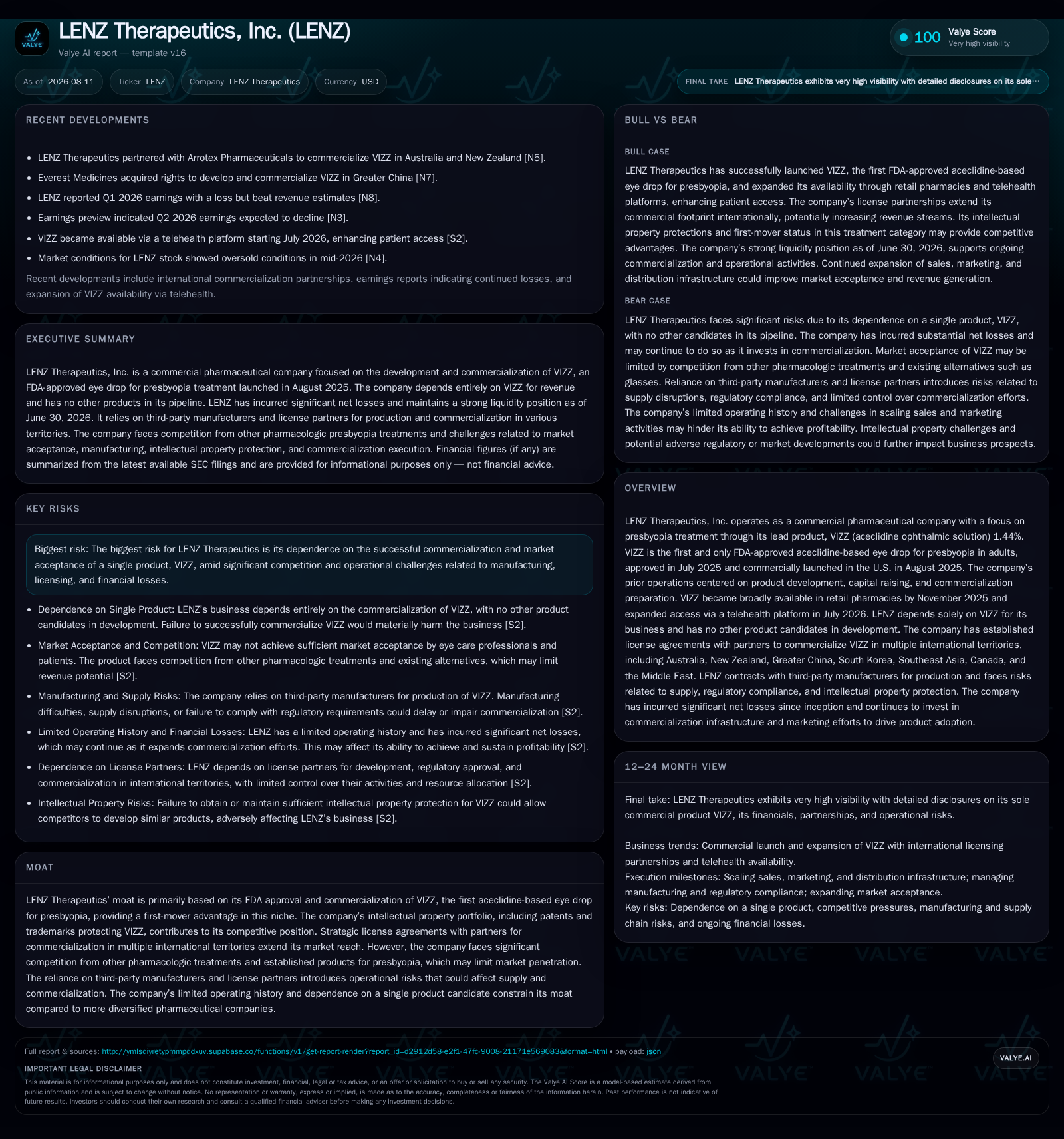
LENZ Therapeutics, Inc. continues to commercialize VIZZ, the first FDA-approved aceclidine-based ophthalmic solution for presbyopia, with broad U.S. pharmacy availability since late 2025 and recent telehealth access expansion. The company's business hinges exclusively on this single product, introducing material execution risk amid significant competitive pressure and manufacturing dependencies. While licensing partnerships extend global reach, LENZ remains in an early-loss phase, fueled by sales and marketing investments and constrained by its limited pipeline. Key indicators to monitor include physician adoption rates, international regulatory approvals, and manufacturing scalability.
Recent Operating Update Highlights Early Commercialization
LENZ Therapeutics’ latest quarterly filing for Q2 ended June 30, 2026 underscores its ongoing transition from development to commercialization following FDA approval of VIZZ in July 2025 and commercial launch in August that year [S2]. The company reports continued investment in direct-to-ECP (eye care professional) sales force activities alongside e-pharmacy distribution channels initiated in October 2025. By November 2025, VIZZ achieved broad retail pharmacy availability across the United States, representing a key milestone in channel access expansion [S1]. Furthermore, July 2026 saw LENZ extend consumer access by launching telehealth platform distribution — a critical adaptation given shifting consumer prescription channels within ophthalmology [S2].
However, despite these distribution advancements and market introduction progress, LENZ remains in an early loss stage typical for nascent pharmaceutical commercialization ventures. The company continues to incur significant selling, general & administrative expenses related to marketing scaling efforts and building brand awareness among ECPs. It has no other products beyond VIZZ contributing revenues at this stage [S2]. This concentrated revenue reliance introduces execution risk until volume growth sustains cost coverage.
Business Model: Monoproduct Commercialization of a Novel NCE Ophthalmic Therapy
LENZ operates primarily as a commercial pharmaceutical company focused exclusively on VIZZ (aceclidine ophthalmic solution) 1.44%, the first FDA-approved aceclidine-based eye drop treating presbyopia — a condition marked by diminished near vision affecting over 128 million people in the U.S. alone [S1]. The proprietary formulation leverages aceclidine's unique pupil-selective miotic mechanism to create a pinhole effect enhancing near focus while sparing distance vision impact.
Revenue generation depends on net product sales through licensed retail pharmacies nationally and e-pharmacy partners delivering directly to patients post-prescription. Sales efforts target optometrists and ophthalmologists who prescribe VIZZ to appropriate patient segments seeking alternatives to traditional reading glasses or surgical intervention [S1]. Given the prescription-based monetization model typical of niche ophthalmic products with chronic usage patterns, the critical KPIs include physician adoption rates, refill persistence, patient satisfaction, and market penetration within addressable demographics.
Complementing domestic U.S. commercialization are strategic licensing agreements granting partners rights across Australia/New Zealand, Greater China, South Korea, Southeast Asia, Canada among others [S1]. These partnerships serve as scalable international go-to-market levers without requiring internal infrastructure buildouts — common practice among small pharma firms lacking global commercial scale.
However, LENZ currently has no additional clinical-stage or preclinical assets suggesting future pipeline revenue streams [S2]. This leaves all operational dependency on effective uptake of its single therapeutic offering in presbyopia treatment — underscoring binary outcome risk tied to market acceptance and competitive dynamics
Industry Context: Presbyopia Pharmacologic Treatment Landscape
Pharmaceutical companies developing treatments for presbyopia operate at the intersection of ophthalmology innovation and largely underserved patient needs unaddressed fully by glasses or surgery. Regulatory approval pathways hinge on demonstrating not only efficacy but safety profiles preserving distance visual acuity while improving near focus.
In this context, having the first FDA approval for an aceclidine-based solution presents frontline differentiation for LENZ compared to established competitors like Novartis or Allergan who have developed other pharmacologic modalities such as pilocarpine-based drops. While pilocarpine has been marketed longer albeit with distinct mechanism effects that can induce myopic shifts or discomfort symptoms limiting adherence.
The timeline from FDA approval to broad prescribing uptake can span months to years depending on payor formulary inclusion dynamics and physician trust development through real-world evidence generation — factors still unfolding for LENZ’s product since mid-2025 launch [S1][S2]. Third-party manufacturers contracted for drug production face complexity typical of small molecules requiring tight quality controls; interruptions here could materially delay supply continuity risking brand reputation in the early formative market phase.
Furthermore, pricing dynamics are sensitive due to competition from existing branded agents as well as generics entering as exclusivity periods expire post-2030 NCE protections [S1]. Thus intellectual property protection combined with ongoing lifecycle management including potential formulation innovations will be critical to extend commercial viability through patent expiry horizon circa 2044 given current issued patent coverages
Growth Drivers: Regulatory Approvals Abroad and Channel Expansion
International expansion via Lotus license partners constitutes a meaningful growth vector outside the U.S., contingent upon regulatory approvals expected through NDAs already submitted in South Korea (December 2025), Thailand, Singapore (first quarter 2026), among others [S1]. Successful registrations will diversify revenue sources beyond concentrated U.S. markets.
Channel-wise, LENZ’s recent telehealth platform rollout broadens accessibility accommodating patient convenience preferences increasingly integral post-pandemic. Telehealth platforms effectively reduce friction points around prescriptions which otherwise rely exclusively on physical ECP visits or retail pharmacy fulfillment — enabling potentially faster scale if embraced widely by target populations [S2].
Physician adoption remains a prime pacing factor; thus continued clinical engagement programs supported by favorable Phase 3 trial data—showing rapid onset with up to ten hours benefit duration without vision loss—enhance marketing credibility when explaining benefits over alternative options [S1]. Increasing prevalence of presbyopia driven by aging populations supports structural demand growth underpinning multiple-year commercial potential exceeding $3 billion within the U.S alone according to management estimates [S1].
Risks and Constraints: Single Product Reliance Amid Competition and Supply Complexity
LENZ inherits risks typical of small-cap pharmas focused on single-product commercialization lines including high operating leverage with substantial upfront investments required before positive free cash flow emerges [S2]
Competitive threats arise from incumbent pharmacologic options; new entrants able to validate superior safety or efficacy profiles represent potent challenges. Off-label treatments also compete indirectly against repeat prescription volumes reducing breakthrough diffusion potential. Moreover third-party manufacturer dependence exposes LENZ to possible capacity constraints or quality control lapses jeopardizing supply commitments—as well as cost inflation pressures originating from raw material or labor markets impacting margin sustainability.
Intellectual property disputes or failure to secure expansive patent claims would erode exclusivity advantages accelerating generic competition appearance earlier than anticipated under current projections ending exclusivity earliest in July 2030 though patents last longer through 2044 minimum according to disclosures [S1]. Lastly limited operating history reduces institutional confidence as past losses temper forecasts leading to potentially volatile stock price trajectories subject to clinical development results or commercial performance updates.
What To Watch Next
Critical near-term milestones include reported volume growth in key U.S. geographies reflecting physician acceptance rates alongside evolving refill adherence curves — all crucial leading indicators for eventual profitability thresholds.
Progress updates regarding regulatory approvals from Lotus licensees’ submissions across Asia-Pacific will materially affect LENZ’s international footprint expansion prospects which remain unproven but promising avenues given pending NDAs.
Supply chain developments such as scale-up notifications or disruptions will warrant close attention since uninterrupted drug availability underpins commercial momentum.
Monitoring competitive landscape changes including new entrants launching rival treatments or emerging real-world evidence influencing prescribing patterns is essential.
Finally quarterly earnings reporting cadence will reveal whether SG&A spending levels are translating effectively into growing sales base thereby modulating operating loss trajectories toward breakeven despite ongoing patient acquisition costs.
Financial Profile Discussion
As of June 30, 2026, LENZ held approximately $24.2 million in cash and equivalents with current assets totaling $233 million versus current liabilities around $17 million yielding an exceptionally strong current ratio near 13.55x indicating substantial short-term liquidity cushioning operational burn requirements amid investment-heavy commercialization phase [F1]
This financial posture aligns with typical early-stage pharmaceutical companies reliant upon external funding rounds or licensing fees until product sales volumes ramp sufficiently.
Maintaining stringent expense control coupled with achieving sustainable revenue ramp through increased ECP adoption and diversified channel access constitutes the immediate financial path forward.
This analysis synthesizes LENZ Therapeutics’ latest SEC disclosures reflecting its pioneering position launching the first aceclidine-based ophthalmic solution for presbyopia within a complex pharmaceutical commercialization ecosystem defined by regulatory rigor, channel evolution, intellectual property importance, and intense competitive dynamics. Vigilance regarding product uptake trends alongside manufacturing reliability will remain paramount given the company’s undiversified product focus during this nascent commercial phase.
This report does not constitute investment advice but aims to provide detailed industry-informed insight based strictly on publicly available regulatory filings and financial disclosures.
Disclaimer: This is research-only, informational analysis and not investment advice. It may include AI-generated interpretation and general industry context. Always verify important details using primary sources.

Comments