
EBR Systems Advances WiSE Leadless CRT in U.S. Launch and Capital Raise
EBR Systems progresses commercial rollout of its novel leadless cardiac resynchronization therapy device alongside a significant capital raise to support expansion.
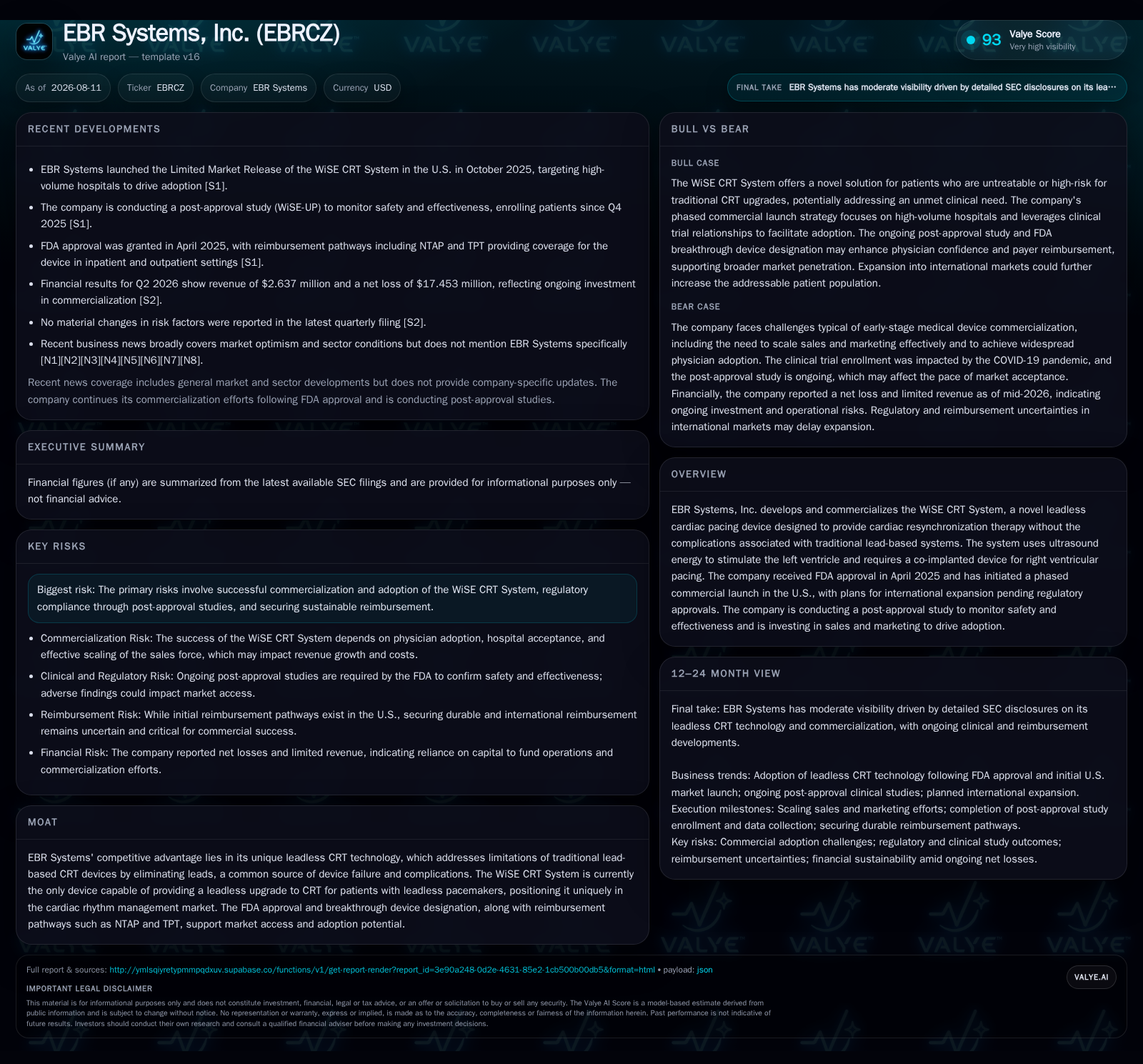
EBR Systems, developer of the FDA-approved WiSE CRT System, reported ongoing progress in its U.S. commercial launch during Q2 2026 and completed a substantial A$150 million capital raise. The WiSE CRT System offers a unique leadless cardiac pacing solution addressing limitations of traditional lead-based CRT devices. While regulatory and post-approval study commitments remain key operational focuses, the company is investing heavily in sales infrastructure to drive physician adoption. Financially, EBR maintains a solid liquidity position with over $59 million in cash as of June 2026 despite ongoing operating losses typical for early-stage medical device commercialization efforts.
Recent Operating Update—Q2 2026 Momentum and Capital Raise
EBR Systems’ latest quarterly filing dated August 11, 2026, reveals continued progress in commercializing the WiSE CRT System following its FDA premarket approval (PMA) in April 2025 [S2][S1]. The company executed a phased U.S. launch concentrating on select high-volume hospitals that treat patients eligible for cardiac resynchronization therapy (CRT) but are contraindicated for traditional lead-based systems due to failed coronary sinus (CS) lead implantation or high-risk upgrade procedures [S1]. This focused rollout approach aligns with the company's strategy to build clinical awareness among electrophysiologists managing complex cardiac rhythm disorders.
Supporting this commercialization effort, EBR completed an institutional equity raise totaling approximately A$150 million (~$100 million USD) primarily through placements of CHESS Depository Interests on the Australian Securities Exchange in June 2026 [S3][S25]. Roughly A$64.4 million was raised via institutional placement without securityholder approval requirements, while additional tranches were subject to approval. This capital infusion is meant to fund sales and marketing expansion, reinforce clinical data collection through ongoing post-approval studies, and prepare for international market entries once regulatory forks clear.
Business Model: Device Offering and Monetization Mechanics
At the core of EBR’s value proposition is the WiSE CRT System—a novel implantable cardiac pacing product designed to deliver left ventricular pacing without leads using ultrasound energy stimulation [S1][S13]. The system's unique configuration includes an implanted battery-powered transmitter placed subcutaneously that emits ultrasonic pulses converted by an electrode implanted inside the left ventricle into electrical stimuli mimicking natural heart rhythm correction. Crucially, the device must be co-implanted alongside an existing right ventricular pacemaker or defibrillator capable of delivering pacing signals detected by the transmitter. This dependency shapes clinical adoption dynamics since electrophysiologists must coordinate combined device procedures.
Revenue generation entails direct sales of the WiSE CRT system components to hospitals via a specialized sales force familiar with electrophysiology device workflows [S1]. Pricing is likely positioned at premium levels relative to legacy CRT systems due to its technological advantage—elimination of leads addresses a known primary cause of device failure and complications such as infection or lead displacement. Margins remain compressed initially due to scale inefficiencies and R&D amortization costs inherent in early adoption stages. Key revenue drivers include expanding hospital customer penetration, increasing implantation volumes per center, reimbursement coverage, and surgeon/electrophysiologist adoption rates.
The business model does not currently generate significant recurring revenues; however, ongoing post-market surveillance obligations require investment in clinical data registries that could underpin future service contracts or software updates enhancing customer stickiness.
Industry Context: Positioning Within Cardiac Rhythm Management
EBR operates within the highly regulated cardiac rhythm management (CRM) medical device sector—a space dominated by industry giants like Medtronic, Abbott Laboratories, Boston Scientific, Biotronik, and MicroPort CRM. These incumbents offer broad portfolios covering conventional implantable pulse generators (IPGs), defibrillators (ICDs), multi-chamber systems with CS leads for CRT indication, as well as emerging leadless pacing solutions primarily targeting right ventricular pacing.
WiSE uniquely addresses an unmet niche by providing a leadless solution specifically engineered for left ventricular pacing within CRT therapy—a significant differentiator given that existing leadless pacemakers from peers typically focus on right ventricular or atrial chambers only [S1][S13]. Lead-related complications have historically limited broader adoption or complicated upgrades in patients previously implanted with standard devices.
This structural trend toward leadless pacing reduces long-term device failure risk and procedural complications. However, it also increases clinical complexity because it requires operator familiarity with ultrasound energy conversion technologies and cross-device coordination during implantation procedures.
Regulatory landscapes are an important barrier to entry; WiSE has achieved FDA PMA granting breakthrough device designation status—an endorsement supporting expedited review pathways—but must comply with rigorous post-market surveillance mandated by FDA conditions via an observational registry study (“WiSE-UP”) initiated in late 2025 and projected through December 2027 [S16][S19]. Success in this post-marketing phase will critically influence payer confidence and clinician comfort.
Growth Drivers
The principal growth levers for EBR revolve around scaling clinical adoption across specialized cardiovascular centers handling CRT indications unsuited to traditional systems. As experience accumulates among key opinion leaders and electrophysiologists advocate for leadless approaches due to lower complication risk profiles, procedure volumes should rise.
Complementing organic demand is aggressive sales force expansion aimed at penetrating additional hospital accounts within the U.S., coupled with increased marketing efforts raising physician awareness about WiSE’s benefits compared to conventional implants [S1][S24]. This front-loaded investment indicates recognition that early clinical education drives utilization rates essential for sustainable revenue growth.
International growth opportunities hinge upon obtaining regulatory approvals in markets like Australia, the European Union, and the United Kingdom where demonstrated safety and efficacy evidence alongside favorable reimbursement frameworks can unlock sizable patient populations [S10]. Geography-specific reimbursement designations such as New Technology Add-on Payments (NTAP) or Transitional Pass-Through Payments (TPT) influence financial viability at hospital level and therefore clinician adoption willingness.
Finally, evolving epidemiology—growing rates of heart failure patients indicated for CRT combined with rising prevalence of complex arrhythmias—expands the addressable market size structurally over time.
Risks and Watchpoints
EBR faces multiple execution risks predominantly related to translation of technological innovation into wide-scale commercial success. First is uncertainty around pace of physician adoption since implanting WiSE requires specific training plus careful patient selection criteria limiting immediate scale [S1][S23]. Delays or slower-than-expected uptake could pressure revenue trajectories.
Second are compliance demands associated with mandated FDA post-market studies. Failure to enroll sufficient patients or adverse safety/efficacy signals could jeopardize regulatory standing or require label adjustments impacting market confidence [S16][S19].
Thirdly, reimbursement challenges remain pivotal: if payers do not recognize adequate compensation relative to incumbent therapies or emerging alternatives from larger competitors arise quicker than anticipated, this could materially limit financial returns.
Additional concerns include cybersecurity vulnerabilities given WiSE’s software components interacting wirelessly—a recognized risk area overseen by dedicated corporate governance committees with incident response protocols [S1][S4]. Manufacturing scale-up constraints or geopolitical trade disruptions could also interfere with supply chain reliability.
Lastly, as an emerging growth company with net losses markedly exceeding revenues currently ($48.8M net loss vs $1.6M revenue reported year-end 2025) [F1], ability to continue securing dilutive equity financing remains critical although recent large capital raise enhances near-term sustainability [F1][S3][S25].
What to Watch Next
Near-term milestones crucial for monitoring EBR’s progress include:
- Quarterly updates quantifying number of devices implanted across targeted hospital accounts measuring commercial traction.
- Rate of salesforce headcount growth alongside productivity metrics indicating effective market penetration.
- Enrollment status and interim readouts from the WiSE-UP observational post-approval registry providing real-world safety/efficacy confirmation required by FDA.
- Regulatory decisions regarding international approvals particularly in Europe and Australia which will inform OUS revenue prospects [S10].
- Reimbursement determinations across jurisdictions influencing hospital purchasing incentives.
- Any reports related to cybersecurity incidents affecting device integrity or patient safety given wireless operational nature.
- Subsequent capital raises beyond mid-2026 placement indicating cash runway sufficiency versus burn rate dynamics.
Financial Profile Discussion
EBR Systems remains in an early commercialization phase typical for innovative medical device companies requiring substantial upfront investment prior to profitable scale. As of June 30, 2026, it held approximately $59.4 million in cash and equivalents against total debt near $41.8 million yielding a positive net cash position around $17.5 million [F1]. The current ratio stands at a healthy 2.12 reflecting solid short-term liquidity coverage relative to liabilities [F1].
Revenues remain nascent ($1.6 million year-end 2025), reflecting initial market rollout stages while operating losses mount ($46 million operating loss year-end 2025) due principally to investments in R&D validation activities, sales force expansion costs, marketing campaigns, and regulatory compliance expenditures [F1].[S2][S3]
The recently closed large equity capital raise (~A$150 million) materially enhances financial flexibility supporting intensified commercialization activities without immediate reliance on debt markets [S3][S25]. Monitoring subsequent quarterly cash burn trends against growing revenue streams will provide insights into path toward breakeven profitability which remains several years away given industry norms for pioneering implantable cardiac devices.
This analysis synthesizes recent SEC disclosures including latest quarterly filings and event-driven announcements alongside broader medical device industry context relevant to cardiac rhythm management innovations. It aims solely to provide informed operational perspective on EBR Systems' commercialization progress without offering investment advice.
Disclaimer: This is research-only, informational analysis and not investment advice. It may include AI-generated interpretation and general industry context. Always verify important details using primary sources.

Comments