
AIM ImmunoTech Advances Ampligen Trial, Faces Financing and Supply Chain Hurdles
The latest quarterly report spotlights a Phase 2 dosing milestone for Ampligen alongside manufacturing contract renewal and equity dilution risks shaping AIM ImmunoTech’s near-term outlook.
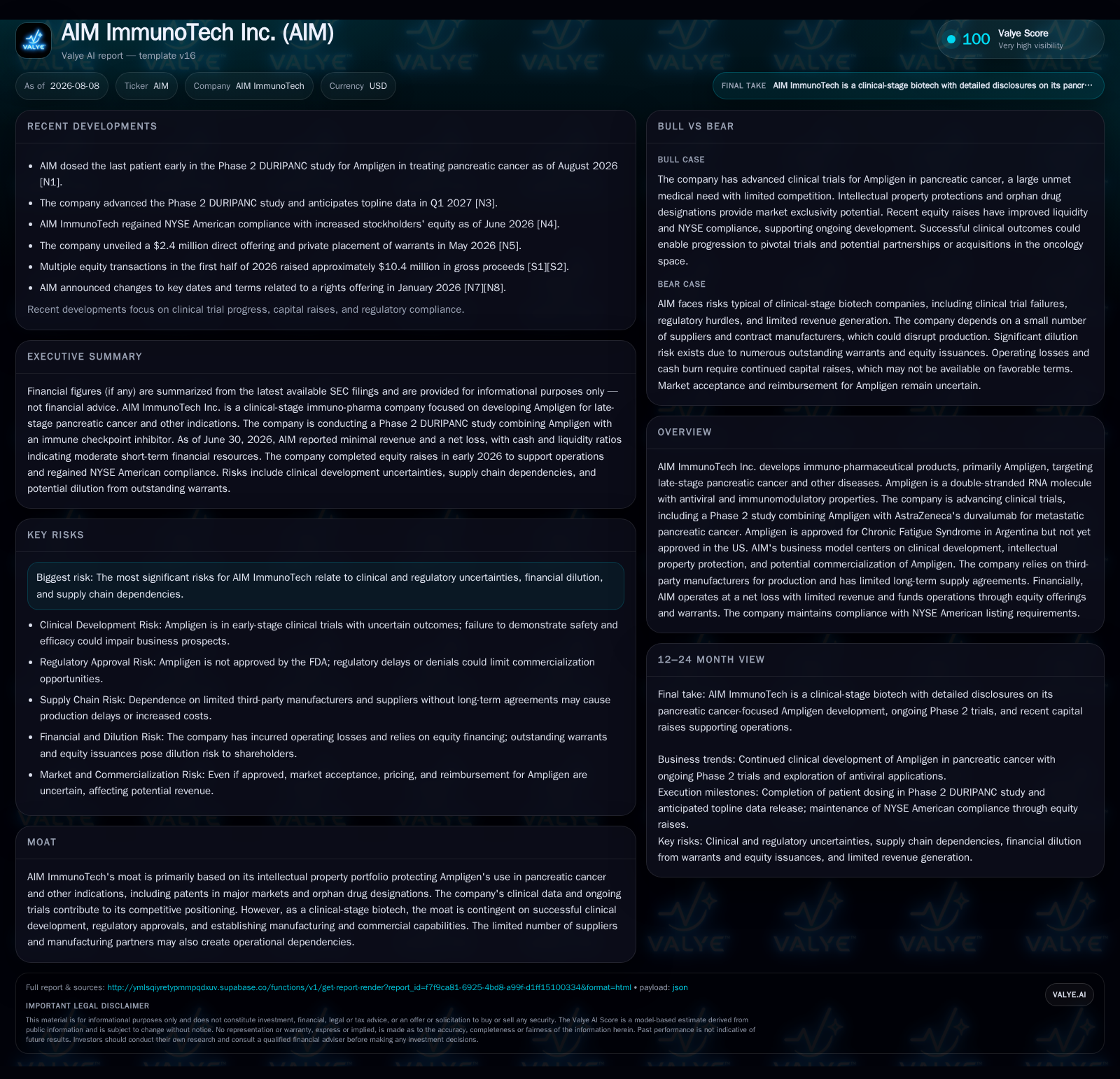
AIM ImmunoTech recently completed dosing of its pivotal Phase 2 DURIPANC trial combining Ampligen with durvalumab for metastatic pancreatic cancer, marking a key clinical milestone that sets the stage for upcoming data readouts and regulatory interactions. Concurrently, the company renewed its manufacturing supply agreement with Sterling Pharma Solutions, underscoring reliance on third-party production capacity that could pose operational risks. Financially, AIM extended its cash runway through multiple equity raises totaling approximately $10.4 million but faces substantial dilution pressure from nearly 48.5 million outstanding warrants. Intellectual property protections for Ampligen remain a strategic asset, supported by orphan drug designations enhancing exclusivity if regulatory approval is achieved. However, the clinical-stage biotech’s operating model hinges on successful trial progression amid capital constraints and supply chain dependencies.
Ampligen Phase 2 Dosing Milestone Validates Clinical Momentum
In its August 7, 2026 Form 10-Q filing, AIM ImmunoTech reported completing the dosing of the final patient in its Phase 2 DURIPANC trial evaluating Ampligen (rintatolimod) in combination with AstraZeneca’s durvalumab for metastatic pancreatic cancer [S2], [N1]. This milestone confirms that enrollment targets were met ahead of schedule, an important KPI reflecting recruitment efficiency and patient interest in this immuno-oncology combo therapy. The DURIPANC trial's completion of dosing signals readiness to advance toward primary endpoint analysis focusing on safety and efficacy metrics crucial for future regulatory filings. The combination approach targets synergistic activation of innate immunity (Ampligen) with immune checkpoint blockade (durvalumab), distinguishing AIM’s candidate mechanistically within a crowded pancreatic cancer landscape dominated by chemotherapy regimens and emerging biologics.
Successful patient dosing completion enhances visibility into near-term catalysts as top-line data readouts become anticipated milestones validating Ampligen's therapeutic potential. Given pancreatic cancer's notoriously poor prognosis and limited treatment options, achieving statistically significant safety or efficacy gains could materially shift competitive positioning versus peers developing alternative immunotherapies or antivirals. However, clinical outcome quality—particularly durability of response and manageable adverse event rates—will ultimately determine Ampligen’s regulatory trajectory.
Manufacturing Contract Renewals Spotlight Supply Chain Dependencies
On July 31, 2026, AIM disclosed entering into a Proposal Agreement extending its Master Service Agreement with Sterling Pharma Solutions for manufacturing additional batches of Polymer precursors PolyI and Poly C12U used in producing Ampligen at Sterling's Dudley, UK facility [S3]. This renewal underscores AIM's continued reliance on Sterling as a key third-party manufacturer (CMO) to ensure supply chain continuity critical for both ongoing trials and anticipated commercialization.
Such dependence exposes AIM to operational risks common among clinical-stage biotechs outsourcing production to limited suppliers. Manufacturing scale-up challenges—especially for complex polynucleotide molecules like Ampligen—may present reliability issues influencing cost structure and timing of drug availability. Delays or quality control setbacks at Sterling could cascade into trial enrollment slowdowns or complicate future market launch commitments.
Competitor reference points include biotech peers who have faced similar outsourcing bottlenecks versus large pharmaceutical firms maintaining internal production control. The lack of long-term diversified supply contracts may constrain AIM’s ability to negotiate pricing or buffer against unforeseen disruptions. Hence, the Sterling agreement renewal serves less as operational assurance than a reminder of supply base concentration risk.
Equity Infusions Heighten Dilution Despite Capital Relief
AIM immunoTech raised gross proceeds approximating $10.4 million during Q2 2026 via multiple equity transactions including rights offerings and registered direct placements [S2]. While these raises extend cash runway essential to sustaining costly Phase 2 development activities, they materially increased share count diluting existing equity holders' interests.
Furthermore, the company reports approximately 48.5 million warrants outstanding at various strike prices as of June 30, 2026 [S2]. Should warrant holders exercise fully, existing shareholders face substantial dilution risks compounded by potential downward pressure on the stock price due to increasing share supply.
This classic biotech funding model—equity-financing heavy pre-commercial stage—inherently balances capital adequacy against shareholder value erosion. Absent near-term revenue inflection from licensing deals or product sales, AIM must periodically revisit capital markets, magnifying dilution uncertainty.
Significant warrant overhang also complicates investor perceptions regarding the achievable net proceeds post-dilution which can affect valuation multiples relative to peer clinical-stage companies navigating similar financing cycles.
Fortify Market Entry Barriers: Intellectual Property Protections
AIM ImmunoTech maintains a substantive patent portfolio protecting Ampligen's use in pancreatic cancer and other indications alongside orphan drug designations granted in multiple jurisdictions including the US [S1],. These IP assets establish legal barriers limiting generic competition thus extending market exclusivity potentially beyond patent life thanks to regulatory exclusivities conferred by orphan status.
Orphan designation not only facilitates accelerated FDA review pathways but also confers enhanced market exclusivity periods that can be monetized through premium pricing strategies pending commercial approval. However, such benefits remain contingent upon successful clinical outcomes evidencing Ampligen’s efficacy—a risk factor common across orphan drugs targeting rare or difficult-to-treat cancers.
Ampligen's mechanism—as an immune modulator leveraging double-stranded RNA activity—positions it distinctively relative to peptide-based immune checkpoint inhibitors or chemotherapeutics pursued by competitors. IP strength coupled with specialized clinical trial data forms a moat that may attract licensees or partners seeking differentiated immuno-oncology assets.
Clinical Business Model Dependent on Trial & Capital Execution
As detailed in AIM’s annual report [S1] and further noted in public disclosures, the company operates as a clinical-stage biotechnology entity focused primarily on advancing Ampligen through costly mid-to-late stage trials without significant current product revenues except niche applications like Chronic Fatigue Syndrome in Argentina.
Revenue generation currently depends largely on grants or milestone payments rather than product sales; hence cash burn correlates mainly with R&D expenditure driving net losses currently reported near $13.95 million per year-end 2025 [F1]. This negative earnings profile is typical for firms reliant on external financing sources during protracted drug development cycles.
Customer endpoints comprise enrolled patients in trials pending broad approval followed by potential payor systems subject to reimbursement policy shifts frequently influenced by demonstration of survival benefit or quality-of-life improvements relative to existing standards-of-care.
Operational leverage challenges stem primarily from lengthy enrollment timelines and high fixed costs related to contracted manufacturing capacity plus overheads associated with compliance governance—factors which amplify sensitivity to any delay or failure in clinical advancement.
Growth Opportunity Confined by Regulatory and Operational Risks
AIM’s growth prospects are tethered closely to successful demonstration of safety/efficacy endpoints in Phase 2 DURIPANC results underpinning future FDA submissions for marketing approval. Regulatory approval would unlock market exclusivity benefits derived from both patents and orphan designations establishing a commercial foothold in pancreatic cancer—a high unmet need indication with limited effective therapies.
However, significant risks persist including possible trial failures, adverse safety events that could terminate development prematurely, FDA objections requiring additional studies introducing cost/time overruns, or competitive displacement by other innovative immunotherapies progressing through accelerated pathways [S11],.
Operationally, constrained manufacturing scalability could limit timely drug supply disrupting next-stage trials or compassionate use programs necessary to bridge regulatory gaps.
Financial constraints introduce dilution pressures bearing down on investor confidence necessitating scrupulous capital management aligned tightly with clinical milestone cadence executed flawlessly.
"Watchpoints": Upcoming Data Readouts, Regulatory Interactions, Capital Strategy Refinement
Key metrics monitoring AIM’s trajectory include:
- Publication timelines for DURIPANC Phase 2 primary endpoint results confirming enrollment completeness,
- Safety/adverse event profiles influencing FDA feedback pace,
- Regulatory submission filings projected post-data availability,
- Updates from Sterling Pharma regarding batch manufacturing volumes addressing scale-up concerns,
- Capital raise announcements indicating sufficiency of liquidity extending runway beyond pivotal trial readouts,
- Potential partnering/licensing discussions leveraging IP portfolio strength potentially mitigating dilution risk. Monitoring these factors will indicate whether operational execution aligns sufficiently with strategic plans given sector-specific risks inherent in immunomodulatory oncology therapeutics development.
Financial Profile Discussion
As of June 30, 2026, AIM ImmunoTech reported cash and equivalents totaling approximately $9.9 million against total debt near $4.07 million resulting in net cash positive positioning reflective of prudent recent financings supporting ongoing operations [F1]. The current ratio stood at a healthy 2.11 indicating adequate short-term liquidity relative to liabilities also underpinning near-term solvency assurances despite accumulated deficit status approaching $441 million historically [S1], [F1].
Operating loss accruals around $11.7 million yearly illustrate persistent negative earnings typical at this developmental stage where no meaningful product sales have commenced except minor revenue streams from foreign indications totaling merely $88k last fiscal reported period [F1]
Continuous financing through equity offerings has been vital given limited licensing income prospects so far; however dilution effects tied closely to warrant exercises require careful management to balance capital adequacy without excessive shareholder value erosion consistent with patterns observed among peer early-stage biotechs advancing analogous clinical assets.
In conclusion, AIM’s financial structure supports ongoing Phase 2 activities but necessitates further capital access solutions aligned with imminent clinical milestones essential to reduce investment uncertainty while balancing shareholder dilution concerns effectively.
Disclaimer: This is research-only, informational analysis and not investment advice. It may include AI-generated interpretation and general industry context. Always verify important details using primary sources.

Comments