
indie Semiconductor’s Restructuring and Product Focus Amid Financial Pressures
Recent quarterly results reveal indie Semiconductor’s ongoing restructuring efforts to enhance operational efficiency within a capital-intensive, competitive semiconductor landscape.
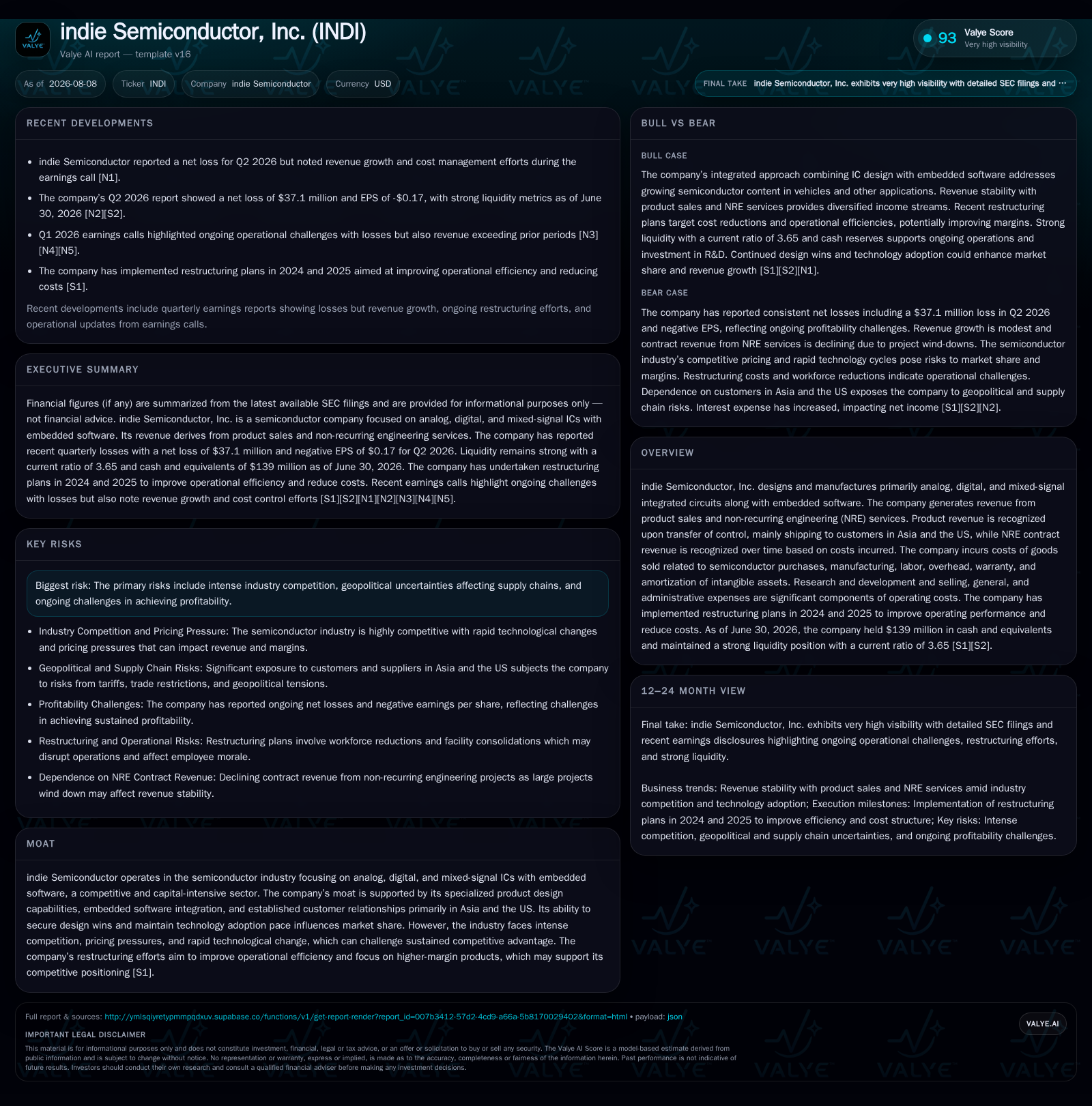
indie Semiconductor reported continued operating losses in Q2 2026 despite revenue beating expectations, underscoring persistent challenges in profitability tied to high operating expenses and restructuring costs. The company’s business model centers on mixed-signal ICs with embedded software for automotive and industrial applications, with revenues derived from product sales and NRE engineering contracts. indie’s strategic push to improve margins involves cost reductions through restructuring initiatives and targeted acquisitions, positioning itself amid intense competition from fabless peers and IDMs in analog and mixed-signal semiconductor segments. Key operational metrics such as design wins, product mix evolution towards higher-margin offerings, and supply chain resilience will be critical growth levers to monitor.
Recent Operating Update
indie Semiconductor’s second quarter ended June 30, 2026 report underscored continued financial challenges despite top-line strength. Revenue beat estimates attributed to sustained demand for its analog, digital, and mixed-signal integrated circuits (ICs), yet operating losses persisted driven by sizable research & development (R&D), selling general & administrative (SG&A) expenses, and restructuring costs initiated since 2024 [S2][N1][N2]. Importantly, the current ratio stands healthy at 3.65 due to current assets significantly exceeding liabilities [F1][S2]. However, this liquidity cushion must be weighed against negative cash flow trends inherent to the semiconductor design model during loss-making phases.
Business Model Analysis
indie Semiconductor designs primarily analog, digital, and mixed-signal ICs integrated with embedded software tailored toward automotive advanced driver assistance systems (ADAS), autonomous driving platforms, connected vehicles user interfaces, electrification components as well as industrial applications [S1]. Revenues are twofold: product sales recognized upon delivery of semiconductors under commercial supply agreements—mainly shipping to Asia and U.S. locations—and non-recurring engineering (NRE) contract fees recognized over time based on input methods correlating to engineering costs incurred [S1]. This combined revenue model targets OEMs or Tier-1 suppliers requiring specialized IC designs plus software integration capabilities vital for next-generation vehicle electrification and autonomy sectors.
Cost of goods sold (COGS) encompasses purchased wafers via subcontractors including fabrication testing/assembly costs plus labor overheads related to manufacturing support activities. The company also carries warranty provisions inline with generally assured limited warranties typical in semiconductor products but without separate performance obligations recognized under revenue accounting standards [S1]. Heavy R&D investment rails innovation pipelines essential in an industry where product lifecycle velocity directly influences market share retention via design wins secured from auto OEMs or Tier-1 partners.
Since its inception as a fabless semiconductor entity with selective vertical integration into embedded software solutions accompanying its IC offerings, indie pursues differentiation through technology depth in multi-modality edge sensing covering LiDAR, RADAR ultrasound sensors combined with computer vision capabilities central to ADAS/autonomy functions [S1]. Expanding embedded software expertise aims at elevating product value creation beyond silicon level which aligns with peers such as Qualcomm or NXP focusing on system-level integration.
Industry Structure and Competitive Position
The semiconductor design industry is highly capital-intensive with rapid innovation cycles mandating continuous reinvestment into next-gen device architectures. indie competes broadly with fabless giants like Broadcom specializing in mixed-signal ASICs or heavyweights like Texas Instruments focusing on analog ICs. The market structure demands robust design win pipelines translating into assured production volumes to sustain gross margins typically pressured by commoditization effects over time.
indie holds niche positioning through an emphasis on automotive sensor fusion segments supporting electric/autonomous vehicle growth trends while concurrently addressing industrial IoT markets. However, competitive dynamics remain fierce given large incumbents' scale advantages in R&D expenditure ($hundreds of millions annually), established IP portfolios shielding barriers to entry as well as entrenched customer relationships constraining indie’s expansion pace. Moreover, pricing power is variable influenced by cyclicality in auto production volumes plus evolving regulatory mandates around vehicle safety/energy efficiency standards that modulate demand elasticity.
Growth Drivers
Several structural growth vectors underpin potential opportunity for indie Semiconductor:
- Increasing semiconductor content per vehicle driven by advanced ADAS/electrification proliferation requires more sophisticated mixed-signal ICs capable of edge processing coupled with embedded sensing software.
- Expansion of autonomous driving features fuels demand for diverse sensor modalities blending LiDAR/RADAR/vision solutions where indie's multi-technology platform can capitalize.
- Growing adoption of connected car ecosystems elevates focus on user experience hardware/software layers leveraging embedded processors designed by indie.
- Recent acquisitions including emotion3D GmbH offering complementary imaging and sensor tech along with an anticipated close of ams-OSRAM CMOS image sensor business acquisition enhances portfolio breadth critical for OEM sourcing rationalization [S11][S26].
- Geographic distribution targeting Asia (largest automotive production base) plus North America supports diversified end-market exposure reducing customer concentration risk.
Monitoring design win momentum through quantifiable metrics — backlog build-up on NRE contracts converting into firm orders — alongside managing time-to-market velocities will confirm efficacy of growth strategies aligned with industry demand trajectories.
Risks and Constraints
indie Semiconductor faces notable risks common among mid-sized fabless players:
- Intense competition imposes pricing pressure undermining gross margin sustainability unless offset by proprietary IP or specialized system-level integration capabilities.
- Geopolitical tensions especially U.S.-China trade dynamics risk disruption across foundry subcontractors predominantly situated in Asia which could constrain supply availability or increase component cost inflation.
- Execution risk around restructuring plans initiated in 2024–2025 intended to improve cost structures; failure could prolong operating losses eroding investor confidence [S1][S4].
- Customer concentration risk remains if marquee OEMs dominate revenue streams without broader diversification; design win volatility can lead to lumpy revenue recognition patterns.
- Ongoing technological shifts require continuous investments in R&D; falling behind could render certain product lines obsolete rapidly given short life cycles characteristic of this sector.
- Inventory management challenges arise due to variable end-market demand cycles risking obsolescence or write-downs impacting earnings quality.
What to Watch Next
Key near-term milestones include closing regulatory approvals anticipated shortly for the CMOS image sensor acquisition targeted in Q3 2026 enhancing indie’s imaging capabilities within automotive sensing suites [S26]. Tracking metrics related to NRE contract backlogs converting into production orders will provide insight into future revenue visibility alongside analysis of product mix shift toward higher margin embedded software enhanced IC offerings will indicate margin expansion prospects.
Additional indicators consist of yield improvements or supply chain stabilization post restructuring actions evidencing efficiency gains impacting operating income trends. Cash burn rates vis-à-vis liquidity buffers amid capital expenditures grants perspective on financial flexibility supportable through these transformations.
Financial Profile Discussion
Capital allocation has included acquisitions aimed at bolstering technology leadership though these also add near-term integration expense load. Cash flow generation remains negative consistent with investment phase typical among aggressive semiconductor innovators leveraging external financing sources including ATM equity programs providing incremental funding optionality [S21]. Managing capital structure prudently while advancing pathways toward sustainable positive free cash flow conversion is critical given intrinsic capital expenditure needs embedded deeply within semiconductor lifecycle economics.
This analysis is provided strictly for informational purposes without investment advice or research views.
Disclaimer: This is research-only, informational analysis and not investment advice. It may include AI-generated interpretation and general industry context. Always verify important details using primary sources.

Comments