
United States Oil Fund Navigates Regulatory Limits and Market Structures in Q2 2026
USO’s latest quarterly filing highlights the operational impact of futures market constraints, regulatory position limits, and contango on crude oil exposure and investor flows.
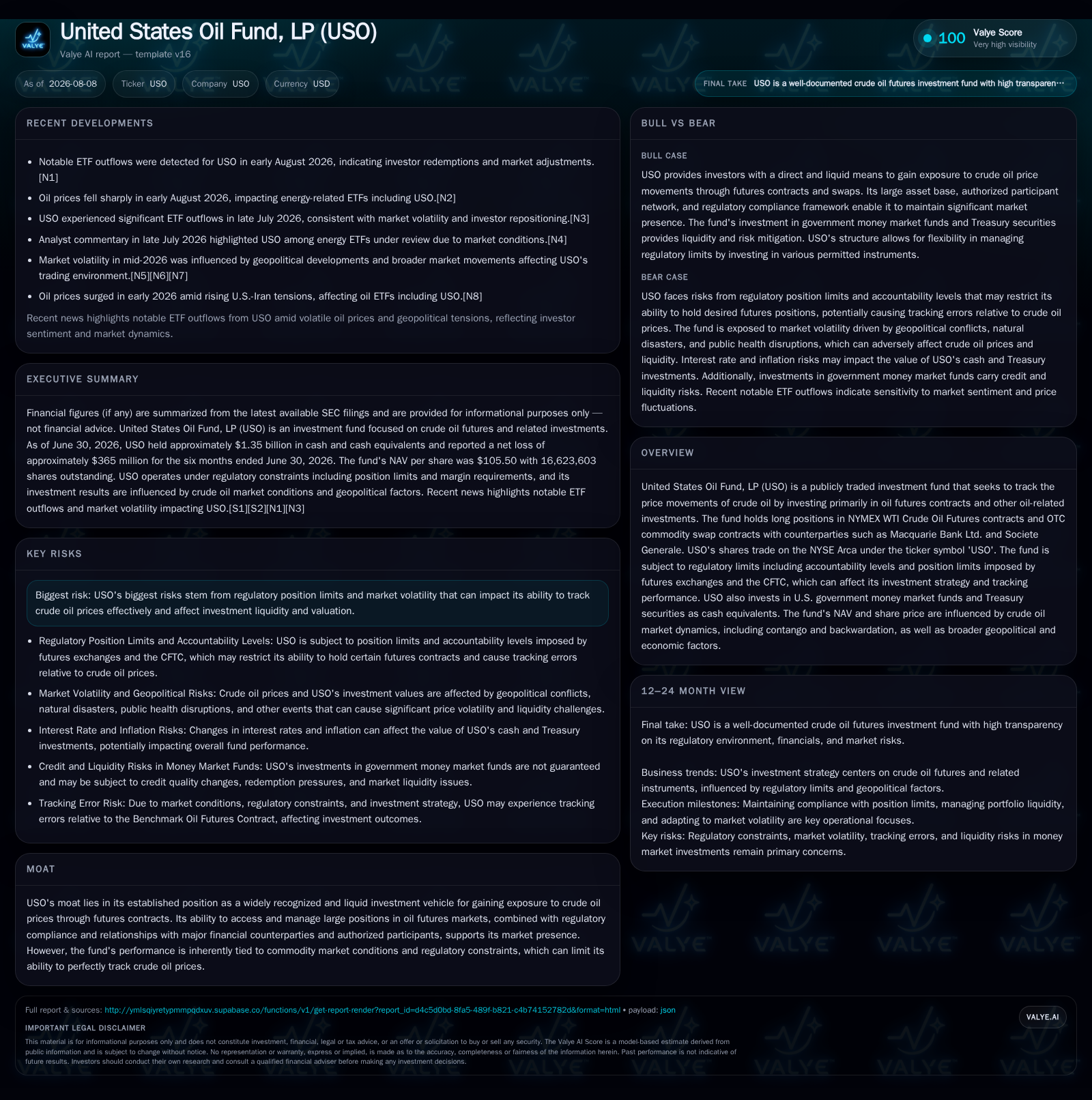
The United States Oil Fund, LP (USO) manages a portfolio primarily composed of NYMEX WTI crude oil futures contracts and OTC commodity swaps to deliver investors exposure to oil price fluctuations. In Q2 2026, USO faced persistent challenges from regulatory accountability levels exceeding futures holdings and structural market conditions like contango that increase tracking error relative to spot prices. The fund’s credit risk is managed through established counterparties with ISDA agreements, while liquidity is supported by a substantial cash balance invested mainly in U.S. Treasuries. Recent ETF outflows underscore investor sensitivity to crude volatility and emphasize the importance of liquidity management. These factors collectively illustrate the complexities commodity-focused ETFs face in replicating physical commodity returns within regulatory and market constraints [S1][S2][S12][F1][N2].
Q2 2026 Update: Navigating Futures Positions Amid Oil Price Volatility
In its latest quarterly filing ending June 30, 2026, United States Oil Fund (USO) detailed operations centered on managing a portfolio dominantly composed of NYMEX WTI crude oil futures contracts complemented by OTC commodity swaps with established financial institutions [S2]. The fund calculates its net asset value (NAV) per share daily using closing prices from relevant exchanges adjusted for liabilities and divided by shares outstanding. This method aligns USO's income or loss per share closely with benchmark futures price movements but remains subject to structural complexities inherent in derivatives-based commodity investing.
USO held approximately 13,180 NYMEX WTI Crude Oil Futures contracts as of quarter-end—exceeding the NYMEX accountability level threshold of 10,000 contracts for any single month but still below absolute position limits imposed by regulators [S1]. Accountability levels prompt enhanced exchange oversight without immediate enforcement but expose USO to potential scrutiny or required adjustments if positions grow further. Historically, despite surpassing these thresholds (up to 16,767 contracts in prior periods), USO has not been compelled to reduce holdings. However, this regulatory environment represents an execution risk factor affecting the fund's ability to mirror benchmark price changes precisely.
Contango Effects Amplify Tracking Error Relative to Spot Prices
USO's performance is structurally influenced by term structure patterns such as contango—a scenario where futures prices exceed spot prices for later delivery dates—resulting in negative roll yields when near-month contracts are sold at lower prices and replaced with costlier longer-dated contracts [S1][S2]. This dynamic creates systematic drag on returns compared with direct spot price investments and generates tracking error that can cause NAV fluctuations disproportionate to spot crude movements.
Backwardation—the inverse condition—can provide positive roll yields but tends to be less persistent. The prevalence of contango during much of early-2026 has contributed significantly to NAV declines beyond those explained solely by spot price changes [S12]. This underscores an intrinsic challenge faced by derivative-based commodity ETFs like USO: replicating physical commodity returns without bearing storage or other physical ownership costs.
Regulatory Position Limits Constrain Investment Strategies
USO operates under strict position limits enforced by the Commodity Futures Trading Commission (CFTC), NYMEX, and ICE Futures designed to cap maximum net long or short positions excluding bona fide hedges [S1]. Accountability levels serve as monitoring thresholds triggering disclosure obligations without immediate enforcement actions; fixed position limits represent hard ceilings.
These restrictions require USO to balance desired benchmark replication against mandatory compliance constraints. When nearing or exceeding these limits during heightened demand or market stress periods, USO may need to reduce contract exposure or diversify into other permissible instruments. Such constraints inherently increase tracking error potential since full benchmark exposure may not be feasible.
Strategic Use of OTC Swaps Balances Exposure and Credit Risk
To enhance flexibility beyond exchange-traded futures limitations, USO employs over-the-counter swap agreements with counterparties including Macquarie Bank Ltd. and Societe Generale [S2][S19]. These swaps enable tailored exposure aligned with underlying crude indices while offering capital efficiency benefits.
However, OTC instruments introduce counterparty credit risk absent centralized clearinghouse protections typical of exchange-traded contracts. USO mitigates this through robust ISDA master agreements incorporating netting provisions and margin requirements that limit net credit exposure even during volatile market conditions.
Liquidity Management Amid Investor Flows and Market Volatility
USO’s liquidity profile benefits from a sizable cash reserve (~$1.35 billion) concentrated in short-term U.S. Treasury securities and money market funds used as collateral for margin requirements tied to leveraged futures positions [F1][S20]. This liquid buffer supports operational agility amid fluctuating margin calls driven by commodity price volatility.
Despite this, recent months have seen material outflows from USO shares reflecting investor sensitivity to oil market turbulence amplified by geopolitical risks such as Middle East tensions reported throughout mid-2026 [N2][N4][N9][N6]. Authorized participants facilitate creation/redemption mechanisms that help stabilize share liquidity despite these pressures; however, sustained negative sentiment could widen premiums or discounts relative to NAV.
Growth Drivers: Investor Demand for Liquid Commodity Exposure Amid Uncertainty
Long-term growth potential is linked to macroeconomic factors driving demand for transparent energy commodity vehicles—such as inflation hedging needs amid monetary policy uncertainty—and geopolitical events impacting supply stability like Hormuz Strait tensions [N6][N13].
ETF adoption among institutional allocators continues expanding as investors seek liquid alternatives to direct commodity ownership fraught with logistical complexities. Enhancements in authorized participant networks further support scalability despite regulatory ceilings on contract volumes.
Risks & Watchpoints: Regulatory Constraints, Market Volatility & Operational Challenges
Key risks include:
- Position limits restricting full benchmark replication leading to tracking deviations;
- Volatile crude prices causing sharp NAV swings impacting investor returns;
- Negative roll yield effects from contango diminishing total return over time;
- Counterparty credit risks inherent in OTC swaps mitigated but extant;
- Complex tax treatment due to limited partnership structure potentially affecting distributions;
- Operational risks including cybersecurity vulnerabilities reliant on third-party service providers managing trading infrastructure [S1][S2].
Close monitoring of regulatory developments regarding contract holdings will be essential alongside geopolitical events shaping crude supply-demand balances that influence volatility.
Financial Profile Discussion
As of June 30, 2026, USO held approximately $1.35 billion in cash and equivalents invested mostly in short-duration U.S. Treasury securities plus money market funds providing liquidity for margin calls linked to leveraged futures positions [F1][S20]. Commission expenses are modest at an annualized rate around 0.12% of average net assets reflecting efficient trade execution supportive of net returns compared with peers facing higher brokerage costs due to scale or fragmented relationships [S2]. This financial positioning provides operational flexibility amid fluctuating market conditions while balancing cost efficiency essential for competitive standing among energy commodity ETFs.
Disclaimer: This is research-only, informational analysis and not investment advice. It may include AI-generated interpretation and general industry context. Always verify important details using primary sources.

Comments