
Embecta Corp. Expands Drug Delivery Portfolio While Managing Supply Chain and Regulatory Challenges
Embecta's latest quarter highlights progress from its Owen Mumford acquisition alongside persistent operational and market risks in diabetes care devices.
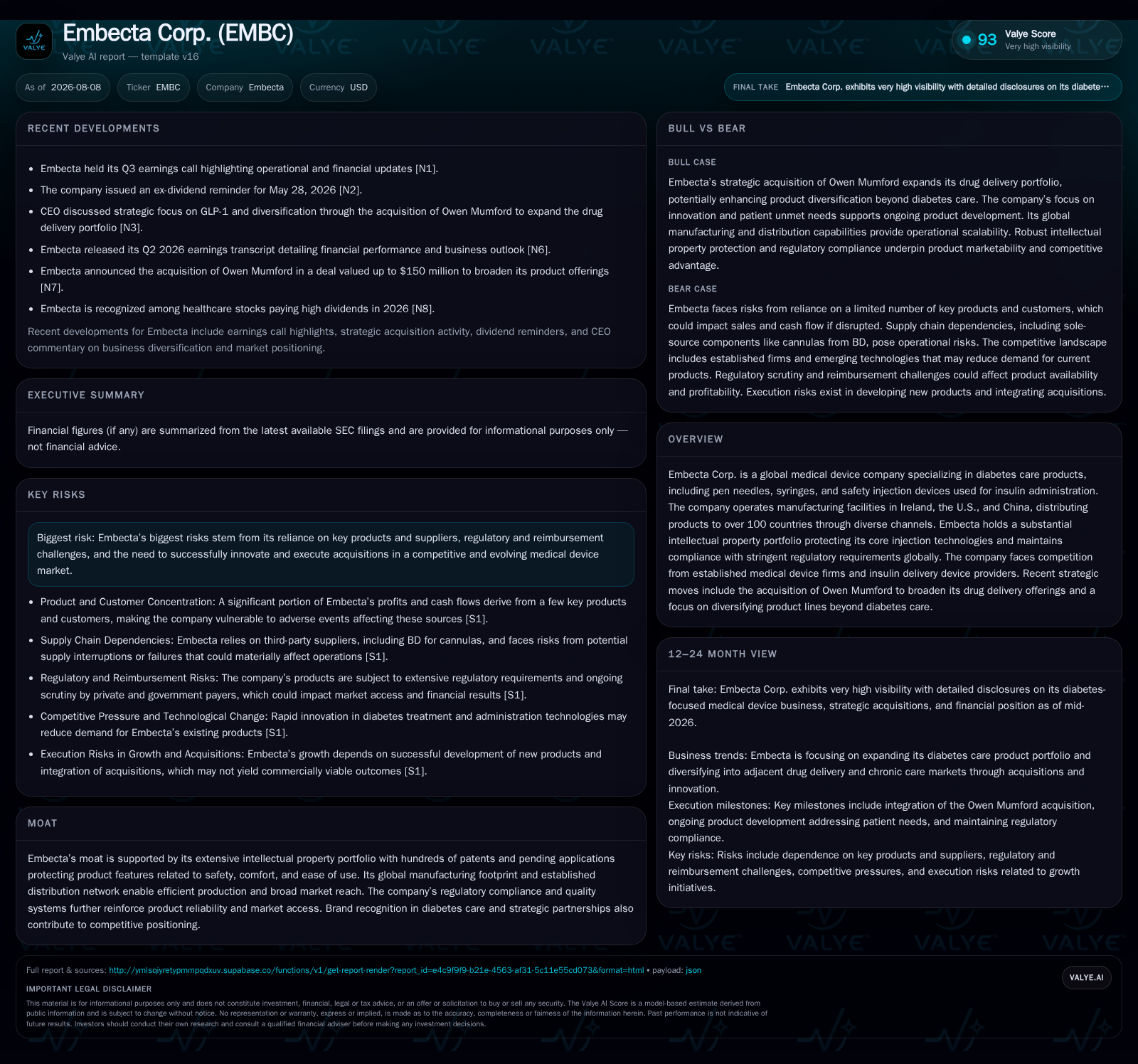
Embecta Corp. is advancing the integration of its Owen Mumford acquisition, expanding beyond diabetes-specific injection devices into broader drug delivery technologies. The company operates a global manufacturing and distribution network supporting over 100 countries, underpinned by a robust intellectual property portfolio protecting key insulin administration products. Recent disclosures reflect stable operations but highlight ongoing challenges including supply chain dependencies, regulatory compliance demands, and concentration among major distributors. Near-term growth hinges on successful integration, commercial execution of new product platforms, and sustained innovation in safety-focused injection devices.
Recent Operating Update
Embecta Corp.'s Q3 2026 filings highlight significant progress integrating Owen Mumford Holdings Limited (OM), acquired for an upfront £100 million plus contingent milestone payments tied to commercial performance through mid-2029 [S2][S3][S10][S12]. This strategic acquisition extends Embecta’s portfolio beyond insulin delivery devices into advanced drug delivery technologies such as OM's Aidaptus® next-generation auto-injector platform. Management commentary during the earnings call reflects confidence in potential synergies while acknowledging integration execution risks that could affect near-term revenue growth [N1].
No material changes in risk factors were reported compared to prior quarters, indicating operational stability post-acquisition. Embecta continues investing in research and development focused on patient safety innovations amidst complexities in global manufacturing and supply chain management.
Business Model
Embecta generates revenue primarily by designing, manufacturing, and marketing sterile single-use medical devices including pen needles, conventional syringes, and safety-engineered alternatives aimed at reducing needlestick injuries during insulin administration [S1]. These products are sold worldwide through a network comprising healthcare providers, pharmacies, distributors, and occasionally direct-to-patient channels. Revenue drivers include unit volumes influenced by global insulin therapy prevalence, product mix between conventional and premium safety devices affecting average selling prices, contractual terms negotiated largely with major distributors, and reimbursement environments varying across geographies
The addition of OM enables diversification into chronic disease drug delivery markets via innovative auto-injector platforms leveraging Embecta’s manufacturing expertise and channel relationships. Manufacturing capacity utilization at Embecta’s three sites—located in Ireland, the U.S., and China—is pivotal given stringent sterilization requirements critical to regulatory compliance and product safety [S1][S21]. Component sourcing remains partly dependent on third-party suppliers such as BD
Embecta sustains profitability through its extensive intellectual property portfolio that protects proprietary device features enhancing injection comfort and automatic safety mechanisms. These patents create barriers to generic competition in a commoditized segment dominated by firms like BD, MTD Group, Terumo Medical Corporation, and Novo Nordisk’s integrated solutions [S1]. This IP-driven differentiation supports premium pricing strategies aligned with improved patient adherence.
Industry Structure and Competitive Position
The medical device sector for diabetes care is defined by rigorous regulatory oversight (including FDA 510(k) clearance pathways), high-quality sterile manufacturing standards, reimbursement pressures from payors seeking cost efficiency, and rapid innovation cycles that threaten incumbents with disruptive technologies. Embecta competes against established players such as BD—possessing scale advantages—and niche manufacturers specializing in needle technologies like MTD Group.
Competition extends to insulin pump manufacturers offering integrated delivery systems that challenge traditional syringe/needle modalities. Maintaining relevance requires continuous innovation focused on enhanced safety features like dual-ended shields or one-handed activation mechanisms.
Regulatory demands vary internationally with US FDA regulations complemented by EU Medical Device Regulation (MDR), necessitating robust multi-site quality systems supported by Embecta’s global footprint [S20][S23]. Additionally, a broad distribution network servicing over 100 countries affords scale advantages difficult for smaller competitors to replicate.
Growth Drivers
Key industry tailwinds include rising global diabetes prevalence driven by demographic trends alongside increasing diagnosis rates fueling adoption of insulin therapies—a direct driver of demand for Embecta’s core products. Innovation efforts target enhanced safety injection features addressing unmet needs related to needlestick injury prevention aligned with healthcare provider safety mandates.
Strategic growth is accelerated via the OM acquisition unlocking access to adjacent drug delivery markets through novel auto-injector platforms with potential for new revenue streams beyond traditional diabetes care products [S10][N1]. Geographic expansion into emerging markets presents further opportunity as healthcare infrastructure improvements increase access to modern diabetes management tools.
Ongoing regulatory approval cycles underpin medium-term pipeline vitality while strengthening distributor relationships support sales consistency.
Risks and Growth Constraints
Risks include dependency on a concentrated customer base where three distributors represent about 42% of gross sales; shifts in purchasing behavior or pricing pressures here could materially impact revenue [S21]. Manufacturing complexity includes sterilization bottlenecks exacerbated by limited qualified external facilities and supply chain disruptions arising from geopolitical tensions or health crises [S21][S28].
Regulatory risk remains salient; delays or enforcement related to FDA or international compliance failures may restrict market access adversely affecting revenues [S20][S22][S23]. Competitive threats stem from rapid technological advances in alternative diabetes treatments or drug delivery methods requiring sustained R&D investment.
Integration risks linked to the OM acquisition persist; failure to realize synergies or successfully commercialize new platforms may dampen financial performance [S9]. Financial leverage is elevated with net debt approximating $1.25 billion as of June 2026 balanced against cash reserves near $215 million providing liquidity buffers but necessitating prudent capital management amid debt servicing obligations [F1]. Pricing pressures within complex reimbursement frameworks also present margin challenges.
Environmental regulations tightening emissions standards may increase compliance costs or necessitate facility upgrades affecting future expenses [S25]. Product liability litigation exposure inherent to medical device manufacturing adds potential financial volatility despite insurance coverage layers.
What To Watch Next
Critical near-term milestones include the commercial ramp of OWEN MUMFORD’s Aidaptus® auto-injector platform validating acquisition rationale. Regulatory approvals pending across key jurisdictions will indicate pipeline robustness.
Operational metrics such as manufacturing capacity utilization rates and supply chain reliability indicators—including component availability and sterilization throughput—will inform production sustainability assessments. Monitoring contract negotiations with major distributors like Cencora, McKesson Corporation, and Cardinal Health will provide insights into volume trends and pricing dynamics impacting top-line momentum.
Tracking R&D spending relative to sales will reveal commitment levels toward sustaining innovation amid competitive pressures.
Financial Profile Discussion
As of June 30, 2026, Embecta reported cash & equivalents of approximately $215 million versus total debt near $1.47 billion resulting in net debt around $1.25 billion—a leverage profile reflecting financing raised chiefly for acquisitions including OM [F1]. The current ratio stood at a healthy 1.68 demonstrating adequate short-term asset coverage over liabilities [F1].
Capital allocation balances debt servicing needs with R&D investments essential for maintaining patent-protected innovation pipelines complemented by strategic acquisitions aimed at diversification beyond core diabetes care devices [S26]. Working capital discipline amid raw material price volatility will remain important for cash flow preservation.
Disclaimer: This analysis is based solely on publicly available SEC filings as of August 7, 2026 and company disclosures without speculative projections or investment research views.
Disclaimer: This is research-only, informational analysis and not investment advice. It may include AI-generated interpretation and general industry context. Always verify important details using primary sources.

Comments