
How Elevated CRE Loan Exposure Shapes Great Southern Bancorp's Profitability and Risk Profile
Great Southern Bancorp’s significant commercial real estate loan concentration above regulatory thresholds presents challenges and opportunities affecting capital adequacy, earnings stability, and risk management.
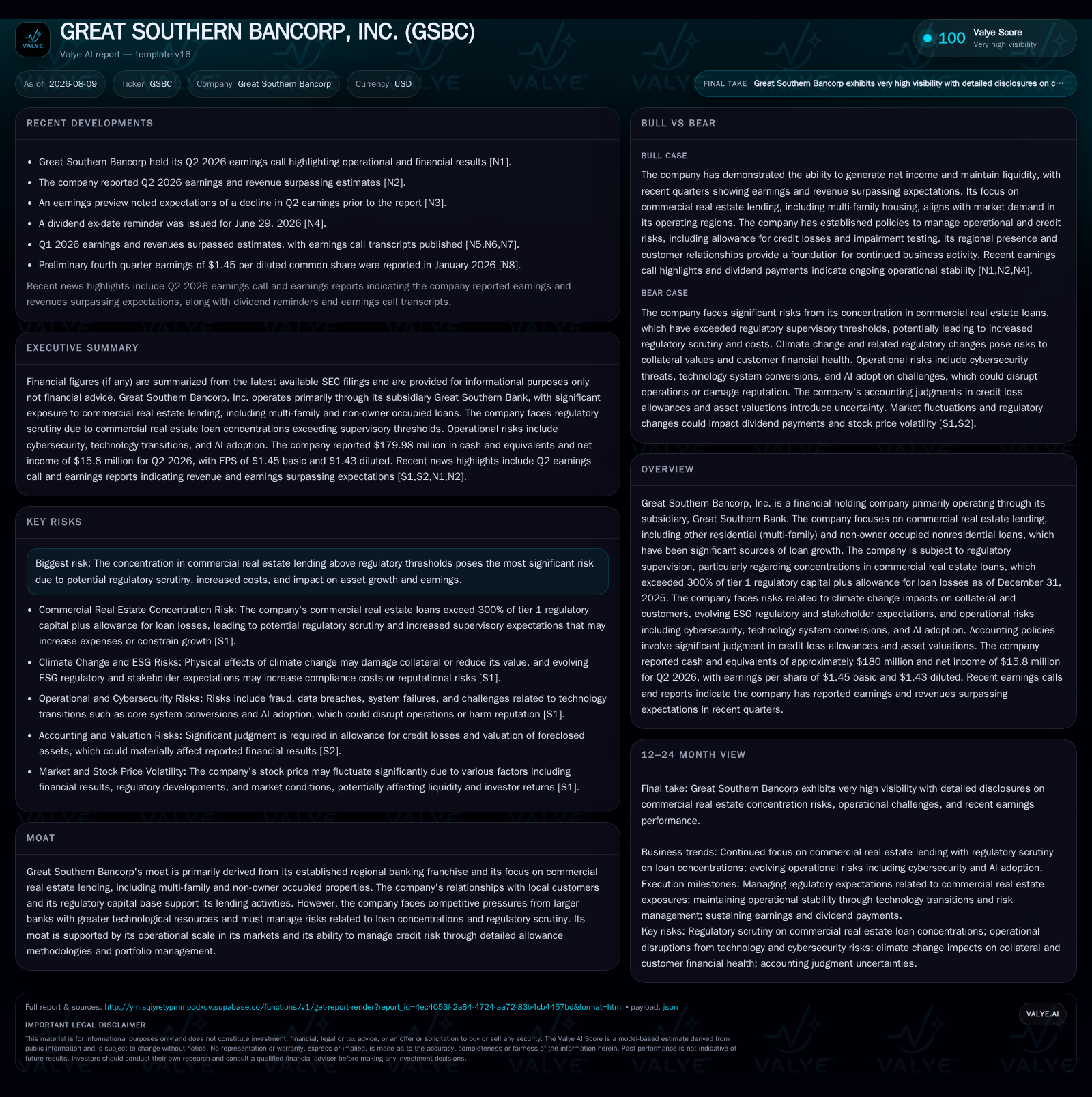
Great Southern Bancorp reported in its Q2 2026 filing that its commercial real estate (CRE) loans exceed 300% of tier 1 regulatory capital plus allowance for loan losses, triggering heightened supervisory scrutiny. This concentration is driven by the company’s focus on multi-family and non-owner occupied CRE lending, which fuels loan growth but introduces potential regulatory costs and credit risks. The bank employs a CECL-based allowance model incorporating historical loss experience and macroeconomic forecasts to manage credit losses amid uncertain conditions. Elevated CRE exposure compresses capital buffers and influences margin dynamics given deposit funding cost pressures and operational expenses tied to technology upgrades and cybersecurity. Going forward, regulatory dialogue outcomes, credit quality trends, and operational execution will be critical markers of the bank's strategic resilience.
Quarterly Update Unpacks CRE Lending Concentration Exceeding Supervisory Thresholds
Great Southern Bancorp’s Q2 2026 Form 10-Q reveals that as of December 31, 2025, its total commercial real estate loans exceeded the critical supervisory guideline of 300% of tier 1 regulatory capital plus allowance for loan losses [S2]. This ratio places GSBC under increased scrutiny from regulators tasked with monitoring real estate concentration risk. The elevated concentration arises from recent rapid growth in commercial real estate lending that surpasses typical thresholds monitored by the Federal Reserve's guidance. Notably, supervisory criteria define CRE loans broadly to include multi-family residential properties as well as non-owner occupied commercial properties—two categories that have been prominent sources of GSBC's loan growth [S1].
This development is pivotal because exceeding this threshold often results in intensified supervisory oversight, potential additional expense requirements for compliance, and ultimately influences strategic decisions related to loan portfolio growth pacing. Given these dynamics featured prominently in the July event filing press release alongside Q2 results [S3], GSBC faces a defining inflection point where loan expansion ambitions must be balanced against evolving regulatory capital demands.
Commercial Real Estate-Driven Loan Growth: Strategic Focus and Financial Implications
GSBC derives most of its revenue through net interest income earned on loans funded principally by stable customer deposits. The bank’s loan portfolio is heavily concentrated in commercial real estate segments—especially multi-family residential and non-owner occupied property loans—that have experienced notable growth in recent periods [S1][F1]. This product mix reflects GSBC's regional banking franchise strategy to leverage local market knowledge and relationships within specialized CRE sectors.
However, these particular CRE segments typically exhibit cyclical sensitivity correlated with broader economic trends such as housing demand fluctuations, rental market conditions, and interest rate environments. Despite pricing power limitations imposed by competitive deposit funding markets—as deposit beta rises with increasing interest rates—the company continues to prioritize this segment given its established expertise [N1][N2]. The reliance on deposit funding underscores the importance of deposit base quality; any pressure on deposit costs directly compresses net interest margin (NIM), a fundamental profitability driver.
Decoding Credit Loss Allowance Methodology Under CECL: Judgment Amid Uncertainty
GSBC applies the Current Expected Credit Loss (CECL) model to calculate its allowance for credit losses—a methodology requiring considerable management judgment combining historical loss data with forward-looking macroeconomic forecasts [S1][S2]. Specifically, the allowance estimation involves segmenting loans into pools with similar risk attributes (e.g., borrower type or collateral class), calculating average historical net charge-offs over lookback periods tailored per pool, and adjusting these rates based on reasonable and supportable macroeconomic expectations including unemployment rates, GDP forecasts, consumer sentiment indices, construction spending levels, and critically a commercial real estate price index.
Regulatory Capital Adequacy: Balancing Tier 1 Ratios Against CRE Concentrations
The excessive CRE exposure strains GSBC’s capital adequacy framework by inflating risk-weighted assets against a finite tier 1 capital base augmented only modestly by allowance balances deemed includable in total regulatory capital [S1][F1]. Maintaining sufficient capital buffers is not only necessary for regulatory compliance but also crucial for preserving market confidence given GSBC’s substantial leverage concentrated in cyclical commercial real estate assets.
The company explicitly notes the trade-off between pursuing further growth in non-owner occupied CRE loans versus slowing growth to prevent further elevation of concentration ratios that may trigger costly supervisory mandates or increased capital charges. A pause or reduction in portfolio expansion could weigh on asset growth metrics and net interest income generation while aggressive build-out increases compliance burdens. Subsequent quarterly filings revealing changes in tier 1 capital ratios or allowance coverage will serve as vital indicators substantiating management's ability to navigate this balancing act effectively.
Comparative Efficiency and Earnings Quality Among Regional Peers
While GSBC benefits from entrenched regional banking relationships enabling focused product specialization, it operates with constraints relative to larger national banks possessing more advanced technological platforms delivering scale efficiencies. The company documents rising operating expenses linked chiefly to investments in cybersecurity defenses, core IT system conversions incorporating artificial intelligence capabilities, and compliance infrastructure enhancements mandated by elevated supervision requirements [S1][N1].
Such cost pressures detract from efficiency ratio improvements (operating expenses over total revenue), particularly when juxtaposed against peer regional banks able to leverage scale for lower incremental technology spend per dollar lent. These factors likely contribute to net interest margin compression amid deposit beta escalations described during recent earnings calls [N2], reducing overall earnings quality despite favorable underlying asset yields.
Growth Enablers: Deposit Base Stability, Market Demand, and Ancillary Fee Income
The funding model underpinning GSBC’s lending activities centers primarily around retail customer deposits—a relatively stable source compared with brokered deposits or wholesale funding in terms of cost predictability—albeit susceptible to competitive pricing pressures that impact margins [S3][F1]. Deposit beta dynamics indicate that as prevailing market rates rise following monetary tightening cycles, customer deposit costs rise partially eroding spreads between asset yields and liability costs.
Complementing net interest income are fee-generating services including treasury management, trust administration, and wealth management offerings targeting local business clients whose funds also feed into deposit pools. These ancillary revenues mitigate some pressure from margin compression yet remain subordinate contributors relative to core lending income streams.
Economic vitality within GSBC’s key regional markets bolsters demand for specialized CRE financing solutions tied closely to demographic trends impacting multi-family residential developments alongside commercial space utilization needs—conditions supporting sustained loan originations despite the cautious tone introduced by rising regulatory constraints.
Risks to Watch: Credit Quality Volatility, Regulatory Scrutiny, and Operational Complexity
Credit risk exposure tied directly to concentrated commercial real estate portfolios makes non-performing asset trajectories critical watchpoints since any uptick signals deteriorating borrower repayment capacity potentially precipitating higher provision expenses or charge-offs [S1][S2]. Furthermore, climate change-related risks pose emerging threats via possible physical damage to collateral properties from severe weather events or shifts in local economic environments diminishing tenant revenues—risks GSBC acknowledges though empirical quantification remains challenging given limited historic data.
Intensifying regulatory oversight stemming from concentration breaches escalates compliance costs while raising uncertainty over future supervisory directives potentially influencing operational flexibility. Operational risk also heightens during ongoing technology system transformations encompassing cybersecurity safeguards alongside AI adoption introducing complex implementation variables requiring ongoing managerial attention.
Next Steps: Key Milestones in Portfolio Management, Regulatory Dialogue, and Technology Integration
Investors should monitor forthcoming quarterly filings for updates on GSBC’s tier 1 capital ratio trajectory relative to CRE concentrations as well as disclosed changes in allowance adequacy reflecting evolving macroeconomic assumptions embedded within CECL models [S2][S3]. Dialogue outcomes with regulators concerning concentration mitigation strategies or additional capital requirements will be germane signals regarding strategic latitude.
Progress reports addressing completion timelines for AI-enabled system conversions impacting cost structures alongside cybersecurity resilience updates will additionally shed light on operational risk mitigation success. Lastly, management commentary concerning loan portfolio composition shifts—whether aimed at diversifying away from high-concentration buckets—and actual deposit beta responses amid dynamic interest rate environments will be important barometers affirming adaptive responses.
Financial Profile Discussion
As of June 30, 2026, Great Southern Bancorp held $180 million in cash and equivalents underpinning liquidity positioning adequate for meeting depositor demands alongside operational needs without immediate reliance on wholesale funding sources [F1]. While total debt figures are reported from prior dates around $223 million with implied net debt approximately $43 million after cash offsets [F1], current leverage metrics remain pressured by asset concentrations notably elevated beyond customary regional bank thresholds demanding close surveillance.
Operating income levels reported previously underscore profitability sustained through disciplined credit management yet face margin compression headwinds linked partly to deposit cost inflation balancing CRE-related yield advantages across economic cycles. Overall equity stands solid enough to absorb moderate shocks while enabling measured deployment toward selective loan opportunism subject to regulatory comfort zones established going forward.
Disclaimer: This analysis is based solely on information sourced from public SEC filings dated August 7th, 2026 or earlier and public news releases as indicated; it does not constitute investment advice or research views concerning Great Southern Bancorp or its securities.
Disclaimer: This is research-only, informational analysis and not investment advice. It may include AI-generated interpretation and general industry context. Always verify important details using primary sources.

Comments