
Wilson Bank Holding Navigates Regional Economic Shifts with Real Estate Loan Focus
Wilson Bank Holding’s 2026 Q2 update highlights the interplay of real estate lending concentration, hedging against rate volatility, and branch expansion shaping localized financial performance.
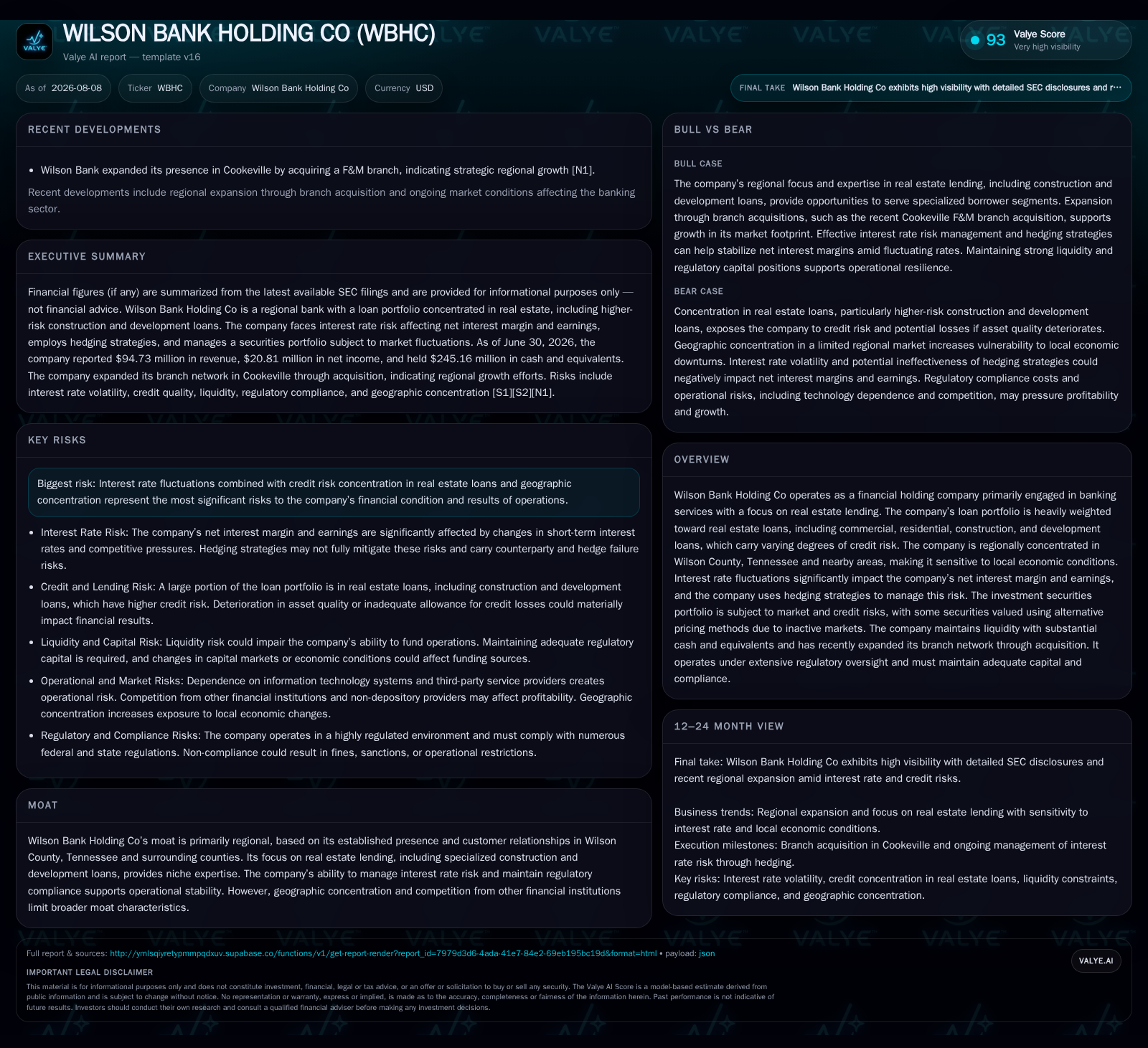
In its latest quarterly filing, Wilson Bank Holding detailed stable earnings supported by net interest margin resilience amid rising rates and tactical hedging activities. The firm’s loan portfolio remains concentrated in real estate loans—commercial, residential, and construction—which carries elevated credit risk but aligns with regional market demand. Branch network expansion in the Tennessee footprint boosted deposit growth, supporting liquidity for loan originations. The company faces pronounced geographic and credit concentration risks, managed through capital buffers and risk monitoring frameworks. Key near-term markers to watch include asset quality trends, provision adjustments, and regulatory capital levels.
Latest Quarter Signals: Stable Earnings Amid Rate-Driven Margin Dynamics
Wilson Bank Holding Company's Q2 2026 10-Q reveals net interest margin (NIM) stability despite ongoing interest rate volatility, reflecting effective use of hedging strategies to mitigate earnings fluctuations [S2]. While rising short-term rates typically enhance NIM by widening spreads on new loans, the bank faces challenges managing legacy assets with different repricing schedules. Hedging programs help offset these mismatches but carry execution risk if actual rate movements diverge from expectations embedded at hedge inception [S1]. This highlights the bank’s operational focus on sustaining margin resilience amid a dynamic monetary policy environment.
Real Estate Lending Concentration: Balancing Growth with Elevated Credit Risk
The company's loan portfolio remains heavily weighted toward real estate loans, which constitute approximately 93% of loans held for investment [S1]. This includes roughly 40% commercial and multi-family real estate loans, 38% residential mortgages (including equity lines of credit), and about 22% construction, development, and farmland loans. Concentration in construction and development loans introduces heightened credit risk compared to stabilized residential mortgages due to their greater sensitivity to economic cycles and borrower cash flow variability. Wilson Bank Holding's credit risk management emphasizes continuous monitoring of borrower segments such as homebuilders and land developers who represent significant credit concentrations. Adequate allowance for loan losses is maintained to absorb potential credit deterioration aligned with localized real estate market conditions [S1][S2].
Interest Rate Risk Management: Hedging as a Double-Edged Sword
The bank's hedging strategies aim to reduce net interest income volatility stemming from fluctuating interest rates; however, their effectiveness depends on how closely actual rate paths align with those anticipated when hedges were implemented [S1][S2]. Given the sizable unrealized losses in the investment securities portfolio driven by prior years’ rising rates, premature asset sales or restructuring could crystallize losses impacting reported earnings [S1]. Thus, asset-liability management integrates calibrated hedge adjustments alongside strategic decisions on securities holdings to safeguard profitability.
Branch Network Expansion Supports Deposit Growth and Liquidity
Wilson Bank Holding has pursued branch expansion within its core Tennessee markets during early 2026 as part of its growth strategy [S2]. These expansions facilitate deeper customer engagement and diversification of the deposit base beyond existing municipal concentrations. Deposit inflows are vital funding sources for the bank’s extensive real estate lending activities. By growing core deposits organically through physical presence rather than relying on higher-cost wholesale funding like brokered deposits or Federal Home Loan Bank advances, the bank supports stable liquidity coverage ratios while managing funding costs effectively [S4][S7].
Competitive Positioning: Local Expertise Amid Regional Banking Landscape
Operating predominantly in Wilson County and surrounding areas in Tennessee, Wilson Bank Holding competes with larger regional banks such as Regions Financial Corporation and M&T Bank Corporation alongside community banks serving similar markets. Its competitive advantage lies in localized economic knowledge combined with expertise in complex loan segments like construction financing. However, scale limitations relative to peers restrict investments in technology platforms and broader product offerings. The bank must navigate regulatory compliance demands while contending with competitive pressures affecting lending yields and deposit acquisition costs from both traditional banks and non-bank financial service providers [S1].
Growth Drivers: Local Economic Trends Fuel Loan Demand
The bank’s growth prospects hinge on regional economic strength supporting demand for residential housing finance alongside commercial real estate development projects requiring interim construction loans [S1]. A modestly rising interest rate environment enhances NIM potential subject to effective hedging. Additionally, expanding fee-based services linked to deposits or wealth management could incrementally diversify revenue streams. Improvements in credit quality or reduced provisioning would further bolster profitability going forward [S2].
Risks & Watchpoints: Geographic Concentration and Credit Sensitivities
Key risks stem from geographic concentration in Wilson County exposing the bank to local economic downturns that might impair borrower repayment capacity [S1][S20]. Heavy reliance on real estate-secured loans amplifies cyclicality risk especially if construction projects stall or property values decline materially. Interest rate risk affects not only earnings volatility but also unrealized losses in securities portfolios. Maintaining regulatory capital at well-capitalized levels is essential; any deterioration could constrain growth initiatives including branch openings or dividend payments [S4][S15]. Increased competition may pressure margins through higher deposit costs or compressed lending yields.
Operational Milestones: Monitoring Asset Quality and Capital Resilience
Investors should monitor non-performing loan (NPL) ratios as indicators of emerging credit stress within specialized loan categories. Trends in provision expenses relative to net charge-offs will reveal reserve adequacy amid evolving economic conditions [S2]. Sustained capital adequacy measures such as CET1 ratios will demonstrate regulatory compliance underpinning franchise stability [S15]. Continued deposit growth reflecting successful branch expansion efforts alongside disclosures on hedge accounting effectiveness will provide additional insights into operational execution.
Financial Profile Discussion
As of June 30, 2026, Wilson Bank Holding held approximately $245 million in cash and equivalents, underscoring solid liquidity capacity within its regional banking model [F1]. Total debt remains modest at about $10 million reported at year-end 2025 relative to cash holdings, reflecting conservative leverage consistent with community banking prudence [F1]. Regulatory capital ratios remain robust at well-capitalized levels per federal guidelines, providing strategic flexibility for measured organic expansion primarily funded through retained earnings rather than external financing [S4][S15]. This financial positioning supports confidence in navigating localized economic fluctuations while pursuing growth priorities.
This analysis synthesizes information from Wilson Bank Holding Company’s SEC filings through August 7, 2026 ([S2], [S3], [S1]) supplemented by current financial snapshot data ([F1]). It aims to evaluate recent operating trends within regional banking industry dynamics without offering investment advice.
Disclaimer: This is research-only, informational analysis and not investment advice. It may include AI-generated interpretation and general industry context. Always verify important details using primary sources.

Comments