
Weyco Group's Q2 2026 Earnings Highlight Brand Resilience and Tariff Challenges
Q2 results show solid earnings uplift driven by strong wholesale product sales and florsheim brand stability despite tariff-related margin pressure and retail softness.
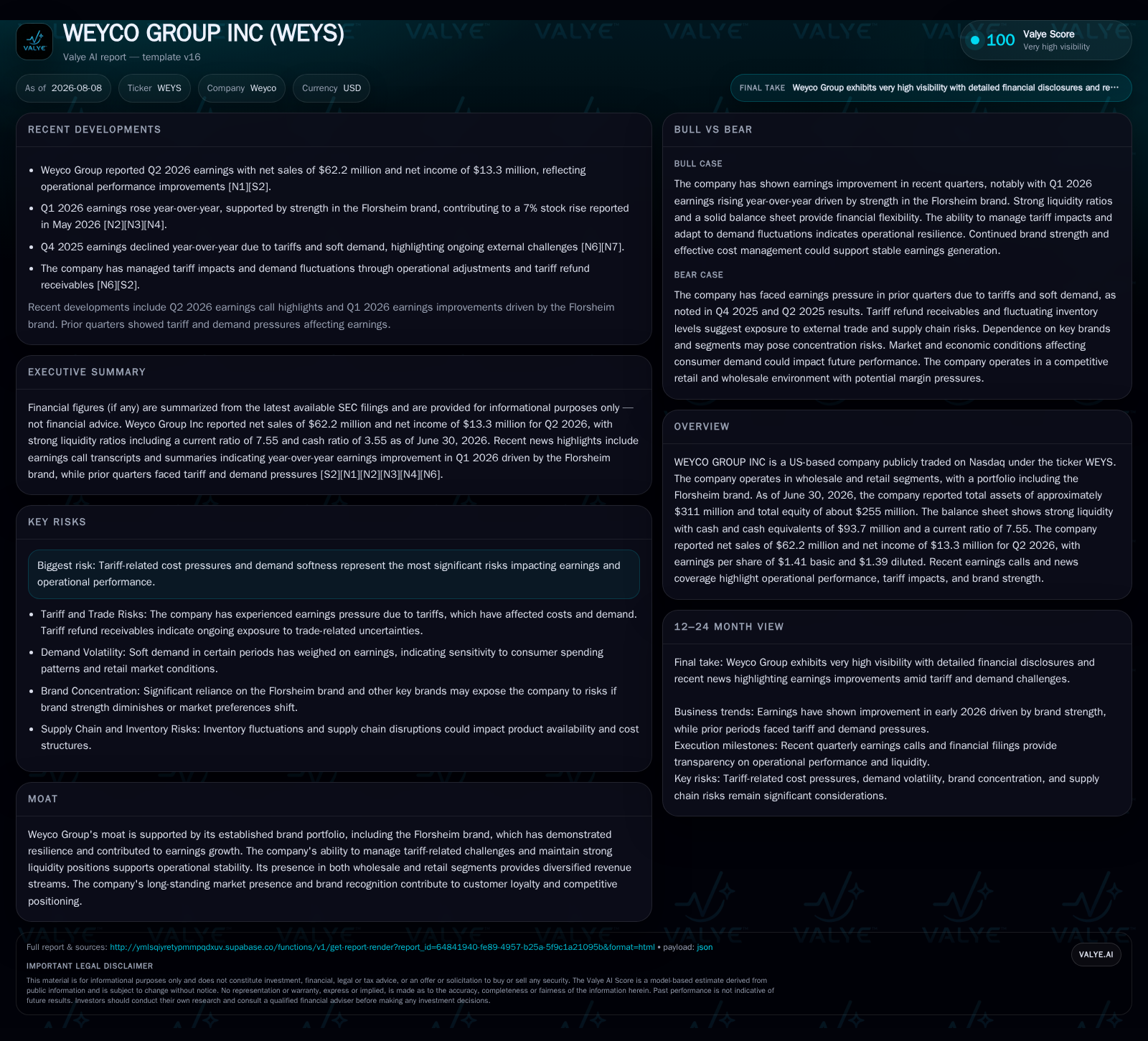
Weyco Group reported sharp net income growth to $13.3 million in Q2 2026, fueled primarily by robust wholesale segment product sales totaling $48.3 million and steady licensing revenues. The company’s flagship Florsheim brand continues to underpin customer loyalty, cushioning the impact of mid-tier retail softness experienced by entry-level Nunn Bush amid private-label competition. While tariff headwinds imposed cost pressures, management’s value engineering and selective pricing adjustments have moderated gross margin erosion. The firm’s dual-channel approach balancing wholesale and retail helps navigate uneven demand trends. Strong liquidity with cash of $93.7 million positions Weyco well to absorb external supply chain shifts and economic uncertainties.
Q2 Operational Highlights Reveal Dual Segment Performance Strengths and Headwinds
Weyco Group delivered a robust operating quarter ending June 30, 2026, posting net income of $13.3 million, a substantial increase over prior periods, translating to basic earnings per share of $1.41 [S2]. Total product sales for the quarter reached approximately $55.3 million, with the North American wholesale segment contributing the lion’s share at $48.3 million and the retail segment accounting for about $7 million [S2]. Licensing revenues added a modest but stable $0.5 million primarily from established brand agreements.
The earnings strength stems from the wholesale segment's continued dominance and relatively higher margins compared with retail operations. The wholesale channel's broad distribution network across third-party retailers supports volume scale despite the challenges in mid-tier retail environments that have pressured direct store revenues [N1]. This balanced channel mix allows Weyco to partially offset softer retail trends with solid reseller demand.
However, operational commentary during recent earnings calls underscores tariff-related cost pressures impacting input costs across both segments, constraining gross margins despite volume gains [N1]. Management highlighted ongoing mitigation efforts through sourcing adjustments and strategic pricing tweaks.
'Florsheim' Brand Stability Buffers Against Mid-Tier Retail Pressures and Private-Label Risks
The company’s brand portfolio remains strategically anchored by Florsheim, its flagship premium footwear nameplate that maintains strong customer loyalty and consistent sell-through rates despite volatile market conditions [S1]. Florsheim's positioning allows Weyco to sustain pricing power amidst inflationary inputs and competitive noise.
Conversely, Nunn Bush—a core entry price-point brand focused on mid-tier trade channels—continued to face headwinds; its revenues declined roughly 10% over the prior year due to intensified competition from private-label footwear programs adopted by major retailers seeking margin expansions [S1]. This segment's sensitivity to private-label penetration underscores the competitive pressures at lower price points where product differentiation narrows.
To counteract these challenges, Weyco has emphasized value engineering within Nunn Bush offerings to align price points without eroding perceived benefits compared to private labels—a strategy seen as critical for regaining growth momentum in this vulnerable segment [S1]. Retail sell-through metrics for Nunn Bush have remained stable despite volume softness, indicating maintained consumer interest if stock allocations improve.
'Tariff Impacts' Crimp Cost Structure but Strategic Price Point Adjustments Mitigate Margin Pressure
Tariff-related cost inflation has been a notable disruptor for Weyco's cost base since the imposition of IEEPA tariffs increased product costs between 19% to as much as 50% depending on SKU category [S23]. These elevated costs translated into gross margin compression during late 2025 and early 2026 periods.
A pivotal U.S. Supreme Court ruling invalidated the authority under IEEPA to levy those tariffs; accordingly, Weyco filed refund claims totaling approximately $18.6 million covering Phase 1 tariff payments with further claims pending timing clarity for Phase 2 entries amounting to around $1.2 million [S23]
Despite this favorable legal development, a new across-the-board tariff of approximately 10% is currently enforced under alternative statutory authority, preserving an uncertain cost environment moving forward [S23]. The company acknowledges ongoing trade-policy unpredictability which injects near-term risk into margin forecasting.
In response, Weyco deploys selective price increases and value engineering—modifying product design features or manufacturing processes—to hold key price points resilient while managing raw material inflation effects [N1],[S1]. This proactive approach aims to balance consumer expectations against cost rebound capabilities.
'Channel Diversification' Via Wholesale and Retail Offsets Consumer Demand Shifts
Weyco’s operational model is distinguished by its dual exposure combining a predominantly wholesale-led distribution system alongside owned retail outlets and e-commerce platforms—an arrangement that enables diversification of revenue sources within the branded footwear industry’s fluctuating demand landscape [S1],[S2].
The wholesale segment benefits from expansive relationships with department stores, specialty retailers, and mass merchandisers who are essential intermediaries in footwear trade channels but are subject to shifting assortment preferences and inventory controls [N1]. Retail operations complement this by fostering direct consumer engagement via brick-and-mortar locations supplemented increasingly by digital sales channels.
Weyco reports satisfactory sell-through rates particularly for Florsheim products at retail outlets implying positive acceptance that supports steady replenishment cadence without excessive discounting pressure [N1]. This operational discipline safeguards gross margins by minimizing clearance stock buildup.
Moreover, the company's working capital profile is bolstered by a high current ratio of approximately 7.55 as of Q2-end June 30, 2026—largely stemming from substantial cash balances relative to current liabilities—which reduces liquidity risks related to inventory financing or supply chain disruptions during unpredictable market intervals [F1],[S2].
'Liquidity Cushion' Enhances Resilience Against External Supply Chain Disruptions and Economic Volatility
On the financial front, Weyco maintains a robust liquidity position supported by cash and cash equivalents close to $93.7 million as of June 30, 2026 with minimal recorded debt (about $2.57 million) resulting in a strong net cash position estimated at negative $91 million net debt based on available figures [F1],[S2].
Management commentary hints at incremental investment or marketing support behind these initiatives aiming to leverage existing brand equity while adapting selectively to consumer lifestyle changes favoring casual yet quality footwear options post-pandemic recovery phases.
The combination of these strategies reflects industry best practices amongst branded footwear players seeking both scale economics via wholesale partners along with higher-margin direct retail connections akin broadly to peers like Wolverine World Wide or Deckers Outdoor but calibrated within Weyco’s niche portfolio scale.
'Watchpoints' Focus on Tariffs, Competitive Private-Label Encroachment, and Retailer Behavior Moves Ahead
Critical risks remain centered on the trajectory of U.S. trade policies impacting import duties which directly influence cost structures absent offsetting pricing power or input supply reengineering [S23],[S2]. Ongoing vigilance is warranted regarding any legislative or regulatory shifts that could reimpose or modify tariff rates unexpectedly.
Additionally, sustained private-label proliferation in mid-tier retail channels continues pressuring volume growth especially for entry-level brands such as Nunn Bush where retailer margin strategies may preferentially skew towards own-brand offerings challenging branded vendors’ shelf space economics [S1],[N1].
Retailer purchasing behaviors including order timing changes or inventory pullbacks related to macroeconomic variability will also be key monitors given their immediate effect on sell-through success rates at locations critical for direct consumer access.
These watchpoints will determine if management’s tactical responses suffice or call for more structural changes in brand mix focus or channel emphasis going forward.
Financial Profile Discussion
Weyco Group displays enviable balance sheet strength uncommon among smaller scale branded footwear companies through its large cash reserve totaling nearly $94 million against minimal debt obligations ([F1]). This liquidity level contributes heavily toward mitigating ongoing risks associated with global sourcing tariffs as well as temporary consumer demand softness especially reflected in its retail segment performance ([S2]). The high current ratio over seven times underscores prudent working capital policies ensuring low short-term funding stress even amidst inventory seasonality fluctuations ([F1]).
Profitability metrics evidenced in Q2 suggest operational leverage mainly through successful top-line execution in wholesale distribution aligned with differentiated brand positioning ([S2]). However tariff uncertainties imply some caution until clarity improves regarding duty reimbursements or policy permanence ([S23]). Capital allocation strategies continue favoring dividends augmented modestly alongside selective share repurchases reflecting confidence tempered by external headwinds ([S21]).
Overall the financial profile supports continuity of current business strategies while maintaining optionality for further investments into growth-driving areas such as e-commerce expansion or additional licensing arrangements without undue leverage concerns.
Disclaimer: This is research-only, informational analysis and not investment advice. It may include AI-generated interpretation and general industry context. Always verify important details using primary sources.

Comments