
UNG’s Execution on Futures Roll Strategy Amid Position Limits Signals Tracking Challenges
The latest quarterly filing reveals how UNG navigates regulatory position limits and market conditions to maintain natural gas exposure, influencing its tracking performance and liquidity profile.
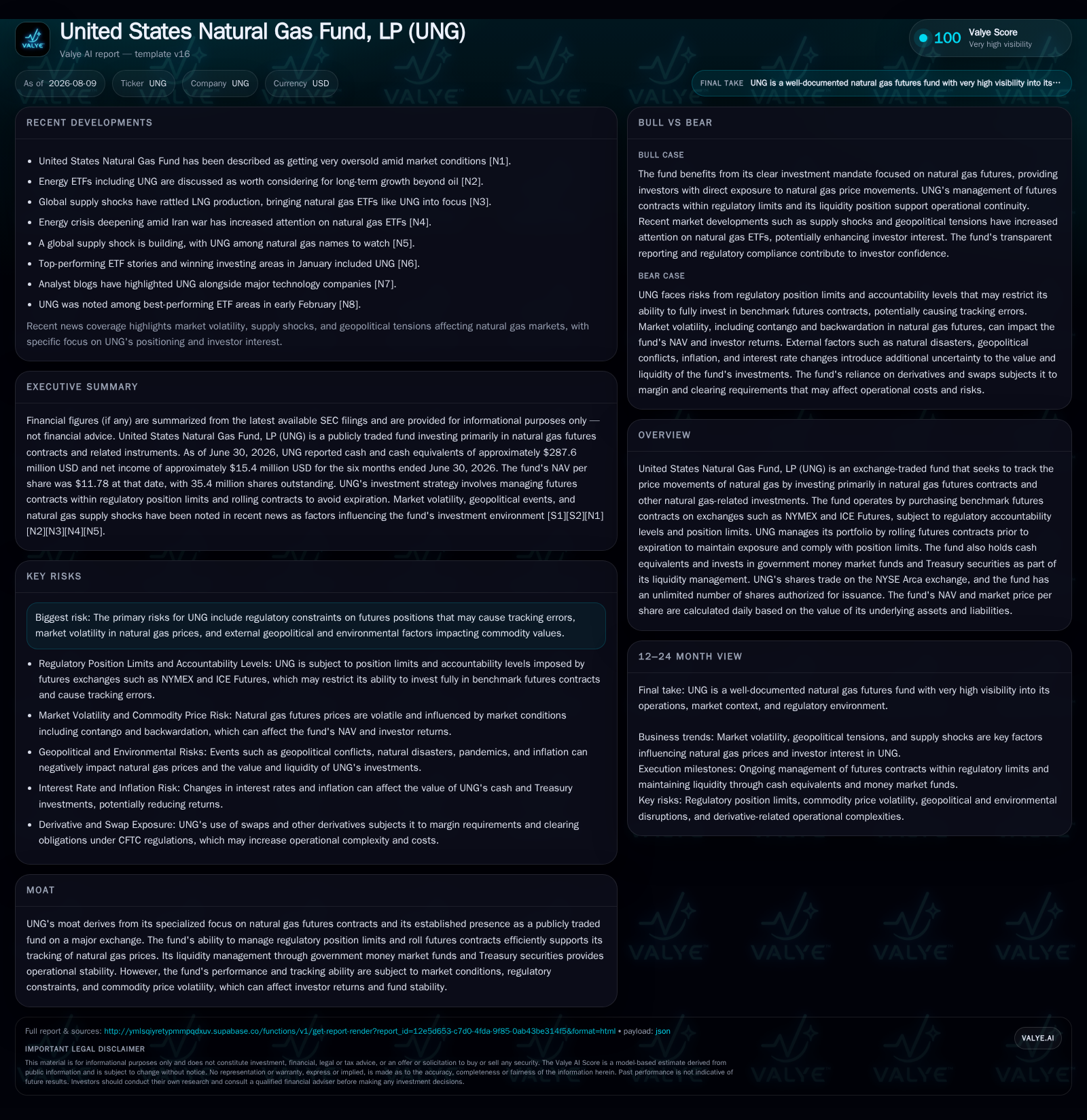
United States Natural Gas Fund, LP (UNG) continues to face inherent challenges balancing natural gas futures exposure within regulatory accountability levels and position limits, as highlighted in its Q2 2026 10-Q. The fund's strategic rolling of benchmark futures contracts aims to preserve natural gas price exposure but is constrained by exchange rules. This creates tracking error potential relative to spot prices, compounded by futures market structures such as contango or backwardation. UNG’s liquidity management through cash equivalents and government securities supports margin requirements but also adds operational complexity. Investor returns reflect these dynamics in a sector shaped by commodity price volatility and regulatory oversight.
Q2 2026 Operational Shifts Portray Regulatory Constraints Impacting Futures Positions
In its August 7, 2026 Form 10-Q filing, United States Natural Gas Fund, LP (UNG) outlined the ongoing pressures exerted by exchange-imposed accountability levels and position limits on its natural gas futures holdings. Historically during fiscal year 2025, UNG exceeded the NYMEX accountability thresholds for natural gas futures contracts without being compelled to reduce positions by regulators. This repeated crossing of accountability levels signals elevated monitoring from NYMEX but also indicates a constrained environment whereby UNG must carefully manage exposure without breaching hard position limits that would mandate forced liquidation [S1], [S2]. The implications are twofold: the fund’s flexibility in maintaining continuous benchmark futures exposure can be hampered, possibly resulting in partial underinvestment relative to ideal target allocations, which then impacts tracking fidelity.
Notably, accountability levels act as warning thresholds rather than absolute ceilings; however, these invite close scrutiny that could lead to restrictions or requests for detailed disclosures concerning trading intent and liquidity resources. Concurrently, ICE Futures maintains similar oversight mechanisms for its natural gas contracts affecting UNG. Managing this regulatory overlay requires proactive governance of contract position sizes across multiple maturities.
Fund Structure: Balancing Natural Gas Price Exposure Through Benchmark Futures during Limitations
UNG’s business model centers on replicating daily price changes in natural gas by investing predominantly in benchmark natural gas futures contracts traded on regulated U.S. exchanges including NYMEX and ICE Futures. To maintain continuous exposure despite contract expirations, the fund systematically rolls its positions prior to expiry. This entails closing near-expiring futures contracts while opening longer-dated ones—typically overcoming daily price fluctuations and liquidity constraints during rollover windows [S1], [S2]. Moreover, UNG incorporates over-the-counter (OTC) swaps linked to natural gas price indices as supplementary instruments enhancing its exposure replication.
This rollover practice exposes UNG to roll yield impacts heavily influenced by underlying market phenomena such as contango (where deferred contracts trade at higher prices than front-month) or backwardation (inverse condition). Contango leads to negative roll yields whereby the fund effectively sells low-priced expiring contracts to buy higher-priced longer-dated ones, compressing returns relative to spot prices. Conversely, backwardation offers positive roll yield benefits but is less frequent in natural gas markets historically.
Operationally, margin requirements mandated by futures exchanges compel UNG to hold significant cash balances or equivalent liquid assets as collateral against its derivative positions ensuring risk mitigation without leverage usage. These margin obligations fluctuate with market volatility.
ETFs in Energy Commodities: UNG’s Position Versus Broad Energy Peers
Within the landscape of energy-focused exchange-traded funds (ETFs), UNG occupies a specialized niche focused exclusively on natural gas commodity futures rather than physical production or diversified energy sector equities. Its peers include other commodity ETFs like the United States Oil Fund (USO)—which similarly tracks oil futures—and broad-based energy ETFs such as the Energy Select Sector SPDR Fund (XLE), which holds equity stakes across integrated oil & gas companies.
UNG’s pure-futures approach subjects it to distinctive tracking errors linked with derivatives market structures absent in equity-based funds. While USO faces analogous roll cost issues due to contango/backwardation in crude oil markets, XLE provides broader sector risk diversification albeit with less direct commodity price correlation. Consequently, UNG appeals more acutely to investors seeking pure plays on natural gas price movements through a liquid security but accepts ancillary risks around tracking variance influenced by regulatory controls and futures curve shapes.
Tracking Error Sources: Contango, Backwardation, Roll Yield Effects
A core challenge outlined repeatedly in UNG’s filings is mitigating tracking error between the fund’s net asset value (NAV) changes and the spot price fluctuations of natural gas. This discrepancy arises chiefly from the mechanics of rolling futures contracts amid persistent contango conditions typical of natural gas markets.
Contango imposes a structural cost where longer-dated futures command premiums over near-term contracts forcing the fund into a systematic loss every roll cycle—propagating cumulative negative roll yield that depresses cumulative returns versus the spot market benchmark [S1]. Backwardation scenarios offer relief but are transient depending on supply-demand fundamentals influenced by weather patterns, storage levels, and geopolitical events impacting production or transport.
As of June 30, 2026 quarter-end, UNG held approximately $288 million in cash equivalents encompassing money market funds and short-term Treasury instruments. These liquid assets serve dual purposes: meeting fluctuating margin calls imposed by FCMs (Futures Commission Merchants) and providing collateral for OTC swap counterparties required under credit risk mitigation frameworks [F1], [S2].
The fund benefits operationally from this buffer preserving continuity of trading activities even during periods of significant volatility yet simultaneously equalizes some return stream dilution as cash holdings earn low yields relative to commodity price swings.
Additionally, shares trade publicly on NYSE Arca subject to periodic premiums or discounts relative to NAV reflecting investor sentiment imbalances or execution frictions typical for commodity ETFs. Such divergences exacerbate total return volatility beyond NAV fluctuations alone.
Growth Prospects: Demand Drivers for Liquid Natural Gas Exposure in Volatile Markets
Structural growth drivers supporting UNG include rising appetite among institutional and retail investors seeking liquid access points into natural gas markets outside direct commodity trading or physical infrastructure ownership. Elevated volatility fosters speculative inflows as well as hedging demand from energy-dependent sectors navigating uncertain fuel pricing.
Regulatory evolutions fostering transparency and facilitating ETF marketplace participation enhance product accessibility amid growing global energy consumption trends emphasizing cleaner-burning fuels like natural gas compared with coal or oil alternatives. Moreover technological advances streamline roll execution minimizing slippage creating incremental efficiencies.
Together these underpin long-term demand tailwinds despite episodic setbacks linked with macroeconomic cycles influencing discretionary speculative capital flows.
Risk Management: Navigating Regulatory Limits, Price Volatility, Tax Complexity
Financial exposure management continues confronting risks pivoted around:
- Commodity price volatilities causing drastic NAV oscillations harmful for risk-averse profiles;
- Tracking error sources rooted in both mandated contractual positioning limits reducing portfolio agility plus inherent futures market dynamics;
- Counterparty credit exposures mitigated via collateralization but still representing contingent risk;
- Tax complexities stemming from limited partnership structure affecting shareholder tax liabilities differently than conventional mutual funds potentially complicating investor after-tax returns [S1], [S2].
Robust internal controls over reporting combined with compliance frameworks aimed at securing adherence toward exchange mandates guard operational integrity amidst these challenges.
Near-Term Milestones: Upcoming Contract Expirations, Position Limit Windows, Investor Demand Signals
Attention will focus on forthcoming quarterly contract expirations necessitating another cycle of precise roll transactions accommodating prevailing position caps while minimizing frictional costs observed previously in recent quarterly filings [S2]. Monitoring investor flows evidenced through creation/redemption basket activity will illuminate demand shifts signaling growth or contraction phases impacting AUM dynamics essential for sustaining management fee revenues.
Moreover evolving regulatory oversight from entities such as CFTC coupled with contemporaneous macro drivers including climate events will shape forward-looking strategies guiding portfolio construction within allowed parameters.
Financial Profile Discussion: Cash Reserves, Income Streams and Expense Neutrality
From a financial vantage point anchored at Q2 ending June 30, 2026 data points reveal approximately $288 million held in cash equivalents primarily across government money market funds providing ample liquidity for operational mandates including margin coverage without resorting to debt or leverage strategies—a prudent stance consistent with stated fund policies emphasizing risk containment over return enhancement via borrowing [F1], [S2].
Income generation largely derives from management fees set at an annualized rate of 0.60% on net assets up to $1 billion—with incremental decreases applied beyond this threshold—ensuring steady revenue streams offsetting administrative expenses related chiefly to contract rolls administration alongside third-party service providers' fees such as custodianship and transfer agency costs identified within contractual agreements with USCF as general partner [S9], [S18].
This fee structure aligns incentives between manager and investors focused on asset base stability amid variable gains/losses inherent from fluctuating underlying commodities driving total returns absent explicit profit-sharing clauses tied directly to investment performance metrics.
This analysis synthesizes information derived solely from disclosed SEC filings dated through August 7, 2026 ([S1],[S2],[S3],[F1]) combined with domain-specific knowledge of energy-focused commodity ETFs without conjecture beyond documented data points.
Disclaimer: This is research-only, informational analysis and not investment advice. It may include AI-generated interpretation and general industry context. Always verify important details using primary sources.

Comments