
RGA Strengthens Premium Growth and Hedging Amid Regulatory Reserve Pressures
RGA's Q2 2026 results highlight premium volume expansion and robust investment income, offsetting reserve growth challenges in life reinsurance.
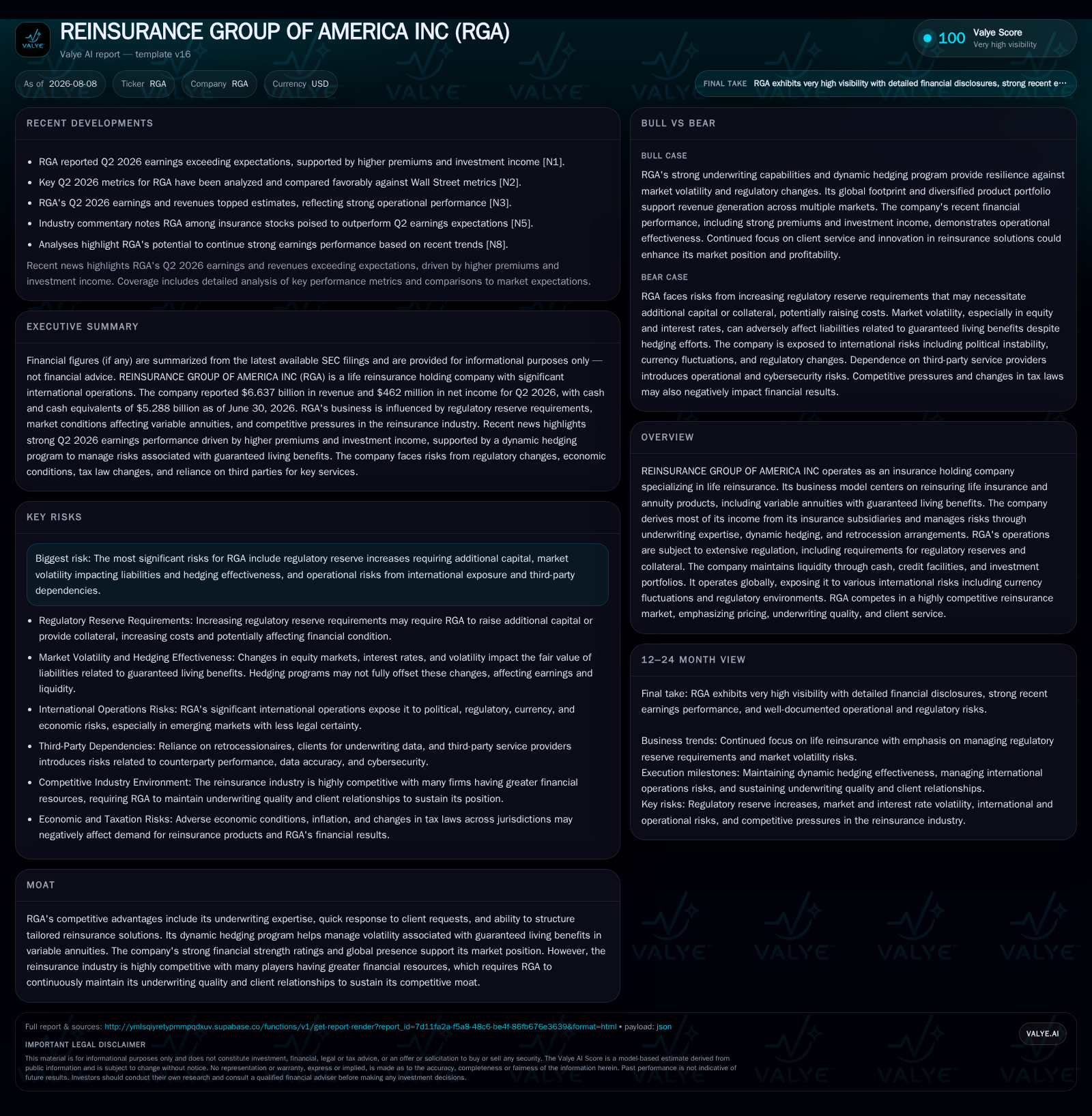
Reinsurance Group of America Inc (RGA) reported strong second-quarter premium growth and investment income, reflecting ongoing demand for life reinsurance solutions including variable annuities with guaranteed living benefits. The company continues to contend with elevated regulatory reserve requirements and collateral costs that impact capital needs and operational flexibility. RGA's underwriting discipline, dynamic hedging programs, and retrocession strategy support risk management in a competitive global market characterized by evolving regulatory scrutiny and capital intensity. Monitoring reserve development trends and hedging effectiveness will be critical to assessing sustainable profit margins going forward.
Recent Operating Update: Q2 2026 Highlights
RGA's latest 10-Q filing reveals a favorable near-term operating environment with second-quarter premiums rising alongside net investment income contributions that exceeded market expectations [S2][N1]. This combination points to sustained demand for reinsurance protection on life insurance products during ongoing industry complexity. The quarterly disclosure confirms that RGA maintains its focus on underwriting quality and the management of variable annuity liabilities via active hedging strategies designed to dampen earnings volatility stemming from guaranteed living benefit exposures [S2]. These factors underpin RGA’s resilience despite challenging regulatory headwinds.
Business Model: Life Reinsurance Centered on Risk Transfer and Capital Management
Reinsurance Group of America operates primarily as a life reinsurance provider specializing in assuming mortality, longevity, and morbidity risks ceded by primary life insurers. Its portfolio includes significant exposure to variable annuity products featuring guaranteed living benefits (GLBs), which embed complex financial guarantees sensitive to equity markets and interest rates [S1]. Revenue primarily stems from premiums ceded by insurers seeking both risk transfer and capital relief under increasingly stringent regulatory regimes.
The monetization mechanics hinge on disciplined underwriting—assessing longevity/mortality assumptions—and pricing that accounts for the cost of embedded guarantees. RGA supplements this with dynamic hedging programs aimed at offsetting market risks inherent in variable annuities. Retrocession arrangements provide an additional layer of risk mitigation by transferring portions of assumed risk to other reinsurers or retrocessionaires.
Regulatory reserves present a material influence on the operating model: principles-based reserving (PBR) frameworks in the U.S. require high levels of policyholder reserves calibrated to loss expectations under adverse scenarios [S1]. To comply, RGA must hold collateral often supported by credit facilities or letters of credit. The availability and cost of such collateral influence pricing patterns and transaction volumes in its reinsurance contracts.
Industry Structure and Competitive Position
Life reinsurance globally is dominated by peers like Munich Re, Swiss Re, and SCOR who benefit from scale advantages particularly in underwriting analytics, capital deployment efficiency, and product breadth. RGA holds competitive strengths through its specialized underwriting expertise focused on GLB liabilities and swift responsiveness to client needs for tailored contract structures.
Pricing discipline remains paramount given the intense competition; reinsurers must continually refine models to avoid adverse selection while maintaining margins amid regulatory capital pressure. In this landscape, RGA's reputation for reliability backed by strong financial strength ratings sustains client stickiness but demands persistent innovation in risk transfer mechanisms.
The company's global footprint exposes it to international regulatory variability and currency exchange risks requiring robust monitoring frameworks [S1]. Retrocession strategies also balance counterparty credit considerations against capacity needs.
Growth Drivers
Several forces underpin medium-term growth prospects:
- Primary Insurance Market Expansion: Growth in life insurance sales globally drives increased ceded premiums.
- Escalating Regulatory Capital Requirements: Heightened reserves compel insurers to outsource risk for capital relief.
- Demand for Variable Annuity Solutions: The complexity of GLB riders fuels demand for specialized reinsurance with sophisticated risk management.
- Emerging Markets Penetration: Untapped regions offer new pools of life insurance business.
- Innovation in Underwriting Analytics: Advanced predictive modelling enhances risk selection and pricing accuracy.
- Enhancements in Hedging Techniques: Improved hedging reduces earnings volatility enhancing investor appeal.
- Industry Consolidation Trends: Outsourcing risk retention fosters reliance on reinsurers like RGA.
These drivers signal structural tailwinds rather than transient volumes tied to short-term market cycles.
Risks and Watchpoints
The dominant risks spotlight the need for cautious monitoring:
- Increasing Regulatory Reserve Levels: Could accelerate capital strain requiring fresh funding or constrain writing capacity if collateral is scarce [S1].
- Market Volatility Impacting Hedging Effectiveness: Unexpected dislocations could reduce hedge program efficiency thus increasing earnings swings.
- Counterparty Credit Risk from Retrocessionaires: Defaults or downgrades may force retention of more risk or require costly collateral rearrangements.
- Pricing Pressure: Competitive dynamics might compress margins if underwriting discipline softens.
- Operational Complexity: Global regulation diversity heightens compliance burdens risking errors or sanctions.
- Longevity/Mortality Assumption Errors: Misestimation could produce reserve deficiencies impacting capital adequacy.
- Interest Rate Fluctuations: Affect both asset yields invested to back reserves and discount rates used in liability valuation.
- Currency Exchange Volatility: Impacts reported earnings given multinational operations.
- Model Risk: Reliance on complex actuarial models presents exposure if assumptions prove inaccurate over time.
- Key Client Concentration Risks: Loss of major cedants could materially affect premium volume and profitability.
What to Watch Next
Key milestones for upcoming periods include:
- Quarterly updates on combined ratio evolution reflecting underwriting discipline versus reserve development releases.
- Hedge program reports revealing effectiveness during volatile market conditions particularly affecting GLB portfolios.
- Changes in regulatory environments or interpretations affecting reserving requirements or collateral standards.
- Retrocession arrangement renewals or expansions signaling appetite for risk transfer.
- Capital adequacy ratios reported by rating agencies reflecting financial resilience amidst evolving regulations.
- Geographical revenue breakdowns highlighting emerging markets penetration progress or currency impact shifts.
These markers will guide assessment of RGA’s ability to sustain profitable growth while navigating regulatory complexities.
Financial Profile Discussion
RGA’s liquidity position appears solid entering Q3 2026 with cash & equivalents totaling approximately $5.3 billion as of end-June 2026 [F1]. Although total debt reported was about $5.75 billion at year-end 2025 yielding an estimated net debt near $466 million after cash offsets, the company’s available credit lines supplement liquidity for collateral posting needs [F1]. This leverage scale seems manageable relative to statutory capital levels maintained above regulatory thresholds per prior disclosures [S1].
Earnings durability depends substantially on premium growth sustained through disciplined underwriting combined with stable net investment income — both demonstrated positively in Q2 results [N1][S2]. The company’s ability to manage reserve increases without excessive dilution of capital or erosion of return metrics will remain a pivotal factor influencing rating agency assessments and investor perceptions going forward.
This analysis leverages verified SEC filings along with recent public disclosures to elucidate RGA’s current operating dynamics within the life reinsurance industry context. Forward-looking elements address observable business model traits without speculative forecasts. It aims to provide a grounded perspective suitable for professional consideration while avoiding investment research views.
Disclaimer: This is research-only, informational analysis and not investment advice. It may include AI-generated interpretation and general industry context. Always verify important details using primary sources.

Comments