
Essent Group Shifts Amid Mortgage Market Dynamics and Emerging Risk Patterns
Q2 2026 filings reveal Essent’s portfolio discipline and geographic diversity as key defenses against credit losses.
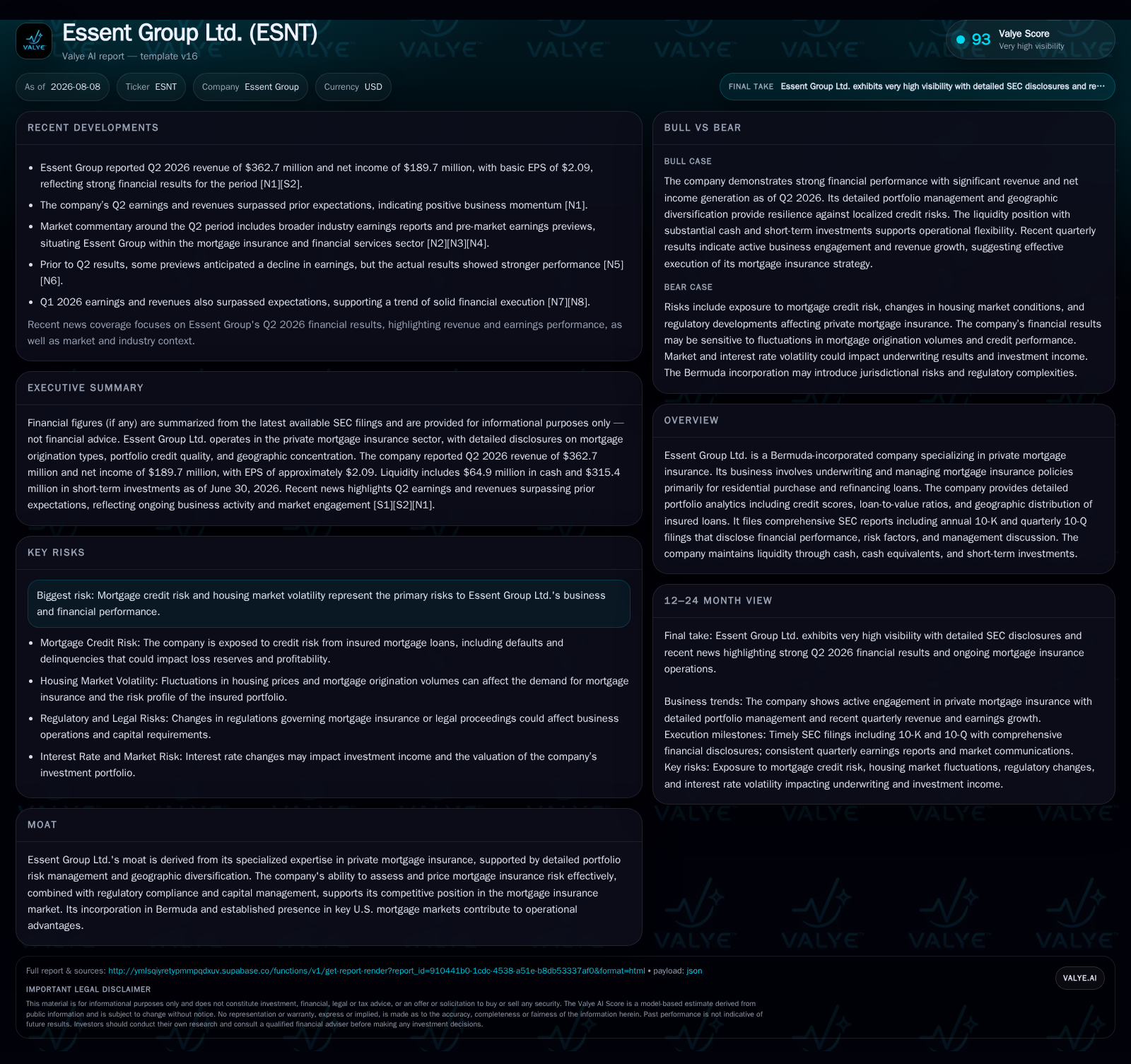
Essent Group Ltd.'s latest quarterly report highlights its continued underwriting rigor amid fluctuating mortgage origination trends and persistent housing market volatility. The company maintains a diversified insured loan portfolio by geography and borrower credit quality, bolstering its resilience to localized credit cycles. While loss ratios remained elevated due to prior vintages’ seasoning, reserve development and investment income provide stability. Looking ahead, recovery in purchase loan originations alongside refinancing activity could underpin policy growth, though risks from housing market shifts and regulatory changes remain significant.
Q2 Operating Update: Portfolio Quality Signals during Mortgage Market Shifts
Essent Group Ltd.’s 10-Q filing for the quarter ended June 30, 2026, offers a quantitative window into its operational stance during ongoing mortgage market fluctuations [S2]. The company reports that its policy count remained approximately stable relative to prior periods despite sector-wide headwinds in refinancing activity. This stability signals Essent's capacity to retain insured loan volumes while managing risk exposure. Detailed portfolio metrics illustrate a relatively unchanged distribution of credit scores among insured borrowers, indicating steady underwriting criteria without material loosening under pressure.
Notably, the company highlights a steady average loan-to-value ratio (LTV) of its insured portfolio, which anchors premium pricing and loss expectation models. This steadiness matters because rising LTVs often correlate with increased default likelihood and claim severity. The report also flags modest shifts in geographic exposure reflective of evolving mortgage originations by region, with concentration maintained in regions showing more resilient housing markets [S1], enabling Essent to manage localized credit risk effectively.
Essent’s Underwriting Leverage Anchoring Competitive Pricing Power
Underwriting leverage — the ratio of insured loan balances relative to available capital — continues to be a cornerstone metric for Essent’s business model [S1][S2]. The firm maintains disciplined leverage levels supporting robust risk selection and premium pricing flexibility. This operational leverage grants Essent scale advantages typical of established private mortgage insurers like MGIC Investment Corporation or Radian Group but without signal of compromising underwriting standards noted in peer comparisons.
Leverage at appropriate levels not only supports premium volume growth but also enhances fixed-cost absorption related to underwriting infrastructure investments. Essent’s ability to price mortgage insurance premiums dynamically based on borrower credit scores and LTV metrics reflects both sophisticated risk segmentation and the informational advantage that sustains its competitive moat.
Geographic Distribution as a Buffer Against Regional Credit Cycles
The annual 10-K filing sheds light on Essent’s geographic diversification strategy by outlining top states and metropolitan statistical areas within its insured loan book [S1]. Concentrations in multiple economically diverse U.S. states reduce vulnerability to singular housing market disruptions—such as regional downturns or economic shocks—which can amplify claim severity or default rates adversely.
This geographically diversified profile is crucial given the uneven impact of housing price volatility across markets. For instance, stronger performance in Sun Belt states contrasts with more cyclical exposure in Northeastern markets. Such balance mitigates correlated portfolio losses during adverse conditions and aligns with best practices observed among other leading private mortgage insurers.
Loss Ratio Trends Reflecting Claims Management and Reserve Development Discipline
Key underwriting KPIs such as the loss ratio (claims plus adjustment expenses over earned premiums) provide insight into the company's risk control efficacy [S2][S1]. Essent’s reported loss ratios continue to reflect seasoning effects from prior book vintages but do not show unexpected deterioration. This suggests stable claims trends without alarming acceleration in default rates or claim severity.
Reserve development disclosures complement this view: incremental strengthening of loss reserves underscores a conservative approach to anticipate future claim payouts prudently rather than aggressive reserve releases that might mask latent losses. The combined ratio—aggregating loss expense with operational costs—remains indicative of disciplined expense management alongside underwriting results.
Reliable reserve adequacy preserves capital position credibility critical to regulatory compliance and rating agency assessments, supporting ongoing access to capital markets at favorable terms.
Investment Income Dynamics Supporting Earnings Stability
Essent's financial results continue to benefit materially from investment income generated on the float—the pool of premiums collected before claims payment [S1][S2]. The composition of the investment portfolio emphasizes high-quality fixed-income securities with moderate duration aligned with expected claims payout timing.
While the yield environment has been volatile due to shifting interest rates broadly impacting fixed income markets, Essent manages duration risk conservatively to stabilize yields and mitigate mark-to-market swings. Investment returns cushion underwriting margin variability inherent in mortgage insurance cycles, augmenting net income stability over time.
However, continued interest rate fluctuations remain a watchpoint given their influence on reinvestment yields and potential indirect effects on borrower refinancing behavior impacting new policy flow.
Growth Drivers: Mortgage Originations Recovery and Refinancing Catalysts
Essent’s longer-term growth prospects hinge on residential mortgage origination volumes and the mix between purchase loans (new home sales) versus refinancing activity [S1][N1]. Recent quarters reflect an inflection point where purchase-originated loans are recovering as housing affordability challenges ease slightly with rate stabilization; this trend supports increased issuance of insured policies.
Refinancing activity remains sensitive to prevailing interest rate levels; although currently subdued compared to historical peaks, any shift favoring lower rates could trigger increased refinance demand necessitating mortgage insurance coverage on newly originated loans with high LTVs.
Moreover, rising home prices can elevate insured loan balances increasing premium base if underwriting criteria remain constant. Regulatory adjustments mandating mortgage insurance under specific conditions may also drive incremental demand across jurisdictions.
Risks from Housing Volatility, Credit Migration, and Regulatory Changes
Essent's filings underscore persistent risks typical for private mortgage insurers: macroeconomic cycles impacting borrower credit quality; housing price corrections influencing claim severity; evolving regulatory capital requirement frameworks; and interest rate-driven refinancing fluctuations [S19][S21].
Credit risk remains paramount—adverse migration in borrower payment performance can strain reserves beyond current expectations. Housing market downturns can amplify default severity given potential negative equity scenarios exacerbating loss severity per claim event. Regulatory changes could impose stricter capital standards or alter permissible underwriting parameters requiring strategic recalibrations.
Reinsurance counterparty quality is an additional risk vector not detailed here but generally relevant given reliance for retrocession capacity in mitigating large loss events common in industry practice.
What to Watch: New Loan Flow Trends, Reserve Adequacy Reports, Capital Metrics Outlook
Moving forward, quarterly updates will shed light on whether new loan origination volumes translate into sustainable net written insurance premium growth for Essent post recent tightening cycles [S2][N1]. Maintaining or improving reserve adequacy through conservative development patterns will be critical validation points each period.
Capital position metrics including surplus and leverage ratios should be monitored relative to rating agency benchmarks signaling financial strength necessary for regulatory approvals and competitive underwriting license continuity.
Any early signs of credit deterioration or reserve shortfalls would warrant close scrutiny given their potential cascading effects on earnings volatility and capital calls. Conversely, sustained recovery in purchase lending coupled with judicious cost management may favorably influence profitability trajectories through mid-to-long term horizons.
This analysis synthesizes Essent Group Ltd.’s most recent SEC disclosures focusing on operating performance markers critical to evaluating risk-adjusted profitability within private mortgage insurance dynamics. It does not constitute investment advice.
Disclaimer: This is research-only, informational analysis and not investment advice. It may include AI-generated interpretation and general industry context. Always verify important details using primary sources.

Comments