
LivePerson’s AI-Powered Platform Faces Growth and Merger Execution Challenges
LivePerson reported ongoing revenue pressures and highlighted risks associated with its pending merger with SoundHound AI.
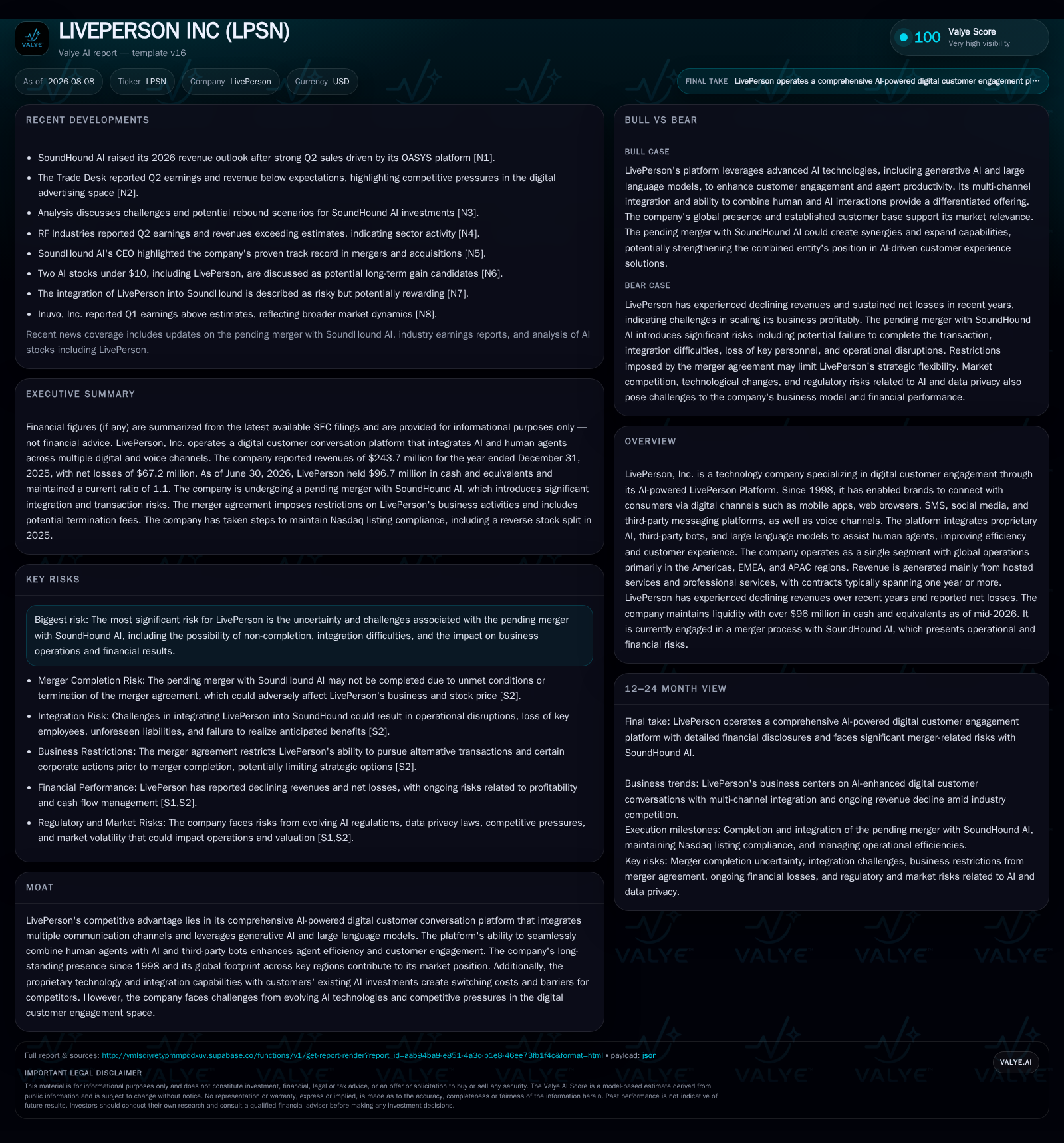
In its latest quarter, LivePerson Inc. continues to grapple with revenue declines and net losses amid efforts to leverage its AI-driven customer engagement platform. The company's multi-channel SaaS model integrates generative AI and LLMs to boost agent productivity, but competitive pressure and integration risks loom. The pending merger with SoundHound AI introduces execution uncertainty, including regulatory approvals and shareholder consent requirements. LivePerson’s financial position shows adequate liquidity but material leverage remains a constraint. Key growth drivers include adoption of AI automation and digital channel expansion, while watchpoints focus on merger milestones and sustained customer retention.
Recent Operating Update
Moreover, the company disclosed no fundamental changes in risk factors but emphasized uncertainties tied to its pending merger with SoundHound AI [S2]. This transaction requires stockholder approval as well as regulatory clearances from multiple jurisdictions including Canada, Italy, Germany, the UK, Bulgaria among others—most approvals have been obtained but completion remains subject to conditional timing by end-2026 deadlines [S3][S27]. Failure to complete risks financial costs such as termination fees ($5 million plus expenses) alongside diversion of management attention [S2].
Business Model
LivePerson operates a subscription-based SaaS business model offering a cloud-hosted platform that empowers brands to engage consumers via AI-enhanced conversations across numerous digital touchpoints: mobile apps and browsers, SMS texting, social media channels, third-party messaging apps like WhatsApp or Facebook Messenger, plus voice integrations [S1]. This multi-channel communication suite is coupled with proprietary conversational AI engines augmented by third-party bots and large language models (LLMs), enabling seamless handoffs between humans and automated agents—termed "the tango" by management [S1].
Revenue is primarily derived from hosted services subscriptions often contracted for annual or multi-year terms alongside professional services that facilitate integration and customized deployment. This structure offers recurring revenue streams but also hinges on maintaining high customer retention rates amid competitive pressures. Monetization revolves around the number of active seats/users engaging the platform plus usage volume for chatbots/agents supported by automation technologies. Professional services utilization provides incremental margin upside if customers adopt advanced platform capabilities or expansion modules.
The platform’s intelligent automation improves agent productivity by automating repetitive tasks while surfacing relevant content for human agents to focus on relationship-building or complex issues—a critical value proposition aimed at reducing operational costs for clients while enhancing customer experience (CX) effectiveness.
Industry Structure and Competitive Position
LivePerson sits within the highly dynamic software sector specializing in AI-powered digital customer engagement platforms targeted at enterprises undergoing digital transformation initiatives. Peers range from broad SaaS CX providers such as Zendesk and Salesforce Service Cloud to specialized conversational AI vendors like Nuance Communications. The company also collaborates or competes indirectly with third-party LLM providers such as OpenAI or Google Cloud’s AI services underpinning chatbot functionalities.
Reliability managed through integration with cloud infrastructure providers AWS, Azure or Google Cloud ensures platform uptime—a crucial KPI given clients’ reliance on uninterrupted customer communication channels. However, market competition exerts consistent pricing pressure while technological evolution demands continuous investment in generative AI capabilities to maintain differentiation.
Switching costs arise from deep integrations into clients' existing communication architectures and alignment with their own investments in generative AI models or bots—however increasing commoditization of chatbot solutions challenges LivePerson’s moat.
Growth Drivers
Key structural growth drivers include accelerating enterprise adoption of automation-infused customer support tools driven by cost containment needs and demand for enhanced personalization in interactions. Multi-channel communications continue expanding as consumers increasingly prefer mobile apps and social media over traditional channels.
The rise of generative AI models opens new avenues for LivePerson to enrich its platform's capabilities—enabling more sophisticated natural language understanding and autonomous conversation handling that can significantly improve agent efficiency ratios. Cross-selling opportunities for professional services accompany platform expansions into adjacent functionalities within clients' ecosystems.
Digital transformation momentum especially among larger enterprises requiring integrated voice-digital engagement combined with behavioral analytics supports upside potential for contract renewals and lengthening average contract durations.
Risks and Watchpoints
Execution risks dominate due to the pending merger agreement with SoundHound that requires multiple clearances including shareholder votes expected before October/December 2026 thresholds [S2][S3][S27]. Any delay or failure negatively impacts investor sentiment and operational focus.
Additionally, emerging technologies could rapidly disrupt current conversational AI approaches if competitors develop more efficient or cost-effective solutions leveraging next-generation LLMs or bot frameworks. Integration complexity at client sites—especially adapting to diverse legacy communication backbones—and evolving regulatory landscapes related to privacy/data security pose continual risks.
Customer churn remains a watchpoint given reported annual recurring revenue (ARR) pressures; improving automation ratio without sacrificing CX quality will be essential alongside managing sales cycle lengths influenced by client budgeting dynamics.
Talent retention in specialized AI engineering roles is another risk factor impacting product R&D velocity relative to competitors.
What To Watch Next
Milestones focus heavily on merger closure progress: timely stockholder approval processes reflecting sufficient vote outcomes will be pivotal along with regulatory compliance updates across geographic jurisdictions.
Operational KPIs worth monitoring quarterly include stabilizing or reversing revenue decline trends through improved ARR expansions or new customer acquisitions; progression in AI automation rate reflecting growing chatbot interaction share; professional services margin recovery; along with narrowing operating losses signaling operating leverage gains.
Management commentary on post-merger integration plans will clarify synergy prospects while guidance revisions may illuminate near-term financial outlook given recent market volatility.
Financial Profile Discussion
LivePerson’s balance sheet at mid-2026 presents liquid assets of $96.7 million against current liabilities of approximately $117.8 million resulting in a modest current ratio near 1.1 which signals limited short-term cushion but functional operating liquidity [F1]. Total debt was last confirmed at approximately $512 million as of March 31, 2024, with net debt around $415 million after accounting for cash [F1]. This capital structure limits strategic flexibility though recurring subscription cash flow partially mitigates financing risks.
The financial backdrop underscores urgency around merger execution not only to combine capabilities but potentially unlock efficiencies benefiting margin profile long-term. Monitoring quarterly cash burn alongside improvements in gross margin facilitated by higher automation rates will provide insight into trajectory toward sustainable profitability.
This analysis synthesizes live SEC filings alongside industry context to evaluate LivePerson's strategic positioning amidst structural shifts in AI-enabled digital customer engagement SaaS markets. It underscores the pivotal nature of the pending merger while emphasizing operational metrics critical for assessing ongoing business resilience without making any investment research views.
Disclaimer: This is research-only, informational analysis and not investment advice. It may include AI-generated interpretation and general industry context. Always verify important details using primary sources.

Comments